As the calendar turns to the final hours of 2025, the entertainment industry is witnessing a corporate chess match of unprecedented scale. Warner Bros. Discovery (NASDAQ: WBD) has become the epicenter of a high-stakes bidding war that could fundamentally reshape the global media landscape. On December 30, 2025, reports emerged via Bloomberg and other major outlets indicating that the WBD board of directors is poised to reject a heavily revised $108.4 billion hostile takeover bid from Paramount Skydance. This decision, while not yet finalized, underscores a significant strategic preference within the Warner executive suite for an alternative deal with Netflix, the world’s most valuable media titan.
WBD’s stock reflected this intense corporate posturing, closing the session on December 30 at $28.94, a modest daily rise that masks a volatile month where shares have surged over 21% on merger speculation. With a market capitalization now exceeding $71 billion, Warner Bros. Discovery is no longer just a content creator; it is a strategic asset in a battle for “ultimate scale” against the backdrop of a $400 billion Netflix. This report delves into the intricate financial, operational, and strategic layers of the company as it enters a potentially transformative 2026.
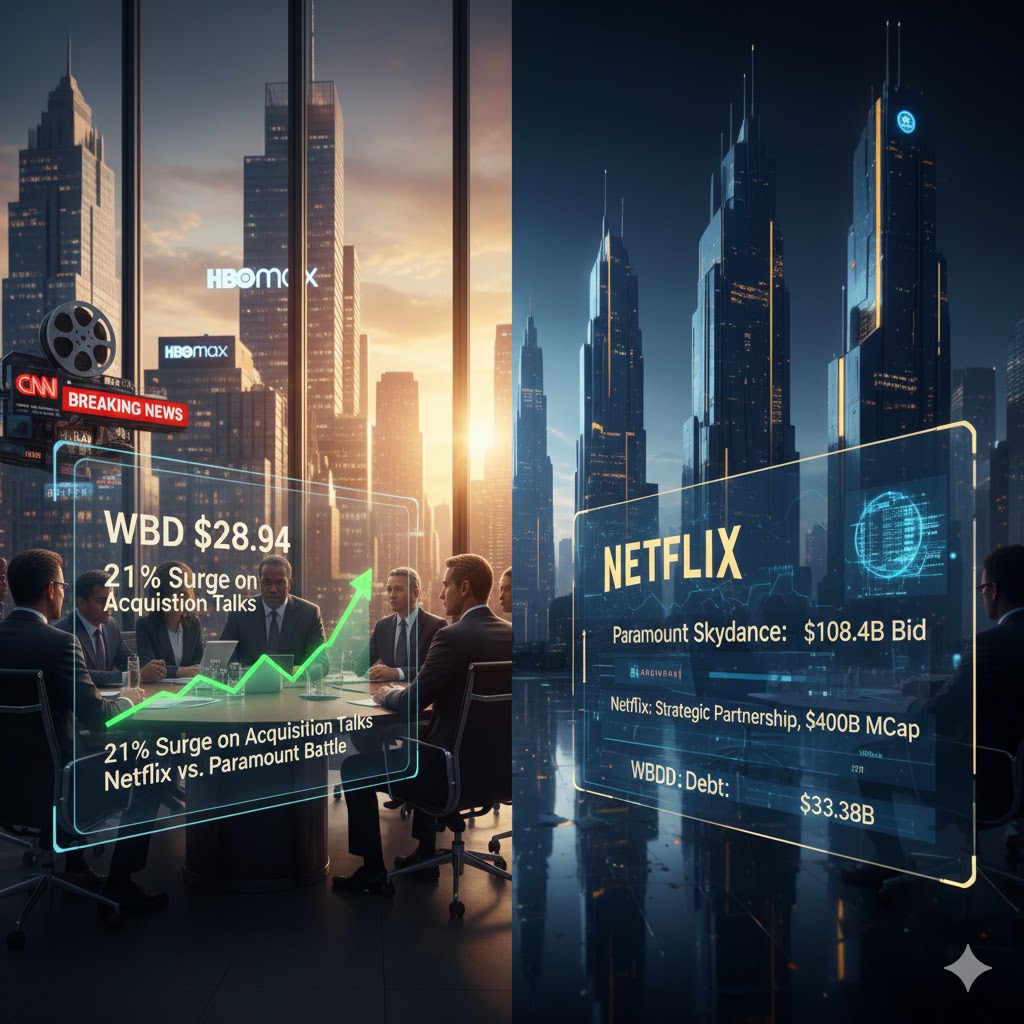
The Paramount-Netflix Tug-of-War: Why Financial Terms Matter
The current impasse centers on a fundamental disagreement over valuation and long-term viability. Paramount Skydance, backed by David Ellison and supported by a $40.4 billion personal guarantee from Oracle co-founder Larry Ellison, has offered an all-cash bid of $30 per share. On paper, this headline figure exceeds Netflix’s cash-and-stock offer, which is pegged closer to $27.75 per share. However, the Warner Bros. board, led by David Zaslav and overseen by a cautious group of directors, has remained unmoved.
The board’s skepticism—highlighted in recent internal deliberations—stems from Paramount’s refusal to further sweeten the financial terms or address the “execution risk.” Specifically, WBD is concerned that a merger with Paramount would saddle the combined entity with a crushing debt load, estimated to be well over $50 billion if refinancing fails. Furthermore, Paramount has not offered a firm guarantee to cover the $2.8 billion “breakup fee” Warner would owe Netflix if it were to terminate their existing exclusive negotiation agreement.
In contrast, the board views the Netflix bid as “superior” despite the lower per-share price. The rationale is simple: Netflix boasts a market cap exceeding $400 billion and possesses the strongest balance sheet in the sector. A deal with Netflix offers WBD shareholders a path toward integration with the industry leader, whereas a deal with Paramount is seen as a merger of two traditional giants struggling with the decline of linear television.
Financial Performance: A Story of Two Segments
To understand WBD’s strategic moves, one must examine its most recent fiscal data. For the third quarter of 2025, Warner Bros. Discovery reported total revenues of $9.05 billion. While this was a 6% decrease year-over-year—primarily due to a sharp 17% decline in linear advertising—the internal composition of those earnings tells a story of a successful pivot.
The Direct-to-Consumer (DTC) segment, anchored by the rebranded HBO Max, has become a profit engine. In 2025, the streaming segment is projected to generate over $1.3 billion in Adjusted EBITDA, a staggering turnaround from the $2.5 billion loss the company faced three years ago. By November 2025, WBD had added more than 30 million new streaming subscribers over a three-year span, bringing its global reach to over 100 countries.
Equally impressive is the company’s focus on deleveraging. As of September 30, 2025, WBD’s long-term debt stood at $33.38 billion, reflecting a 10.18% year-over-year decline. Management has successfully utilized the “Studio” segment’s massive cash flows to pay down nearly $15 billion in debt since the merger. The company’s net leverage ratio has improved to 3.3x EBITDA, down from nearly 5x just 24 months ago. This financial discipline is exactly what has made WBD such a tempting target for both Netflix and Paramount.
Studio Dominance: The $4 Billion Box Office Barrier
While streaming is the future, the Warner Bros. Studio remains the company’s crown jewel. In 2025, WBD became the only film studio to surpass $4 billion in annual box office revenue. This leadership was driven by a relentless slate of original stories and franchise extensions. The successful launch of the “new era” of DC Studios, spearheaded by James Gunn’s Superman, provided a much-needed boost to the studio’s theatrical EBITDA, which is expected to exceed $2.4 billion for the full year 2025.
The Studio segment generated $3.8 billion in revenue in Q2 alone (a 55% increase), bolstered by hits like A Minecraft Movie and The Conjuring: Last Rites. The company’s strategy of targeting 12–14 major theatrical releases per year has allowed it to outpace competitors like Disney and Amazon Studios in terms of theatrical efficiency. This “content factory” is the primary reason Netflix is willing to pay a premium; they are not just buying a platform, they are buying the ability to produce world-class cinema at scale.
Market Expansion and the “Max” Rebrand
Geographic expansion has been a cornerstone of the 2025 growth plan. The decision to re-rebrand Max back to HBO Max in the summer of 2025 was a move to lean into the “prestige” of the HBO brand as the service expanded deeper into Southeast Asia and Latin America. This move has allowed WBD to maintain higher Average Revenue Per User (ARPU) compared to rivals who focused on low-cost, mass-market penetration.
In Europe, the Olympics partnership and the inclusion of premium sports through TNT Sports have made HBO Max a “must-have” utility rather than just an entertainment service. The company is now targeting a goal of 150 million+ subscribers by the end of 2026, a target that analysts believe is achievable if the current international momentum continues.
Other Important Events: Debt Management and Spin-Off Rumors
Aside from the merger drama, WBD is actively exploring a structural split. Internal “Project Split” discussions involve separating the Global Linear Networks (CNN, TNT, Discovery) from the high-growth Studios and Streaming divisions. This spin-off, potentially scheduled for mid-2026, would create two distinct entities: “Discovery Global,” which would house the legacy cash-flow-heavy cable networks, and a “Warner Bros. Creative” entity focusing on Max and the film studios.
This potential split is a “Plan B” if neither the Netflix nor Paramount deals close. By separating the declining linear assets from the growth assets, WBD hopes to unlock “sum-of-the-parts” value that is currently obscured by the company’s complex conglomerate structure. The market’s reaction to these rumors has been largely positive, as it would allow investors to choose between a high-dividend “legacy” play or a high-growth “AI and streaming” play.
Conclusion: A Pivotal Week Ahead
The week of January 5, 2026, will likely be one of the most consequential in the history of Hollywood finance. As the Warner Bros. board convenes to issue its final verdict on the Paramount offer, the industry stands on the brink of consolidation.
Warner Bros. Discovery enters 2026 with a dual identity: it is a financially disciplined studio powerhouse with a profitable streaming business, yet it remains tethered to a declining linear television model and a significant, albeit shrinking, debt pile. Whether it merges with the stability of Netflix or takes a gamble on the Ellison-backed Paramount vision, one thing is certain—the era of the independent “middle-weight” media company is coming to an end. WBD’s current price of $28.94 is a reflection of a market that believes the company’s assets are worth more than its current structure allows, and the resolution of this bidding war will finally determine what that value truly is.
Leave a Reply