The institutional stability of the United States regional banking sector is once again under the microscope as we move through the first month of 2026. While the broader indices have shown resilience in the face of shifting monetary policies, a localized tremor has emerged within the mid-tier banking space. Specifically, New York Community Bancorp (NYSE:FLG)—now operating primarily under its flagship Flagstar brand—has experienced a notable pre-market decline that has reignited conversations regarding the systemic vulnerabilities of small and medium-sized lenders. This recent volatility serves as a sobering reminder that the transition from a “higher-for-longer” interest rate environment to a more normalized yield curve is fraught with idiosyncratic risks, particularly for institutions heavily concentrated in the commercial real estate (CRE) and multi-family housing sectors.
For global analysts, the “crisis” narrative is not a new one, but its 2026 iteration is distinct. Unlike the liquidity-driven panic of early 2023, the current pressure is fundamentally credit-driven. The $443 million settlement for technical aircraft liabilities, though unrelated to banking, highlights a broader trend in the market where historical obligations and structural weaknesses are coming due. In the case of New York Community Bancorp (NYSE:FLG), the pre-market weakness reflects investor anxiety over the bank’s ability to achieve its “peer-level profitability” target by the fourth quarter of 2026, as previously promised by management. The bank’s stock, which has seen significant fluctuations over the past 24 months, remains a barometer for the health of the New York rent-controlled multi-family market, a segment that continues to struggle with stagnating valuations and rising operational costs.
The CRE Maturation Wall: A $1.5 Trillion Headwind
The primary catalyst for the looming crisis among regional banks is the “maturation wall” of commercial real estate debt. According to data from the Mortgage Bankers Association, approximately $1.5 trillion in CRE debt is scheduled to mature between late 2025 and the end of 2026. Regional banks hold a disproportionately large share of this debt compared to their “too-big-to-fail” counterparts like JPMorgan Chase & Co. (NYSE:JPM) or Bank of America Corporation (NYSE:BAC). As these loans come up for refinancing, many borrowers are finding that the market value of their properties—particularly in the office segment—is lower than the outstanding loan balance.
A recent study by the National Bureau of Economic Research (NBER) estimated that in roughly 44% of office loans, the property’s current market value has fallen below the debt owed. For a bank like New York Community Bancorp (NYSE:FLG), which has historically specialized in multi-family and rent-regulated housing, the risk is amplified by legislative changes that have capped rent increases, thereby limiting the income potential of the underlying collateral. While the bank has aggressively moved to diversify into commercial and industrial (C&I) lending, the legacy CRE portfolio remains a heavy anchor on its balance sheet. The pre-market decline is a signal that the “work-out” period for these legacy loans is proving more painful and protracted than the market had initially priced in.
Financial Performance and the Path to 2027
To understand the specific pressure on Flagstar Financial (the rebranded identity of NYCB), one must look at the trajectory of its internal controls and earnings power. In late 2025, the bank reported a significant impairment charge linked to historical transactions, which, while not impacting regulatory capital ratios, severely dented investor sentiment. For the fiscal year ending 2025, New York Community Bancorp (NYSE:FLG) reported a trailing twelve-month (TTM) net margin of -18.40% and a return on assets (ROA) of -0.78%. These figures contrast sharply with the performance of diversified peers such as U.S. Bancorp (NYSE:USB) or PNC Financial Services Group, Inc. (NYSE:PNC), both of which have managed to maintain positive profitability throughout the cycle.
The bank’s strategic overhaul, led by CEO Joseph Otting, aims to reduce the total CRE loan exposure from nearly $45 billion down to $30 billion by 2027. This deleveraging process is essential for the bank’s survival, but it comes at a cost. Selling off assets in a “buyer’s market” often means realizing losses that were previously only “on paper.” Furthermore, the bank has had to adjust its 2026 return on average tangible common equity (ROTCE) projections downward from an initial 7.5%–8% range to a more modest 4.5%–5%. This revision suggests that the “break-even” point for the bank’s turnaround has been pushed further into the future, a reality that short-term traders are currently punishing in the pre-market sessions.
Consolidation as a Survival Strategy
The broader small and medium-sized banking sector is responding to these pressures through a wave of consolidation. The year 2025 saw over 150 bank merger deals, and this momentum is expected to accelerate throughout 2026. The logic is simple: scale is required to offset the rising costs of digital transformation, AI implementation, and regulatory compliance. For a regional player, merging with a peer is often the only way to dilute the risk of a concentrated CRE portfolio while gaining access to a broader, more stable deposit base.
We are seeing a “winner-takes-all” dynamic similar to that described in recent outlooks from J.P. Morgan Global Research. While the top 20 U.S. banks remain well-capitalized with common equity tier 1 (CET1) ratios above 14%, the bottom 20% of regional lenders are facing a squeeze on their net interest margins (NIM). As the Federal Reserve keeps rates steady in the 3.50% to 3.75% range, these smaller banks must pay higher rates to retain deposits while their long-term loan portfolios yield significantly less. This “margin squeeze” is particularly acute for institutions like New York Community Bancorp (NYSE:FLG), where the debt-to-equity ratio sits at a relatively high 2.52.
The Role of Regulatory Oversight and Basel III
Adding to the complexity is the impending implementation of “Basel III Endgame” rules in the United States. These new regulations are expected to increase capital requirements for banks with over $100 billion in assets, a category that NYCB entered following its acquisition of assets from the failed Signature Bank. The transition from a “smaller” bank to a “Category IV” institution has forced New York Community Bancorp (NYSE:FLG) to adhere to stricter liquidity and stress-testing standards. This regulatory “step-up” has been one of the primary drivers of the bank’s recent volatility, as it has had to bolster its provisions for credit losses, which rose to over $1 billion in 2025.
For investors, the concern is that the regulatory scrutiny might uncover further “material weaknesses” in internal loan reviews, a recurring theme for the bank over the last year. The Federal Deposit Insurance Corporation (FDIC) and the Office of the Comptroller of the Currency (OCC) are reportedly maintaining a “heightened presence” within several regional lenders to ensure that the work-out of distressed CRE assets is handled transparently. For companies like Goldman Sachs Group, Inc. (NYSE:GS), which provide advisory services for these types of restructurings, the current environment is a source of active security selection opportunities, but for the average retail investor, it remains a high-risk zone.
Market Sentiment and the Digital Transformation Gap
The pre-market decline of New York Community Bancorp (NYSE:FLG) also highlights a growing “digital gap” in the banking sector. Institutions that have successfully integrated AI and advanced data analytics are better equipped to predict loan defaults and manage their liquidity in real-time. Regional banks that have lagged in this technological arms race are finding it harder to compete for low-cost deposits. Customers are increasingly moving their funds to platforms offered by technology-forward firms like SoFi Technologies, Inc. (NASDAQ:SOFI) or the high-yield savings products from Apple Inc. (NASDAQ:AAPL) and its partner Goldman Sachs.
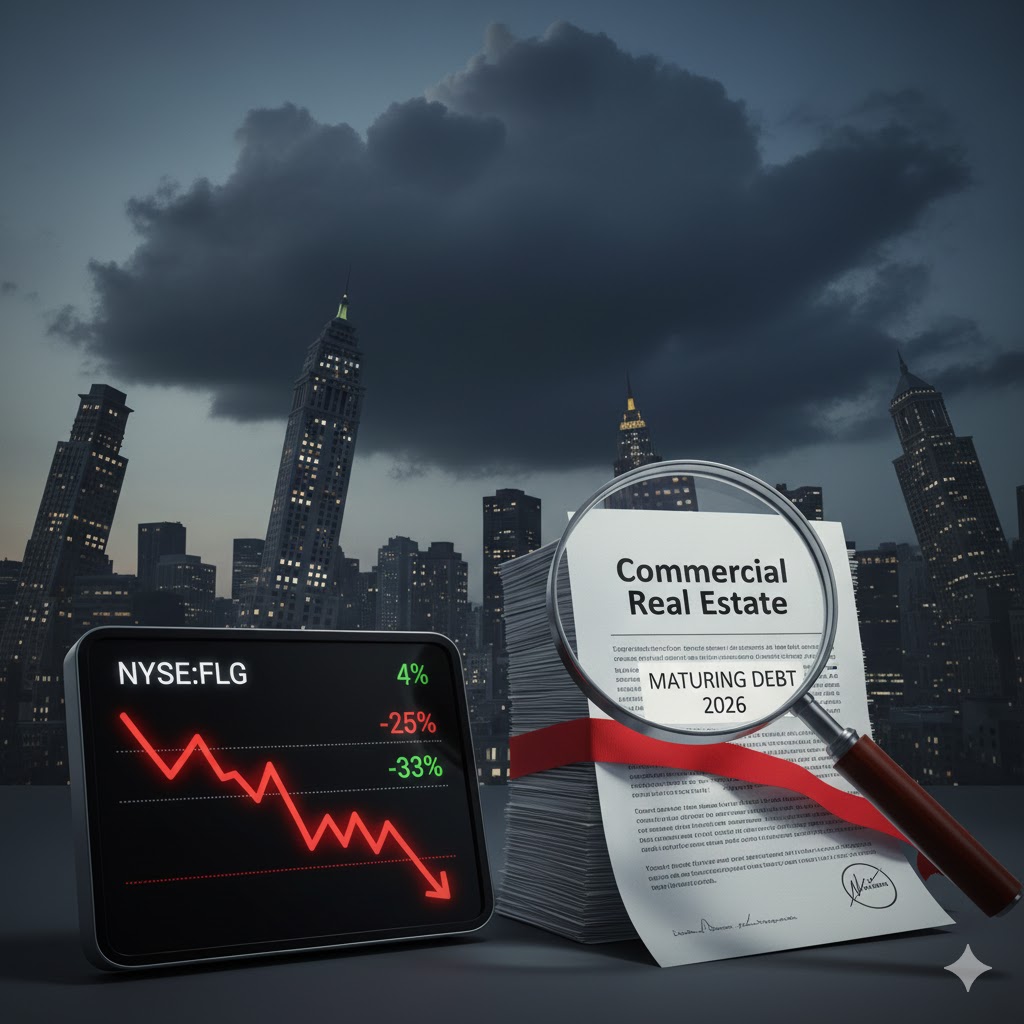
This “deposit flight” to quality and technology further strains the balance sheets of medium-sized banks. To counter this, Flagstar (NYSE:FLG) has been focusing on its C&I lending growth and its mortgage servicing rights (MSR) business, which tends to perform well when interest rates are stable or rising. However, these successes are often overshadowed by the larger narrative of CRE distress. The market’s current “sell first, ask questions later” approach to regional banking stocks is a direct result of the lack of transparency in how these banks are valuing their distressed assets.
Conclusion: A Year of Divergent Fortunes
In conclusion, the pre-market decline of New York Community Bancorp (NYSE:FLG) is a warning shot for the entire regional banking sector. While broad stability is expected for the global banking system in 2026, the U.S. mid-tier space is entering a period of divergent fortunes. Banks with diversified portfolios and strong digital foundations will likely navigate the “maturation wall” with minimal damage. Conversely, those with high concentrations in distressed property sectors and legacy internal control issues will continue to face “crisis-like” volatility.
For the remainder of 2026, the focus will remain on the quarterly earnings reports and the progress of asset sales. If New York Community Bancorp can successfully reduce its CRE exposure to its $30 billion target without triggering massive further impairments, it may yet achieve the “peer-level profitability” it has promised for late 2026. However, the path is narrow, and the margin for error is non-existent. As the “low-altitude economy” booms in other sectors, the regional banking sector is finding that its greatest challenges are still very much grounded in the physical reality of the American office building and the rent-controlled apartment.