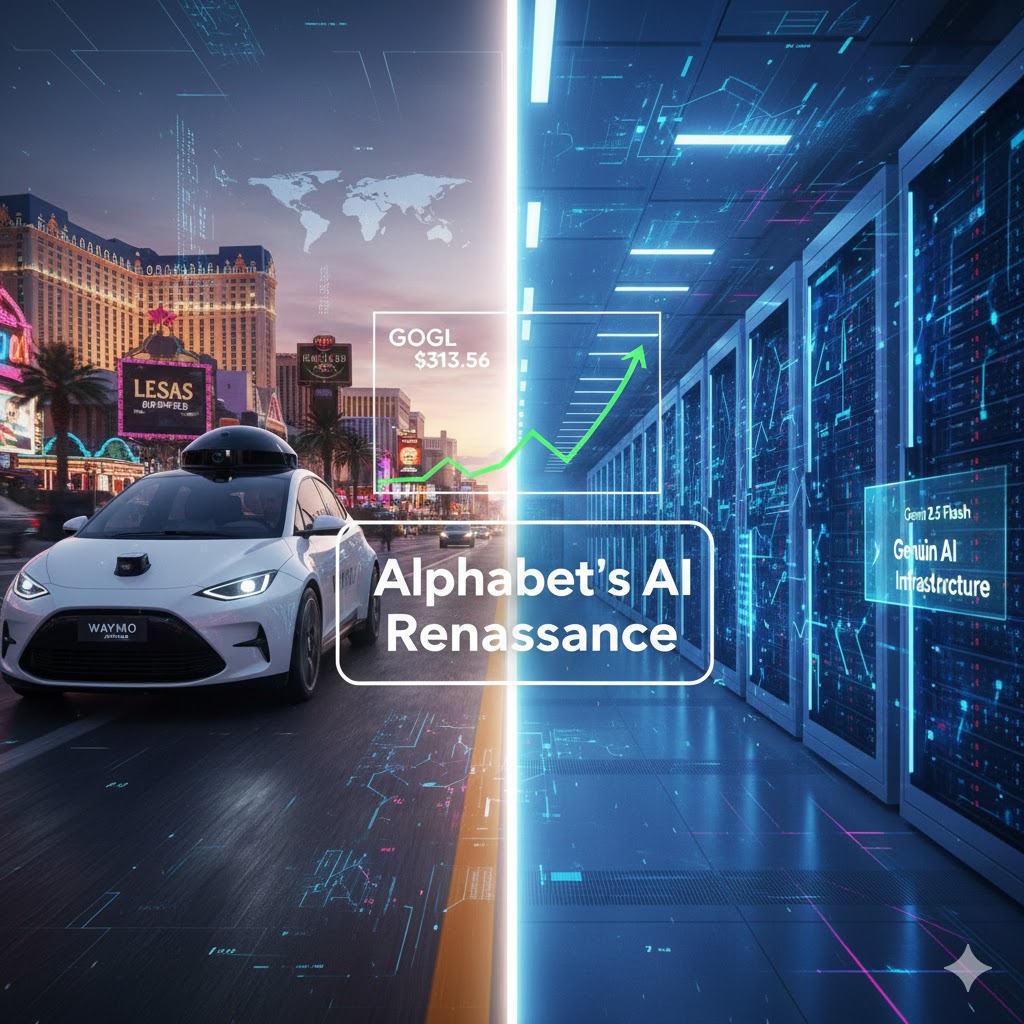
As the curtain closes on 2025, Alphabet Inc. (NASDAQ: GOOG, GOOGL) stands at the pinnacle of a multi-year transformation, defying the “law of large numbers” to deliver one of its most impressive fiscal performances to date. On the final trading day of the year, December 31, 2025, Alphabet’s Class C shares (GOOG) closed at $314.55, while Class A shares (GOOGL) hovered near $313.56, marking a staggering year-to-date climb of approximately 66%. This valuation surge, pushing the company’s market capitalization toward the $3.8 trillion mark, is not merely a reflection of a buoyant tech sector, but the result of a disciplined pivot toward “Sovereign AI” and the long-awaited scaling of its “Other Bets.”
A pivotal moment in this scaling arrived this week as Waymo, Alphabet’s autonomous driving subsidiary, officially received authorization from Nevada regulators to begin testing its self-driving vehicles on the bustling streets of Las Vegas. While initially operating with safety drivers, the move represents a critical strategic expansion into one of the world’s most complex and high-traffic urban environments. This Las Vegas entry, combined with Waymo’s reported milestone of over 450,000 paid rides per week globally by December 2025, suggests that the “autonomous future” is rapidly transitioning from a high-cost research project into a tangible, revenue-generating pillar of the Alphabet ecosystem.
Financial Dominance: The First $100 Billion Quarter
Alphabet’s financial narrative in 2025 has been defined by the successful crossing of historic thresholds. In the third quarter of 2025, the company reported consolidated revenue of $102.3 billion, marking the first time in its history that it has surpassed $100 billion in a single three-month period. This 16% year-over-year growth was fueled by double-digit expansion across every major business segment, proving that Google’s core advertising engine remains robust even as the company aggressively diversifies into Cloud and AI services.
The company’s profitability has seen a significant boost from efficiency initiatives led by CFO Anat Ashkenazi. Operating margins for the third quarter stabilized at a healthy 31%, despite a massive ramp-up in capital expenditures. Alphabet’s net income for Q3 reached $34.98 billion, with a diluted EPS of $2.87, comfortably beating analyst consensus. Perhaps most importantly for long-term stability, Alphabet ended 2025 with a “fortress balance sheet,” holding approximately $110 billion in cash and marketable securities, providing a massive buffer for the intensive R&D required to stay ahead in the global AI race.
Waymo’s Strategic Expansion and the Las Vegas Bet
The news of Waymo’s expansion into Las Vegas is a calculated step in its “multi-city” playbook. Following its dominance in Phoenix and successful scaling in San Francisco and Los Angeles, the Nevada authorization allows Waymo to test its “Waymo Driver” technology against the unique challenges of the Las Vegas Strip—characterized by erratic pedestrian behavior, high-density traffic, and complex pickup/drop-off zones.
By December 2025, Waymo’s operational metrics have reached a tipping point. The subsidiary is now on a revenue run-rate exceeding $350 million annually, and while the “Other Bets” segment still operates at a quarterly loss (approximately $1.1 billion), the trajectory toward unit-economic profitability is becoming clearer. The integration of Waymo with Google Maps and the expansion of its partnership with Uber have drastically lowered customer acquisition costs. Analysts estimate that by mid-2026, Waymo could be facilitating over 1 million rides per week, potentially making it the first autonomous ride-hailing service to reach a scale that rivals traditional TNCs in major metropolitan hubs.
Google Cloud: The $50 Billion AI Infrastructure Engine
While Search remains the primary profit driver, Google Cloud has emerged as the growth superstar of 2025. In the third quarter, Google Cloud revenues surged 34% to $15.2 billion, placing it on an annual run-rate of over $60 billion. This growth is almost entirely driven by the “AI Renaissance.” Google Cloud was the first to offer NVIDIA’s Blackwell and Rubin GPUs at scale, and its proprietary TPU (Tensor Processing Unit) v6 has become the preferred choice for enterprise customers training massive generative models.
The Cloud segment’s operating margin improved significantly to 23.7% in late 2025, up from single digits just two years ago. The company reported a backlog of $155 billion in undelivered orders, representing a 46% sequential increase. This massive pipeline suggests that enterprise adoption of AI is not a fleeting trend but a fundamental re-architecting of corporate IT. Furthermore, nearly 70% of Google Cloud customers are now utilizing at least one of Alphabet’s generative AI products, such as Vertex AI or the Gemini API, creating a high-margin software layer on top of its infrastructure business.
Product Innovation: Gemini and the Search Evolution
In the core Google Services segment, the integration of Gemini 2.5 Flash across Search, YouTube, and Workspace has silenced earlier fears of “AI disruption” to the search monopoly. Google’s global search market share remained dominant at 89.9% as of November 2025. The introduction of “AI Mode”—a conversational, agentic interface within the standard search app—has seen its user base grow to over 650 million monthly active users by the end of the year.
Query volume actually increased by 25% year-over-year in 2025, as AI-powered features allowed users to ask more complex, “natural language” questions that were previously difficult to search for. For example, “tell me about…” queries jumped by 70%, reflecting a shift toward using Google as a research partner rather than just a directory. YouTube has also benefited from the AI tailwind, with YouTube Ads revenue hitting $10.3 billion in Q3, driven by the success of “Shorts” and AI-driven ad targeting that has significantly improved conversion rates for creators and brands alike.
Capital Allocation and the New Shareholder Paradigm
2025 marked a cultural shift in how Alphabet manages its capital. Moving away from its historical “growth-at-all-costs” mindset, the company instituted a recurring quarterly dividend of $0.21 per share in early 2025, which was paid throughout the year. Combined with an aggressive $50 billion share buyback program, Alphabet returned tens of billions of dollars to shareholders in 2025.
This transition into a “mature growth” stock has attracted a new class of institutional investors, including Berkshire Hathaway, which reportedly took a multi-billion dollar stake in the company during the third quarter. By balancing massive investments in future tech (like the $91 billion to $93 billion in 2025 CapEx) with consistent shareholder returns, Alphabet is positioning itself as the “utility of the AI era”—a company that is both a safe haven for capital and a primary beneficiary of technological breakthroughs.
Future Roadmap and Market Penetration
Looking toward 2026, Alphabet’s roadmap is focused on the “Agentic Frontier.” The company is moving beyond chatbots to “AI Agents” that can perform multi-step tasks across the web—from booking travel via Waymo and Google Flights to managing enterprise supply chains through Google Cloud.
Market expansion is also targeting high-growth regions. In late 2025, Alphabet announced several “Sovereign AI” partnerships in Japan and the Middle East, helping governments build domestic AI clouds on Google infrastructure. This strategy not only diversifies revenue away from the US and EU but also mitigates the regulatory risks associated with centralized data control.
Conclusion: A Legacy Reimagined
Alphabet enters 2026 in its strongest position in a decade. The core search business has not only survived the AI challenge but has used it to re-engage users and advertisers. Google Cloud has reached the scale necessary to be a significant contributor to the bottom line, and Waymo’s Las Vegas expansion signals the dawn of the autonomous mobility era.
While challenges remain—specifically the ongoing global regulatory scrutiny and the intensive capital requirements for next-generation data centers—the company’s execution in 2025 has been exemplary. By successfully integrating AI into every facet of its ecosystem, from the low-level silicon of TPUs to the high-level services of Waymo and Gemini, Alphabet has successfully navigated the transition from a mobile-first company to an AI-first powerhouse. For the global markets, Alphabet remains the quintessential blueprint for how a legacy tech giant can reinvent itself in the face of radical technological change.
Leave a Reply