The institutional landscape for The Boeing Company (NYSE:BA) has reached a critical stabilization phase as the aerospace giant enters 2026, a year widely characterized by industry analysts as the “pivot year” for its long-term financial recovery. Among the most significant developments marking the start of this fiscal cycle is the formalization and settlement of a $443 million payment related to the 737 MAX aircraft. This figure, while substantial, represents a multi-faceted resolution of historical liabilities that have weighed on the company’s balance sheet since the mid-air door plug incident of early 2024 and the lingering legal aftermath of the 2018-2019 MAX tragedies. For investors, the “443 million” headline is not merely an expense; it is a clearing of the decks that allows the manufacturer to focus on its primary 2026 mandate: scaling production to meet a backlog that remains one of the largest in industrial history.
Financial records from the fourth quarter of 2025 and early 2026 indicate that this $443 million allocation is primarily composed of two distinct components. The first involves a series of customer concessions and compensation agreements for airline partners, most notably Alaska Air Group, Inc. (NYSE:ALK) and United Airlines Holdings, Inc. (NASDAQ:UAL), who faced significant operational disruptions following the temporary grounding of the MAX 9 fleet. The second component is tied to the finalization of the Department of Justice (DOJ) settlement regarding the 737 MAX crashes. Boeing’s Chief Financial Officer, Jay Malave, clarified during a recent investor summit that while the charge was outlined in 2025, the actual cash outflow of approximately $444.5 million into a crash-victims’ beneficiary fund was deferred into 2026. This tactical timing has provided Boeing with a slightly more resilient cash position at the end of 2025, setting the stage for what the company projects to be its first year of positive free cash flow (FCF) since the pre-crisis era.
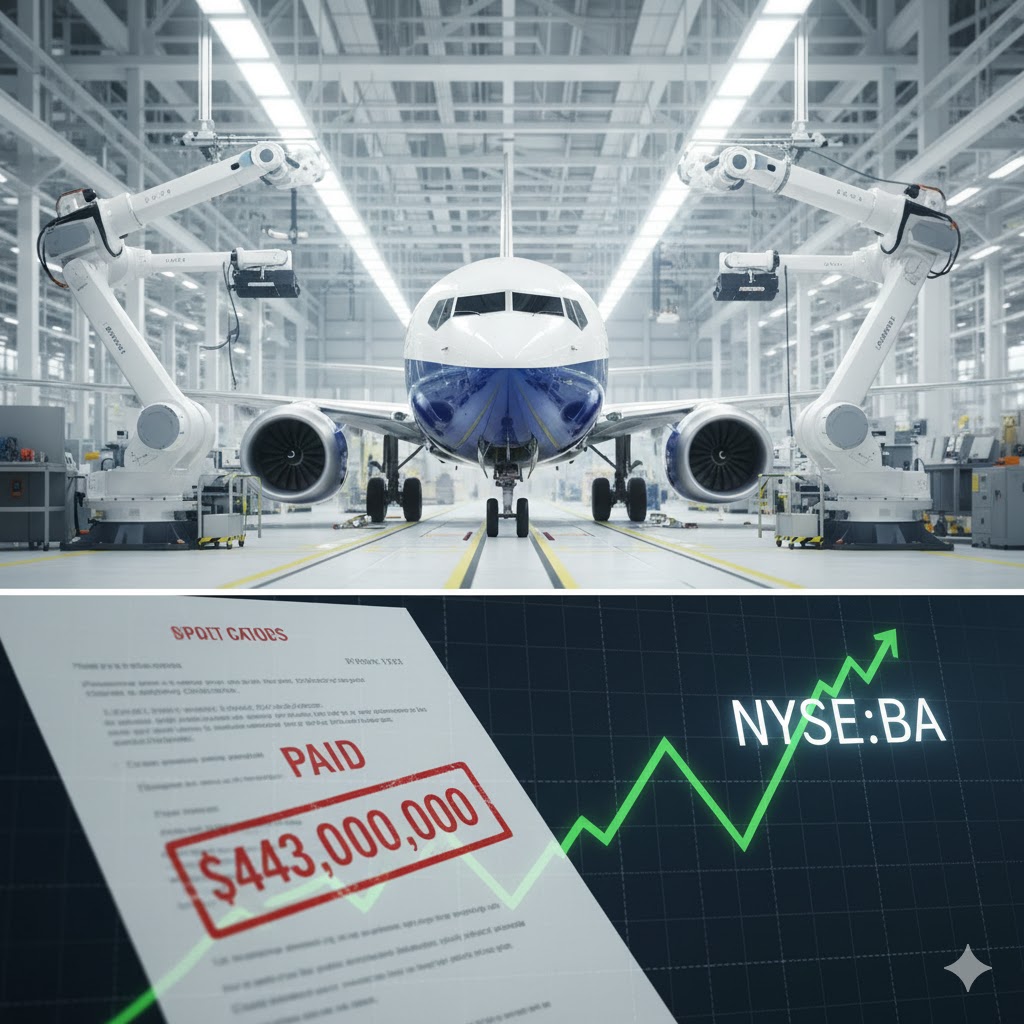
The Cash Flow Narrative: From Outflow to low-Single-Digit Growth
To appreciate the significance of this payment, one must examine Boeing’s (NYSE:BA) broader liquidity trajectory. The company ended 2025 with a cash usage (negative free cash flow) of approximately $2 billion. This was a marked improvement from the double-digit outflows seen during the height of the 2024 production crisis. However, the $443 million payment, combined with a $243.6 million criminal fine also maturing in 2026, creates a combined headwind of roughly $700 million in the first half of the year. Despite this, Boeing management has reiterated guidance for 2026 free cash flow in the “low single-digit billions” range—a target that suggests a dramatic $4 billion to $5 billion year-over-year improvement.
This optimism is predicated on the “inventory flush.” As of December 2025, Boeing confirmed that it has effectively exhausted its stock of stored, pre-built 737 MAX aircraft that had been idling in storage lots like Moses Lake. Consequently, every delivery in 2026 will be a “fresh-from-the-line” aircraft, allowing for a more normalized cash collection cycle. Since Boeing receives the majority of an aircraft’s purchase price upon delivery, the transition from clearing old inventory to delivering current production is the single most important lever for the company’s 2026 financial health. Institutional holders like BlackRock, Inc. (NYSE:BLK) and State Street Corporation (NYSE:STT) are closely monitoring the “days sales outstanding” metric to verify this normalization.
Production Scaling: The 42-to-47 Monthly Ramp
The technical heartbeat of Boeing’s 2026 recovery is the production rate of the 737 MAX. After nearly two years of operating under a stringent Federal Aviation Administration (FAA) production cap of 38 aircraft per month, the regulator officially authorized an increase to 42 units per month in late 2025. Moving into the current year, Boeing (NYSE:BA) has outlined plans to reach a production rate of 47 aircraft per month by the summer of 2026. This ramp-up is essential for the company to begin servicing its 6,000-unit backlog, which is currently sold out well into the 2030s.
The success of this production ramp depends heavily on the integration of Spirit AeroSystems Holdings, Inc. (NYSE:SPR). In a definitive move to resolve chronic quality control issues at the source, Boeing finalized its acquisition of Spirit in December 2025. The 2026 fiscal year will be the first full year of “vertically integrated” manufacturing for the 737 fuselages. While this integration adds approximately $4 billion in debt to Boeing’s consolidated balance sheet, it is expected to eliminate “traveled work”—the practice of finishing assembly out of sequence—which was the primary cause of the defects that led to the $443 million in concessions and settlements.
Segment Performance and the Defense Buffer
While the Commercial Airplanes (BCA) segment is the primary focus of the $443 million payout, the Boeing Defense, Space & Security (BDS) unit has emerged as a critical stabilizing force. In 2025, BDS reported a steady increase in revenue to over $25 billion, supported by high-profile contracts such as the AH-64E Apache for Poland and the MQ-28 Ghost Bat program for the Royal Australian Air Force. Unlike the commercial segment, the defense business operates on a more predictable, though lower-margin, contract cycle.
However, the defense segment has not been without its own financial friction. Boeing (NYSE:BA) continues to face margin pressure on fixed-price development contracts, including the KC-46A tanker and the T-7A trainer. To counter this, the company has implemented a more rigorous “selective bidding” strategy for 2026, moving away from high-risk fixed-price models that led to multi-billion dollar charges in previous years. For aerospace peers like Lockheed Martin Corporation (NYSE:LMT) and Northrop Grumman Corporation (NYSE:NOC), Boeing’s defense turnaround is a vital indicator of the health of the broader U.S. industrial base, especially as global geopolitical tensions drive increased demand for air superiority platforms.
Regulatory Milestones and the Certification Wall
Beyond the production lines, 2026 is a defining year for Boeing’s regulatory roadmap. The company is currently working toward the FAA certification of the 737 MAX 7 and the 737 MAX 10, the latter being the largest variant of the family. The MAX 10 is particularly critical for competing with the A321neo from Airbus SE (OTC:EADSY). Major customers like Ryanair Holdings plc (NASDAQ:RYAAY) and United Airlines (NYSE:UAL) have structured their 2027-2028 growth plans around the MAX 10, making its certification by the end of 2026 a non-negotiable milestone for Boeing’s market share retention.
Simultaneously, the 777X program continues to be a point of financial strain. With the first delivery now delayed until early 2027, Boeing (NYSE:BA) recognized a $4.9 billion pre-tax charge in late 2025. The 2026 focus for the widebody segment will be the continued flight testing of the 777-9, ensuring that no further “program pressure” erodes the hard-won cash flow gains from the narrowbody 737 line.
Conclusion: Navigating the 2026 Debt Maturities
In conclusion, the $443 million payment for the MAX aircraft marks the beginning of the end for Boeing’s era of litigation-driven cash burn. While the company still faces an $8 billion “wall” of debt maturities in 2026, the combination of a $26.3 billion cash buffer (boosted by a successful 2025 capital raise) and the turn to positive free cash flow suggests a manageable path forward. Boeing (NYSE:BA) is no longer a company in crisis; it is a company in a high-stakes operational rebuild.
The 2026 narrative will be defined by the “47-per-month” production target and the seamless integration of Spirit AeroSystems. If CEO Kelly Ortberg and CFO Jay Malave can maintain the current trajectory of defect reduction and delivery acceleration, the 737 MAX will finally transition from being a source of legal liabilities to the primary engine of one of the greatest turnarounds in aviation history. For now, the $443 million serves as a sobering reminder of the costs of the past, but the record backlog and stabilizing production rates offer a clear, if arduous, flight path toward the future.