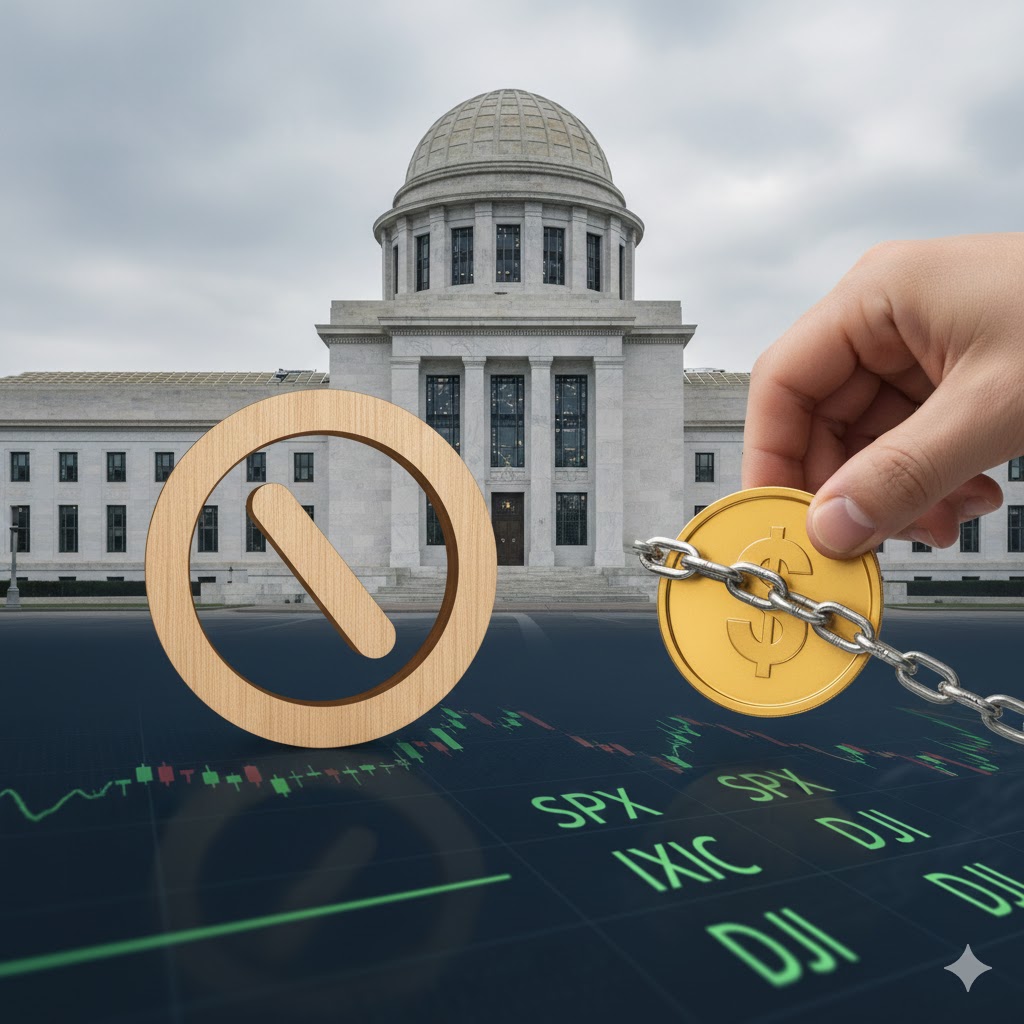
The financial architecture of early 2026 has been defined by a resolute and somewhat cautious Federal Reserve, led by Chairman Jerome Powell as he nears the end of his term in May. In its most recent policy gathering in January 2026, the Federal Open Market Committee (FOMC) elected to hold the federal funds rate steady at a range of 3.50% to 3.75%. This decision, while largely anticipated by fixed-income markets, has sent a clear signal to equity investors: the aggressive “liquidity punchbowl” that characterized the recovery phases of the past decade is unlikely to return in the immediate future. For the broader U.S. stock market, the “stay put” stance suggests that the era of valuation expansion driven purely by falling discount rates has reached a plateau, shifting the burden of performance squarely onto corporate earnings and productivity gains.
For institutional stakeholders monitoring the S&P 500 and the Nasdaq Composite, the lack of a fresh rate cut in January serves as a reminder that the central bank remains hyper-vigilant regarding “sticky” inflation. Despite a series of three 25-basis-point cuts throughout the latter half of 2025, consumer price index (CPI) data has remained stubbornly hovering around 2.6% to 2.8%, well above the Fed’s 2.0% long-term target. By holding rates steady, the Fed is essentially betting that the current restrictive-to-neutral level of borrowing costs is sufficient to cool the labor market without triggering a recession—a “soft landing” that is now entering its second year of attempted execution.
The Impact on Mega-Cap Tech and Growth Valuations
The immediate fallout of a static Fed policy is most visible in the “Magnificent Seven” group of influential technology companies. For Alphabet Inc. (NASDAQ:GOOGL), Microsoft Corporation (NASDAQ:MSFT), and Apple Inc. (NASDAQ:AAPL), the stabilization of interest rates acts as a double-edged sword. On one hand, the lack of further rate cuts prevents the further compression of the equity risk premium, which had been driving the record-high price-to-earnings (P/E) multiples seen in late 2025. On the other hand, a steady rate environment provides a predictable cost-of-capital backdrop for the massive capital expenditure (CapEx) projects required to fund the ongoing artificial intelligence (AI) arms race.
Microsoft (NASDAQ:MSFT), for instance, has recently announced plans to increase its AI infrastructure spending by an additional $15 billion in 2026. In an environment where the Fed “stays put,” the borrowing costs for such massive debt-financed investments remain significantly higher than they were during the zero-interest-rate policy (ZIRP) era. Similarly, Amazon.com, Inc. (NASDAQ:AMZN) faces a higher hurdle for its logistics and AWS expansion projects. For these growth-oriented giants, the “limited stimulus” from the Fed means that future stock appreciation must be driven by operational leverage and the successful monetization of AI tools, rather than a broad-based market rally fueled by central bank easing.
Financial Resilience in the Banking and Energy Sectors
While growth stocks may find the Fed’s pause restrictive, the financial sector has reacted with a degree of resilience. Large-cap banks, including JPMorgan Chase & Co. (NYSE:JPM), Bank of America Corporation (NYSE:BAC), and Goldman Sachs Group, Inc. (NYSE:GS), stand to benefit from a “higher-for-longer” yield curve, which supports net interest margins (NIM). As long as the Fed does not aggressively cut rates, the spread between what banks pay on deposits and what they earn on loans remains healthy, provided the economy avoids a sharp downturn.
In the 2025 fiscal year, JPMorgan Chase (NYSE:JPM) reported record net interest income, and early 2026 data suggests that corporate loan demand remains robust despite the 3.5%–3.75% benchmark rate. However, the “limited stimulus” aspect of the Fed’s decision also means that the surge in investment banking activity—specifically mergers and acquisitions (M&A) and initial public offerings (IPOs)—may remain at a moderate simmer rather than a full boil. Companies considering multi-billion-dollar acquisitions, such as those often pursued by Chevron Corporation (NYSE:CVX) or Exxon Mobil Corporation (NYSE:XOM) in the consolidating energy sector, must still account for a significantly higher “cost of debt” than was prevalent three years ago.
The Fiscal Cushion: “One Big Beautiful Bill” and Infrastructure
Compensating for the Fed’s cautious monetary stance is a substantial amount of fiscal stimulus that began hitting the economy in late 2025. The legislation colloquially known as the “One Big Beautiful Bill,” which provides over $120 billion in corporate tax incentives and infrastructure credits through 2026, has acted as a vital counterweight to the central bank’s restraint. For industrial leaders like Caterpillar Inc. (NYSE:CAT) and United Rentals, Inc. (NYSE:URI), this fiscal injection provides a floor for demand that is largely independent of the Fed’s month-to-month interest rate decisions.
The interplay between a “stay-put” Fed and a “stimulus-active” Treasury has created a unique macroeconomic environment in 2026. While the “monetary lever” is largely static, the “fiscal lever” is pulling hard toward growth. This has led to a divergence in the stock market; sectors that are capital-intensive and debt-sensitive (like real estate and small-cap growth) are struggling with the lack of further rate cuts, while sectors tied to domestic manufacturing and infrastructure are thriving under the new tax regime. For instance, NVIDIA Corporation (NASDAQ:NVDA), which sits at the intersection of AI demand and sovereign-level infrastructure spending, continues to report earnings that defy the broader “limited stimulus” narrative, largely because its customers are increasingly government entities or state-backed tech consortia.
The Labor Market and the Successor Uncertainty
A critical factor in the Fed’s decision to stay put is the cooling, but not collapsing, U.S. labor market. In December 2025, the U.S. economy added 160,000 jobs, a figure that suggests a normalization of hiring after the post-pandemic volatility. However, unemployment has ticked up slightly to 4.2%, a level that the Fed views as consistent with a non-inflationary “neutral” rate. If the Fed were to cut rates now, it would risk reigniting wage inflation; if it were to hike, it might push the labor market into a tailspin.
Adding a layer of complexity to the 2026 outlook is the upcoming leadership transition at the Federal Reserve. With Jerome Powell’s term ending in May, the White House has begun floating potential candidates for the Chair position. This creates a “transition risk” for the markets. If a more “dovish” successor is named, stocks might rally in anticipation of late-2026 easing. Conversely, a “hawkish” or politically influenced appointment could trigger a spike in the term premium for long-dated bonds, such as the 10-year Treasury note, which would exert downward pressure on S&P 500 valuations.
Conclusion: Navigating a Year of Earnings, Not Easing
In conclusion, the Fed’s decision to stay put on rates in January 2026 marks the beginning of a year where “stimulus” will be found in profit margins and fiscal policy rather than central bank interventions. For the U.S. stock market, the message is clear: the easy gains are over, and the “higher-for-longer” reality is now the baseline for 2026. Investors should look to companies with strong balance sheets and “moats” built on technological leadership—such as Meta Platforms, Inc. (NASDAQ:META) or Tesla, Inc. (NASDAQ:TSLA)—which can sustain growth even as the Fed keeps the liquidity valves partially closed.
While the stimulus for U.S. stocks may be “limited” in the traditional monetary sense, the underlying health of the corporate sector and the ongoing AI-driven productivity boom provide a compelling case for a “stabilization” year. The key to 2026 will not be watching the Fed’s “dot plot,” but rather monitoring the ability of the S&P 500 to deliver on its projected 14% earnings-per-share (EPS) growth in a world where the cost of money is no longer free. For now, the Fed has provided the market with a steady hand, but it has left the heavy lifting of value creation to the entrepreneurs and executives of Corporate America.