Tag: META

  • AI “Arms Race” Sparks Semiconductor Rally, Nvidia Sees Strongest Surge in Nearly 10 Months, Pushing Dow Jones Toward 50,000!

    On Friday, Eastern Time, U.S. stocks in the $Semiconductor (LIST2015)$, $Semiconductor Equipment & Materials (LIST2016)$, and $Optical Communications (LIST23979)$ sectors surged across the board. Nvidia (NASDAQ: NVDA) rose 7.5%, nearly marking its largest single-day gain in nearly 10 months, driving the Dow Jones Industrial Average (DJI) closer to the 50,000-point mark.

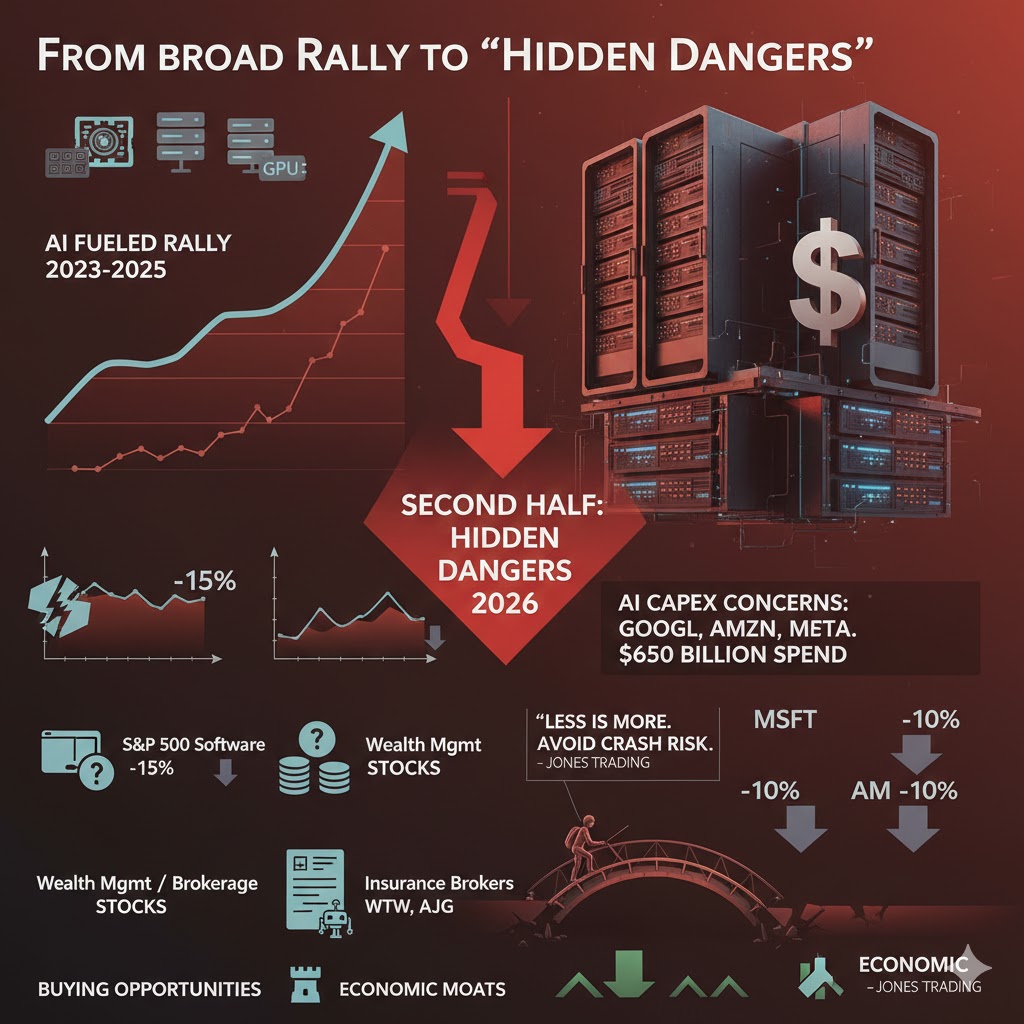
    Earlier, six out of the seven tech giants had already released their earnings reports, and the most notable development is that the combined capital expenditures of Google, Microsoft, Amazon, and Meta in 2026 will total approximately $650 billion.

    Last week, Meta announced that its capital expenditure for the year could rise to $135 billion, an increase of up to 87%. Microsoft also reported a 66% year-over-year increase in its capital expenditure for the second fiscal quarter, with analysts expecting its fiscal year to end in June with capital spending close to $105 billion.

    This week, Google and Amazon raised the bar on capital expenditure, pushing the AI arms race to new heights. Google plans to invest up to $185 billion this year, while Amazon has announced a capital expenditure plan of $200 billion for 2026.

    Gil Luria, an analyst at DA Davidson, stated that these four companies “view the race to provide AI computing power as the next ‘winner-takes-all’ or ‘winner-takes-most’ market,” adding, “None of them wants to lose.” These funds will be used to build new data centers and support equipment, including AI chips, network cables, and backup generators.

    AI Arms Race Shakes Wall Street

    Despite the tech giants’ spending spree, Wall Street is feeling uneasy. Microsoft (NASDAQ: MSFT), Google (NASDAQ: GOOGL), and Amazon (NASDAQ: AMZN) all saw declines after their earnings releases, while Meta Platforms (NASDAQ: META) experienced a sharp drop in stock price following a massive surge in capital expenditure disclosed during their Q3 earnings report.

    Tomasz Tunguz, an investor at Theory Ventures, explained: “You used to have these cash-generating machines, but suddenly, they need all this cash, and more, so they start borrowing.”

    Gil Luria from DA Davidson added, “These four companies view the competition to provide AI computing power as the next winner-takes-all or winner-occupies-most of the market. The question is, how will they afford it? Meta and Google’s profits mainly come from digital advertising; Amazon is the largest online retailer and cloud computing provider; Microsoft is the largest business software vendor. These companies dominate their respective industries and have plenty of cash buffers. They are willing to invest large sums into the AI-driven future, but this means their reserves—and investors’ patience—will be tested.”

    Nvidia CEO Jensen Huang Speaks Out to “Extinguish the Flames”

    On Friday, February 6th, Jensen Huang, CEO of Nvidia (NASDAQ: NVDA), publicly addressed the surge in AI infrastructure capital expenditure in the tech industry, calling it “reasonable, appropriate, and sustainable.” Huang emphasized that this is “the largest scale of infrastructure development in human history,” driven by an “extremely high” demand for computing power.

    Huang explained that the cash flows for these tech companies will start rising, and the development of AI infrastructure will continue for the next seven to eight years. He stressed that AI has become “extremely useful and powerful,” with its adoption reaching “extremely high” levels.

    He continued: “As long as people continue to pay for AI, AI companies will profit, and they will continue to multiply, multiply, multiply, multiply.”

    He cited specific examples of how Nvidia’s clients are profiting from AI. Meta is using AI to transform its recommendation systems, originally running on CPUs, into systems using generative AI and intelligent agents. Amazon’s AWS cloud services’ usage of Nvidia chips will impact the company’s product recommendation methods. Microsoft will use Nvidia-powered AI to enhance its enterprise software.

    Huang also specifically praised leading AI labs OpenAI and Anthropic, stating that both are “making a lot of money.” Nvidia invested $10 billion in Anthropic last year, and earlier this week, Huang expressed plans to make a significant investment in OpenAI’s next round of funding. “If they have twice the computing power, revenue will quadruple,” he said.

    He also pointed out that all of Nvidia’s graphics processing units (GPUs) sold in the past—including the six-year-old A100 chip—are now being rented out, reflecting the ongoing demand for AI computing power. Huang believes that unlike the early days of the internet, there is no idle infrastructure today.

    Semiconductor Industry Revenue to Surpass $1 Trillion for the First Time in 2026

    On Friday, February 6th, the Semiconductor Industry Association (SIA) in the U.S. released a report forecasting that the global semiconductor industry will surpass $1 trillion in revenue for the first time this year, driven by both AI developments and the widespread penetration of chip technology across various economic sectors.

    SIA represents most U.S. chip companies, and its data shows that global chip sales will reach $791.7 billion in 2025, a 25.6% increase from the previous year.

    John Neuffer, CEO of SIA, said, “When our industry grows, it means other industries will experience exponential benefits. Our technology forms the foundation of nearly all critical strategic industries, which is a very strong fundamental signal.”

    Looking at subcategories, the fastest-growing and largest chip category is logic chips produced by Nvidia (NASDAQ: NVDA), Advanced Micro Devices (NASDAQ: AMD), and Intel (NASDAQ: INTC). In 2025, sales of this type of chip will grow by 39.9%, reaching $301.9 billion.

    The second-largest category is memory chips. Under the supply-demand tension triggered by AI, memory chip prices have surged, with sales growing by 34.8%, reaching $223.1 billion.

    Tech companies like Google (NASDAQ: GOOG), Microsoft (NASDAQ: MSFT), Meta Platforms (NASDAQ: META), and Amazon (NASDAQ: AMZN) are accelerating the construction of AI infrastructure, absorbing a large amount of memory chip supply, which has led to a shortage and a subsequent rise in memory chip prices.

    On a regional basis, growth was seen across the Asia-Pacific, Americas, and Europe, with only Japan experiencing a decline.

    Neuffer remarked, “The semiconductor industry will continue to experience its typical cyclical fluctuations, but the long-term upward trend is already very clear.”

    “Our industry has always experienced ups and downs, and there is no doubt that this will continue,” he added. “But the ‘pie’ is constantly growing.”

    “From what I hear, the general sentiment is, ‘No one knows how much AI infrastructure development will progress in a year, but my orders are completely full,’” Neuffer said. “At least for the next year, we’re on a very, very solid growth trajectory.”

    Supporting this view, Taiwan Semiconductor Manufacturing Company (TSMC) (NYSE: TSM) recently set a record in its earnings and plans to significantly increase its capital expenditure to $52 billion-$56 billion by 2026, far exceeding market expectations, in an effort to accelerate the expansion of advanced process capacity to address the ongoing global shortage of AI computing chips.