Recently, the “storage price hike storm” has been intensifying. U.S. memory chip giant Micron Technology (NASDAQ:MU) has received consistent praise from Wall Street’s leading investment banks, with ratings and target prices being raised. After UBS, Mizuho, HSBC, and Deutsche Bank, Morgan Stanley has become the latest investment bank to express optimism about Micron.
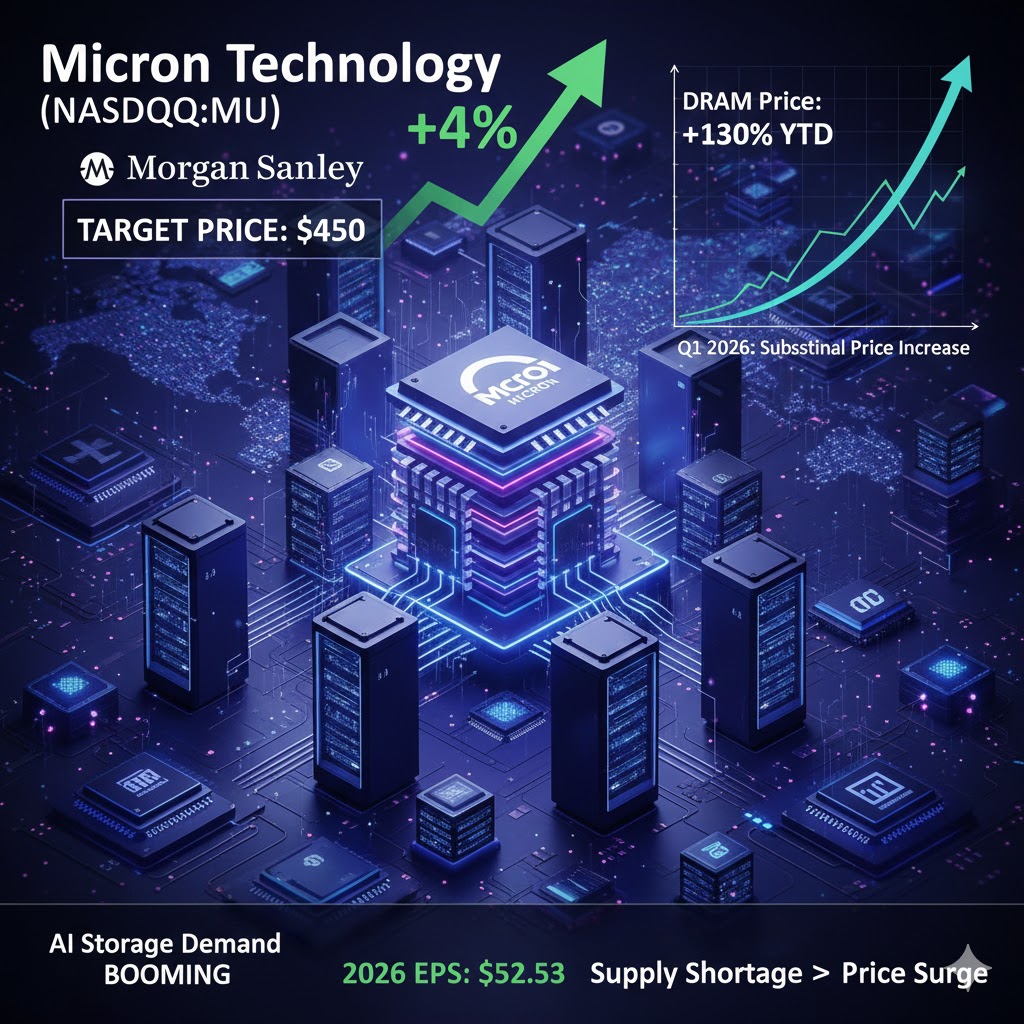
In its latest research report released on Wednesday (11th), Morgan Stanley significantly raised Micron’s target price from $350 to $450 and maintained an “Overweight” rating. At the same time, it listed Micron as its top pick in the semiconductor sector. The reason behind this is straightforward—artificial intelligence (AI) demand is booming!
“Since Micron last issued its earnings guidance, memory chip prices have surged, and all end markets are facing supply shortages. Based on this, we have revised the company’s earnings forecast upward. In the context of strong AI demand, concerns about HBM4 supply, issues in the Chinese market, and capital expenditure worries are not core factors,” the report states.
Notably, storage giant Kioxia Holdings (TSE:285A) reported that its full-year operating profit forecast exceeded expectations. On Thursday evening in the U.S. stock market, storage concept stocks rallied, continuing their strong momentum. SanDisk (NASDAQ:SNDK) surged nearly 8%, while Micron Technology (NASDAQ:MU) and Western Digital (NASDAQ:WDC) each rose over 4%.
In the Hong Kong stock market, storage concept stocks also climbed. As of now, GigaDevice Semiconductor (HK:03986) and Southern Two Times Long on Samsung Electronics (HK:07747) have both surged over 14%, and Southern Two Times Long on SK Hynix (HK:07709) rose over 8%.
Constant Shortage = Constant Price Increase
Over the past 12 months, the DRAM market has experienced significant growth, but the future growth potential remains promising. Morgan Stanley believes that a new round of substantial price increases will occur in Q1 2026, and with limited supply growth expected by 2026, the current severe supply-demand shortage will not be alleviated. As a result, prices are expected to continue rising throughout the year.
The firm further explained that the ongoing global memory chip supply shortage has driven up the prices of DRAM/NAND flash memory. For example, the spot price of DDR5 surged by 30% year-to-date, which is 130% higher than January’s contract price. Morgan Stanley emphasized, “This means that the price of mainstream products could double again.”
Simply put, as long as the supply-demand gap remains unfilled, this price surge will not stop, and the continued strong growth in AI demand has further widened the supply-demand gap.
Specifically, Morgan Stanley wrote:
From the demand side, memory chip manufacturers’ inventories are at extremely low levels. Even if customers are willing to pay premiums, it is difficult to secure enough supply. Whether it’s consumer PC manufacturers who are unable to get enough supply, or core customers who prioritize getting incremental supply, no one can build up inventories—core customers are even willing to pay a premium to secure supply 30 days in advance.
From the supply side, wafer production growth is very slow. Morgan Stanley forecasts that by the end of 2026, the year-on-year growth in wafer volume, including from ChangXin Memory Technologies (CXMT), SK Hynix M15, and Samsung P4L, will only be 7%. This indicates that wafer fabs will not be able to meet demand in the short term.
Explosive AI Demand: By the End of 2026, Nvidia’s Quarterly Revenue Is Expected to Increase by $30 Billion, AMD’s Data Center Revenue Will Double to $10 Billion, and Broadcom’s Semiconductor Revenue Will Double to $25 Billion
In addition, Marvell and Intel are expected to add a combined $1 billion in quarterly revenue. Over the next 12 months, the storage industry will need to support an annualized revenue increase close to $200 billion—larger than the entire logic semiconductor (such as CPU, GPU) market in 2020. Due to the higher wafer demand for HBM, DRAM suppliers will need to invest more capital expenditure to keep up with demand growth.
“Based on this, we believe it’s premature to sell the stock just due to concerns over supply growth in the second half of 2027,” the report concluded.
Price Increase = Significant Profitability Growth
The most direct benefit of this “price hike storm” is a significant boost to profitability. Morgan Stanley forecasts that Micron’s earnings per share (EPS) will soar to $52.53 for the calendar year 2026 (CY26).
The firm further noted that Micron will speak at an investor meeting later this week, and the market widely expects the company to meet or exceed the upper end of the earnings guidance issued at the beginning of Q2. The 37% quarter-on-quarter revenue growth implies an approximate 30% quarter-on-quarter increase in the average selling price (ASP).
Morgan Stanley explicitly stated that this expectation is too conservative, as the data from competitors is even more remarkable. SanDisk just provided guidance showing that its NAND ASP increased by 60% quarter-on-quarter, while teams covering Samsung and SK Hynix have modeled a 48% and 55% increase in Q1 DRAM prices, respectively.
“It’s worth noting that the situation in the previous quarter was similar to the current one. At that time, Micron did not provide a new specific forecast but confirmed that the market environment had improved far beyond expectations. We expect Micron to continue this kind of statement at this meeting. If no specific guidance is provided, there may be a short-term pullback in stock price, but this would present a buying opportunity,” the report added.
As a result, Morgan Stanley emphasized that the current price trends lay the foundation for continued upward revisions in earnings expectations, and the market has greatly underestimated the current tightness in the memory chip market. The market generally expects Micron’s earnings to peak at around $12 per share by the end of 2027. However, this target could be achieved with just a 20%-25% increase in ASP from the current guidance levels.
The firm’s analysts wrote: “But the reality is that the price increase in Q1 2026 has already far surpassed the implied levels in the guidance, so we judge that Micron’s earnings may continue to exceed market expectations over the next 18 months.”
“Additionally, Micron’s cash flow is strong, with the company expected to generate about $10 billion in cash flow per quarter. Its annual cash flow will reach 10% of its current enterprise value (EV), and along with potential large prepayments, its cash reserves will significantly increase,” they added.
Debunking “Bearish Rumors”
Firstly, regarding market concerns about potential impacts from Chinese memory chip companies, Morgan Stanley believes these worries are exaggerated.
Secondly, there are concerns about HBM4 supply.
The AI boom has led to a surge in demand for high-bandwidth memory (HBM), which is made by stacking DRAM and is crucial for advanced AI chips such as those designed by Nvidia. Micron, along with SK Hynix (KR:000660) and Samsung Electronics (KR:005930), is one of the “three giants” in the global HBM market, collectively dominating over 97% of the HBM market share.
HBM is a key part of Micron’s growth story and a crucial reason the market is willing to give it a higher valuation. However, currently, the price momentum in the DDR5 market is stronger, making it a more attractive market. Despite concerns about Micron’s progress with HBM4, Morgan Stanley believes this will not negatively impact the company’s profitability.
The firm pointed out that Micron stated in its December earnings report that it had completed HBM4 product certification and expected mass production to begin in Q2 2026, with no changes to the timeline.
“Even if Micron encounters unforeseen challenges in ramping up HBM4 production, HBM3e will still dominate the market and have a broad ASIC customer base, which won’t negatively impact profitability. Historically, early mass production of HBM4 by Nvidia has been dominated by SK Hynix, which was expected and does not pose a fundamental negative for Micron,” the report said.
Valuation
The report shows that Morgan Stanley used a “through-cycle valuation method” to value Micron and stated, “It is wrong to evaluate Micron based on traditional cyclical thinking.”
Specifically, the firm explained that the previous target price of $350 was based on a “25x cyclically adjusted EPS of $14,” but with the 2026 EPS forecast expected to exceed $50, they raised the “through-cycle EPS” target to $18. This level, although significantly premium to historical averages, still represents less than half of the expected earnings for the next 12 months.
Morgan Stanley concluded that, due to the unique AI-driven growth provided by HBM, it maintains a 25x PE multiple for Micron. The new target price of $450 is derived by multiplying the $18 through-cycle EPS by 25x.
Lastly, Morgan Stanley presented three potential scenarios:
- Bull Case ($600): Based on a 30x “through-cycle EPS” ($20). Benefiting from economies of scale, an increase in AI product share, and new product cost optimization, the gross margin continues to improve. HBM wafer intensity drives demand exceeding supply, and Micron consolidates its leadership position in HBM, alleviating price pressure.
- Base Case ($450): Based on a 25x “through
Leave a Reply