Former U.S. Treasury Secretary and former Federal Reserve Chair Janet Yellen said on Monday that the impact of the Iran conflict on oil markets will determine how much damage it will inflict on U.S. economic growth and the inflationary pressure it brings, which makes the Fed’s decision-making more challenging.
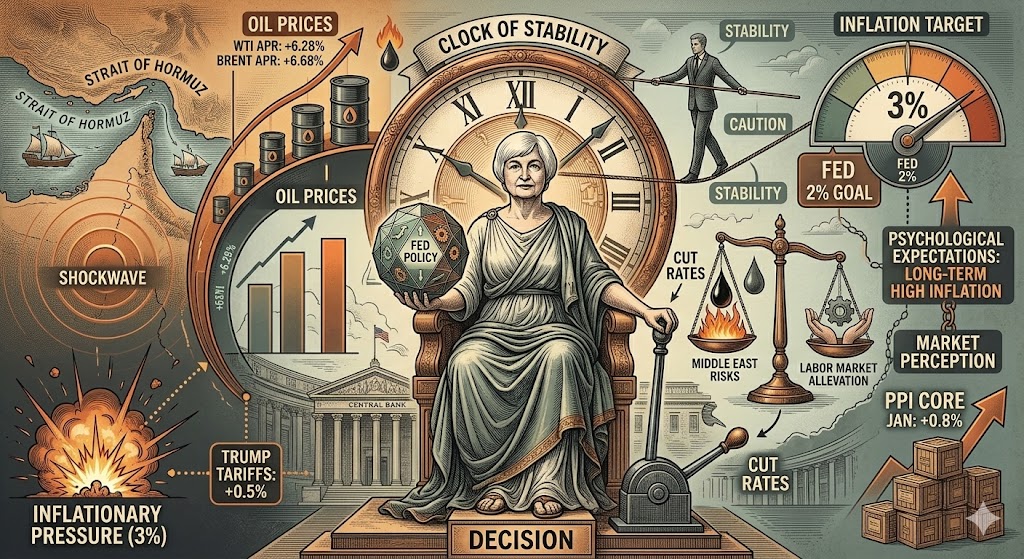
Speaking at a video conference in Long Beach, California, Yellen stated, “I think the recent developments in Iran have made the Fed more inclined to stay put. Compared to before the event, they will be more cautious about cutting rates.”
Yellen noted that U.S. inflation remains about one percentage point above the Fed’s 2% target. She also pointed out that the tariffs imposed under former President Trump contributed roughly half a percentage point to the current 3% inflation rate.
Before the escalation of tensions in Iran, the Fed had largely believed that the issue of a weak labor market had been somewhat alleviated, and policymakers were waiting for further declines in inflation.
“But now there’s the Iran shock, with a sharp rise in oil prices — how things develop in the coming days is uncertain,” Yellen said. She added that if the closure of the Strait of Hormuz lasts longer than a few days, oil prices could remain high or continue to rise.
On Monday, international crude oil futures closed sharply higher, gaining more than 6%. WTI crude oil futures for April delivery rose 6.28%, closing at $71.23 per barrel, while Brent crude oil futures for April delivery climbed 6.68%, closing at $77.74 per barrel.
The rise in oil prices adds new uncertainties to a series of recent indicators. Historically, surging energy costs have often signaled broader inflationary increases.
Yellen emphasized that with inflation still not back to 2%, the Fed must be cautious of market participants developing a perception: “They may begin to think: Inflation has indeed dropped from high levels to 3%, but it seems that the Fed is not really committed to bringing inflation back down to 2%.”
She stated that if this psychological expectation forms, the market will worry that inflation could remain at higher levels for the long term, complicating the policy trade-offs. Therefore, the Fed may be more inclined to keep rates unchanged.
Despite severe risks, including the Iran conflict, Yellen concluded, “Overall, I think the U.S. economy is in fairly good health, and I am relatively optimistic about the economic outlook.”
In addition to the energy market, there are other signs that inflationary pressures might be becoming entrenched. The U.S. core Producer Price Index (PPI) for January rose 0.8% month-on-month, exceeding expectations.
Most economists agree that the impact of rising oil prices is difficult to assess and may ultimately prove to be temporary — a pattern seen in past Middle East conflicts.
“Given that the conflict is still in its early stages, it is unclear whether the price increase will be sustainable in the medium term,” said Ravikanth Rai, Vice Managing Director of Energy and Natural Resources at Morningstar. “It’s hard to judge whether oil and gas supplies from the region will face structural impacts.”
Meanwhile, the market has increased its bets that the Fed will keep interest rates unchanged at its March meeting, and possibly into the summer, as officials weigh the conflicting factors of rising energy prices and uneven economic growth.
Leave a Reply