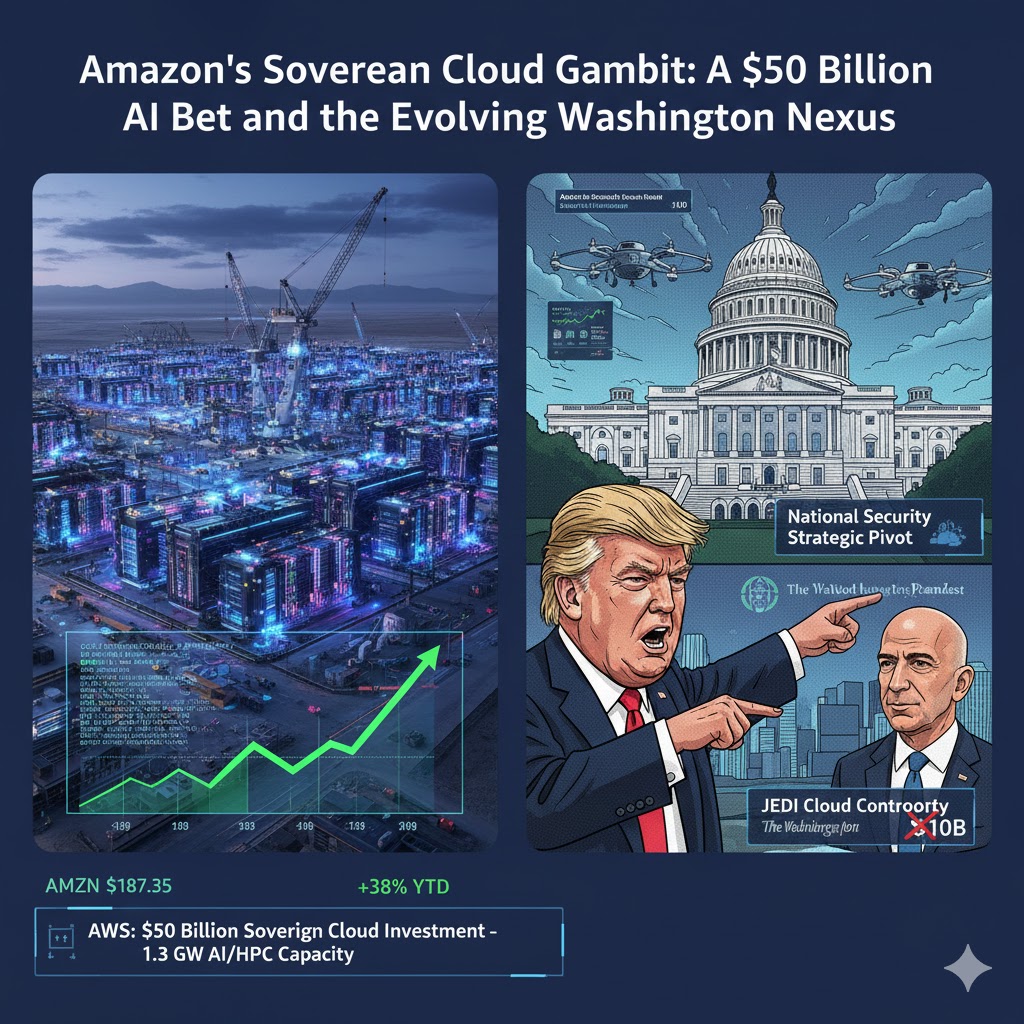
As 2025 draws to a close, Amazon (NASDAQ: AMZN) is not merely building data centers; it is constructing the very infrastructure of national security and advanced scientific discovery for the United States. On December 30, 2025, Fox Business reported a seismic announcement from Amazon Web Services (AWS): a groundbreaking plan to invest up to $50 billion in building and deploying dedicated AI and high-performance computing (HPC) systems specifically for the U.S. government. This monumental investment, set to kick off in 2026, will establish new data centers within AWS’s Top Secret, Secret, and GovCloud (US) regions, adding nearly 1.3 gigawatts of AI and supercomputing capacity.
Amazon’s stock reacted with characteristic robustness, closing the final trading day of the year, December 31, 2025, at $187.35. This marks a year of extraordinary growth, with AMZN shares having climbed approximately 38% over the past 12 months, pushing the company’s market capitalization toward $2.2 trillion. This surge reflects not only the enduring strength of its e-commerce and advertising divisions but, critically, the market’s increasingly bullish outlook on AWS’s dominance in the “Sovereign Cloud” and AI infrastructure race. This report delves into the strategic motivations behind this colossal government initiative, analyzes Amazon’s broader financial health, and explores the nuanced political dynamics that underpin its deepening relationship with Washington.
Financial Foundations: AWS as the Profit Engine and Growth Driver
Amazon’s Q3 2025 earnings report, released in late October, solidified AWS’s role as the company’s primary profit engine. While overall company revenue grew by a healthy 12% year-over-year to $153.8 billion, AWS revenue surged by an impressive 24% to $26.1 billion. This segment alone contributed $7.8 billion in operating income, representing over 70% of Amazon’s total operating profit for the quarter. The announcement of a $50 billion investment in government-specific cloud infrastructure is a direct extension of this core strength.
The company’s net income for Q3 reached $17.1 billion, translating to a diluted EPS of $1.65. Amazon’s free cash flow, a key metric for evaluating its investment capacity, reached a staggering $25.7 billion on a trailing twelve-month basis, providing ample liquidity for this multi-year government initiative without significantly straining its balance sheet. This strong financial position allows Amazon to embark on such ambitious projects, effectively self-funding its expansion into new, high-margin sectors.
Strategic Motivations: The “Sovereign Cloud” Imperative and National Security
The $50 billion AWS investment for the U.S. government is driven by a confluence of strategic imperatives:
- National Security and Geopolitical Competition: The U.S. government, particularly its defense and intelligence agencies, is facing unprecedented pressure to leverage AI for everything from real-time intelligence analysis and cybersecurity to advanced weapons systems development. The “Sovereign Cloud” concept ensures that critical national security workloads are isolated, secured, and operated within a framework compliant with the highest levels of government clearance. This investment directly addresses the escalating global AI race, particularly concerning strategic rivals.
- Market Dominance and Competitive Moat: By being the first major cloud provider to commit such a massive, dedicated investment to government-specific AI/HPC infrastructure, AWS aims to solidify its already commanding lead in the government cloud sector. This creates an almost insurmountable competitive moat, as the cost, complexity, and security requirements for building such systems are prohibitive for most rivals. It also positions AWS as an indispensable partner for future government AI initiatives, from quantum computing integration to AI-powered logistics.
- Future Revenue Streams and High-Margin Workloads: Government contracts are notoriously stable and often come with higher margins due to specialized security, compliance, and customization requirements. The demand for AI and HPC in federal agencies is projected to grow exponentially over the next decade. By securing this foundational infrastructure, AWS is locking in long-term, high-value revenue streams that will be less susceptible to economic fluctuations compared to commercial cloud workloads.
- Technological Leadership and Talent Attraction: Investing $50 billion in cutting-edge AI and supercomputing hardware (e.g., custom chips, advanced cooling, high-bandwidth networking) allows AWS to push the boundaries of cloud technology. This not only benefits government clients but also serves as a proving ground for innovations that can eventually trickle down to commercial offerings. It also attracts top-tier AI and HPC talent, further cementing Amazon’s reputation as an innovation leader.
Beyond the Headlines: Amazon’s Evolving Relationship with Washington
The announcement of this massive government contract implicitly re-contextualizes Amazon’s intricate and often contentious relationship with the U.S. political landscape. For years, Amazon and its founder, Jeff Bezos, faced public criticism from the Trump administration. This friction was notably visible in:
- The JEDI Cloud Contract Controversy (2019-2021): Amazon was initially considered a frontrunner for the Pentagon’s $10 billion Joint Enterprise Defense Infrastructure (JEDI) cloud contract. However, the contract was controversially awarded to Microsoft, a decision Amazon explicitly challenged, citing “unmistakable bias” from the Trump administration. The perception at the time was that political interference had derailed a legitimate competitive process.
- Bezos and The Washington Post: Jeff Bezos’s ownership of The Washington Post, a prominent newspaper often critical of the Trump administration, frequently drew public ire from then-President Trump. This created a perception among some that Amazon, and Bezos personally, were targeted due to their perceived political leanings or media influence.
- Antitrust Scrutiny: Both Democratic and Republican administrations have expressed concerns about Amazon’s market power across e-commerce, cloud, and logistics. The threat of antitrust action has been a persistent theme, regardless of which party controlled the White House.
However, the $50 billion AWS investment under a new presidential cycle (as 2026 implies a post-2024 election environment) signals a pragmatic shift. The relationship is less about personal animosity and more about national strategic necessity. The U.S. government needs the technological capabilities that only hyperscale cloud providers like AWS can deliver. Regardless of who occupies the White House, the imperative to maintain a technological edge in AI and supercomputing will drive partnerships with the private sector. Amazon, with its proven track record in secure government cloud services (dating back to its C2S program for the CIA), is an indispensable partner. The depth of the “Trump relationship” was likely a temporary, high-profile friction point that ultimately yielded to the larger, enduring strategic requirements of the U.S. government for advanced technological infrastructure.
Other Key Business Developments: E-commerce Refinement and Advertising Dominance
While AWS drives the strategic narrative, Amazon’s core e-commerce business continues its relentless march toward efficiency and profitability. In 2025, Amazon announced a $17 billion investment in its Last-Mile Delivery Network, including the deployment of over 50,000 new electric delivery vehicles and the opening of 25 new regional fulfillment centers. This massive expenditure is designed to reduce shipping costs by 8% year-over-year and further accelerate Prime delivery speeds.
The Advertising segment also continues its ascent. In Q3 2025, advertising services revenue grew by 27% to $15.6 billion, making Amazon the third-largest digital advertising platform globally, behind Google and Meta. The integration of AI into product recommendations, sponsored listings, and video ads on Prime Video has significantly increased advertiser ROI, drawing more budget away from traditional media.
Conclusion: The Indispensable Infrastructure Provider
Amazon, through AWS, is cementing its position as not just a technology leader, but a critical component of national infrastructure. The $50 billion investment for the U.S. government is a declaration of intent: AWS will be the foundational layer for American AI and supercomputing capabilities for the foreseeable future. This strategic move, while requiring significant capital, offers unparalleled long-term revenue visibility and reinforces Amazon’s competitive moat against all rivals.
For investors, Amazon represents a unique blend of diversified growth. Its e-commerce engine, while maturing, continues to innovate in logistics and customer experience. Its advertising business is rapidly capturing market share. But it is AWS, with its aggressive expansion into “Sovereign Cloud” and high-performance computing for government and enterprise, that provides the most compelling long-term investment thesis. The stock’s performance in 2025—a robust 38% increase—reflects this multi-faceted strength. As 2026 begins, Amazon stands as an indispensable provider of the digital backbone for global commerce, entertainment, and now, national security.
Leave a Reply