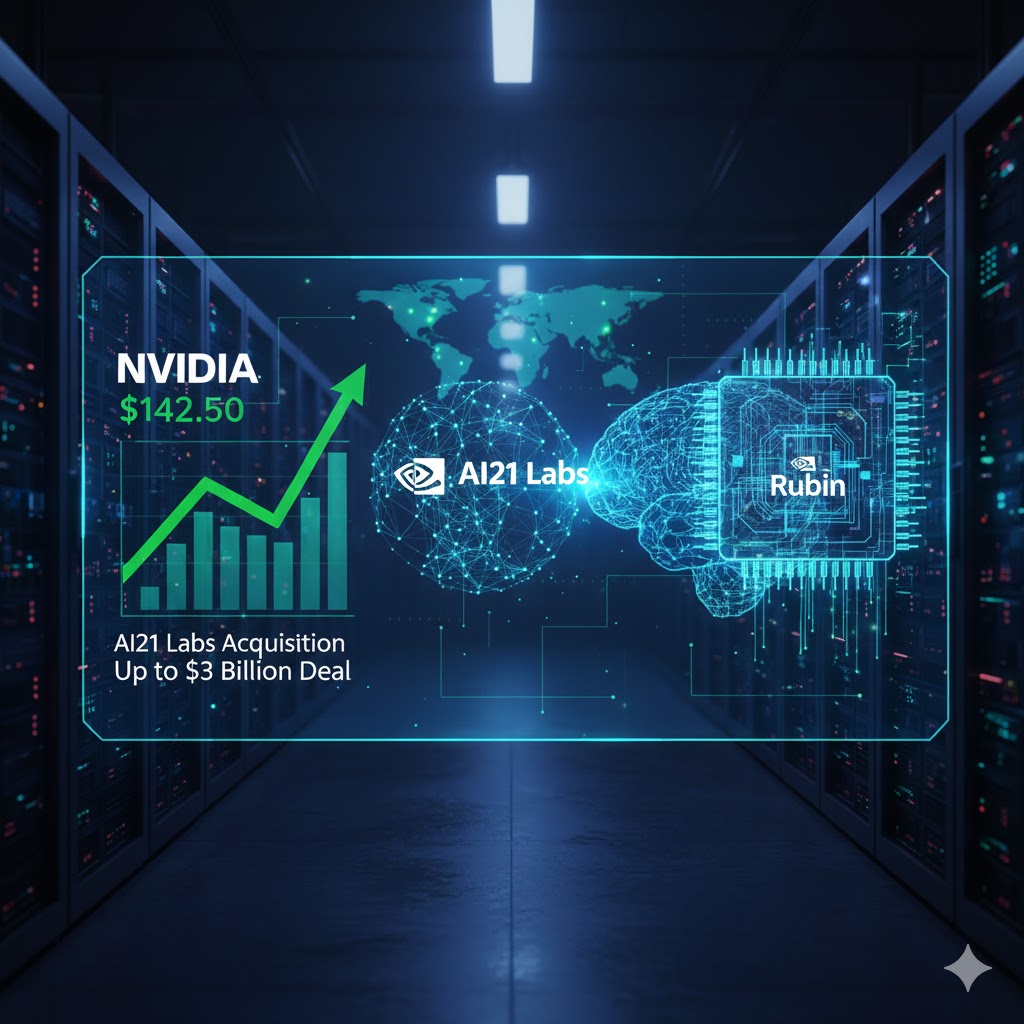
As the final trading days of 2025 unfold, NVIDIA Corporation (NASDAQ: NVDA) continues to operate not merely as a hardware manufacturer, but as the de facto central bank of the artificial intelligence economy. On December 31, 2025, the market is digesting a blockbuster report: NVIDIA is in advanced negotiations to acquire the Israeli AI powerhouse AI21 Labs in a deal valued at up to $3 billion. This acquisition, if finalized, would represent one of NVIDIA’s most aggressive moves into the software and Large Language Model (LLM) layer, signaling a strategic shift from providing the “picks and shovels” to owning the “gold mines” of generative intelligence.
As of the latest market data, NVIDIA’s stock is trading near $142.50, maintaining its position as one of the world’s most valuable entities with a market capitalization hovering around $3.5 trillion. The rumor of the AI21 Labs acquisition has added fresh momentum to the stock, which has already seen a staggering year-to-date climb. This report provides an exhaustive analysis of NVIDIA’s financial health, its recent M&A spree, the progress of its Blackwell and Rubin architectures, and its evolving role in the “Sovereign AI” movement.
Financial Fortress: Analyzing the Trillion-Dollar Balance Sheet
To understand why NVIDIA can casually contemplate a $3 billion acquisition, one must look at its unprecedented financial performance in fiscal 2025. In its most recent quarterly filing (Q3 FY2026), NVIDIA reported record-breaking revenue of $35.1 billion, an increase of 94% year-over-year and 17% sequentially. The Data Center segment remains the undisputed engine of this growth, contributing $30.8 billion—a figure that now dwarfs the total annual revenue of many Fortune 500 companies.
The company’s profitability metrics are equally historic. NVIDIA maintained a non-GAAP gross margin of 75.0%, a testament to its immense pricing power and the inelastic demand for its high-performance compute clusters. Net income for the quarter reached $19.3 billion, with diluted earnings per share (EPS) of $0.78. For the full fiscal year 2025, analysts project total revenue will exceed $120 billion, driven by the transition from H100 “Hopper” clusters to the next-generation “Blackwell” systems.
Equally critical for M&A activity is NVIDIA’s cash position. The company ended the third quarter with $38.5 billion in cash, cash equivalents, and marketable securities. This liquid arsenal allows Jensen Huang to execute “tuck-in” acquisitions like AI21 Labs without needing to tap debt markets or dilute shareholders significantly. Furthermore, NVIDIA’s board has authorized an additional $50 billion in share repurchases, signaling management’s confidence that the stock remains undervalued relative to its long-term AI roadmap.
The AI21 Labs Acquisition: Moving Up the Value Chain
The reported $3 billion negotiation for AI21 Labs is a calculated maneuver to secure high-reasoning LLM capabilities. AI21 Labs is renowned for its Jurassic-2 model and its focus on “semantic engines”—AI that doesn’t just predict the next word but understands the underlying logic of complex documents. For NVIDIA, this is not just about owning another model; it is about vertical integration.
By acquiring AI21 Labs, NVIDIA achieves three strategic objectives. First, it strengthens its NVIDIA AI Enterprise software suite. Instead of just selling the H100/B200 chips, NVIDIA can offer a proprietary, optimized software stack that includes AI21’s advanced reasoning capabilities. This creates a “sticky” ecosystem, similar to Apple’s iOS, where developers are incentivized to stay within the NVIDIA environment for both hardware and the software that runs on it.
Second, the acquisition bolsters NVIDIA’s presence in Israel, a global hub for AI research. Following its successful $7 billion acquisition of Mellanox in 2020 and its recent purchase of Run:ai, NVIDIA is effectively building an “Israeli Archipelago” of technical talent. Integrating AI21’s engineering team will accelerate NVIDIA’s internal development of specialized AI agents.
Third, it provides a hedge against the commoditization of hardware. While NVIDIA currently enjoys a near-monopoly on high-end GPUs, the long-term threat comes from ASICs (Application-Specific Integrated Circuits) developed by hyperscalers like Google (TPU) and Amazon (Trainium). By owning the model layer (AI21), NVIDIA ensures its relevance even if the underlying compute landscape becomes more fragmented.
Product Development: From Blackwell to the Rubin Horizon
NVIDIA’s product cycle is currently in a state of hyper-acceleration. The Blackwell (B200) architecture, which entered full-scale production in late 2024, is seeing “insane” demand, according to CEO Jensen Huang. Each Blackwell GPU contains 208 billion transistors and offers up to 30x the performance of the H100 for LLM inference workloads, while reducing energy consumption by 25x.
The market is already looking ahead to the Rubin architecture, scheduled for 2026. Rubin will feature the next generation of HBM4 (High Bandwidth Memory), which is critical for handling the massive data throughput required by “Frontier” models exceeding 10 trillion parameters. The development of the Vera CPU, designed to work in tandem with Rubin GPUs, indicates that NVIDIA is moving toward a “total system” approach—selling entire racks (like the NVL72) rather than individual chips.
In the robotics and edge AI space, the NVIDIA Thor platform is gaining significant traction in the automotive sector. Leading EV manufacturers in China and Europe are integrating Thor to power Level 4 autonomous driving and in-cabin AI assistants. This expansion into the “Physical AI” market provides a crucial second growth engine that is less dependent on the massive CapEx cycles of cloud hyperscalers.
Market Expansion: The Rise of Sovereign AI
A pivotal development in 2025 has been the emergence of Sovereign AI. Nations such as Japan, France, Canada, and various Gulf states are increasingly viewing AI as a matter of national security and economic survival. They are building domestic AI clouds to ensure data sovereignty and cultural alignment.
NVIDIA is the primary beneficiary of this trend. In the most recent quarter, Sovereign AI revenue was a multi-billion dollar contributor to the Data Center segment. By partnering with state-backed entities to build local data centers, NVIDIA is diversifying its customer base away from the “Big Four” US hyperscalers (Microsoft, Amazon, Meta, Google). This geographic diversification acts as a stabilizer for the stock price, as it mitigates the risk of a synchronized spending slowdown in the US tech sector.
Moreover, NVIDIA’s “Inception” program, which supports over 18,000 AI startups, functions as a massive scouting network. The potential AI21 Labs deal likely originated from this ecosystem, demonstrating how NVIDIA uses its market dominance to identify and absorb emerging threats and opportunities before they reach critical mass.
Operational Challenges and Geopolitical Risks
Despite the optimism, NVIDIA faces substantial hurdles. The most immediate is the supply chain constraint regarding HBM (High Bandwidth Memory) and CoWoS (Chip-on-Wafer-on-Substrate) packaging. While TSMC is rapidly expanding capacity, NVIDIA remains “supply-constrained” rather than “demand-constrained.” Any disruption in the Taiwan Strait or a fire at a major HBM facility in South Korea could have an immediate and severe impact on NVIDIA’s ability to meet its revenue targets.
Regulatory scrutiny is also intensifying. The US Department of Justice and the EU’s competition commission have reportedly begun informal inquiries into NVIDIA’s bundling practices—specifically whether the company uses its GPU dominance to force customers into using its networking (InfiniBand) and software (CUDA) products. The AI21 Labs acquisition may face rigorous antitrust reviews, as regulators become increasingly wary of “Big Tech” consolidating the AI model layer.
Finally, the ongoing US-China trade tensions remain a persistent headwind. While NVIDIA has developed “compliant” versions of its chips (like the H20) for the Chinese market, the performance gap between these and the Blackwell-class chips is widening. If the US further restricts the export of lower-tier AI chips, NVIDIA could lose a significant portion of its remaining revenue from the world’s second-largest economy.
Conclusion: The Ecosystem as an Economic Moat
NVIDIA’s potential $3 billion acquisition of AI21 Labs is a clear signal that the company is not content with being a hardware vendor. It is building an integrated “AI Operating System” for the world. When you combine the world’s fastest GPUs (Blackwell/Rubin), the industry-standard software (CUDA), the fastest networking (Spectrum-X), and now high-end reasoning models (AI21), the result is an economic moat that is virtually impenetrable.
The financial data supports this vision: 75% gross margins, 90%+ year-over-year revenue growth, and a $38 billion cash pile. While the stock’s valuation invites debates about “AI bubbles,” the fundamental earnings power of NVIDIA is unprecedented in the history of the technology sector. As 2026 approaches, the company’s success will be measured not just by how many chips it ships, but by how deeply it integrates its intelligence into the infrastructure of global government and industry.
NVIDIA is no longer just a participant in the AI revolution; through its relentless product cycles and strategic acquisitions, it is increasingly becoming the infrastructure upon which the future is being built.
Leave a Reply