The closing bell of 2025 is ringing in a new era for semiconductor investors, one where “storage” is no longer a cyclical commodity but a high-margin necessity. On December 24, 2025, the sector witnessed a powerful intraday surge: Micron Technology (MU) jumped over 4% to hit a fresh all-time high of $286.68, while the newly independent SanDisk (SNDK) soared more than 5%, and Western Digital (WDC) gained over 1%. With the year-to-date returns for these stocks reaching staggering levels—SanDisk is up over 500% since its February spinoff—investors are left asking if the rally has overextended or if the “Memory Supercycle” still has room to run.
While SanDisk’s post-spinoff momentum is undeniable, a closer analysis suggests that Micron Technology remains the most fundamentally sound and strategically positioned buy for 2026. Micron isn’t just a beneficiary of the AI trend; it is the primary bottleneck. As AI models transition from training to massive-scale inference, the demand for High Bandwidth Memory (HBM) and enterprise-grade SSDs has outstripped global production capacity, creating a “perfect storm” of rising prices and record-breaking margins.
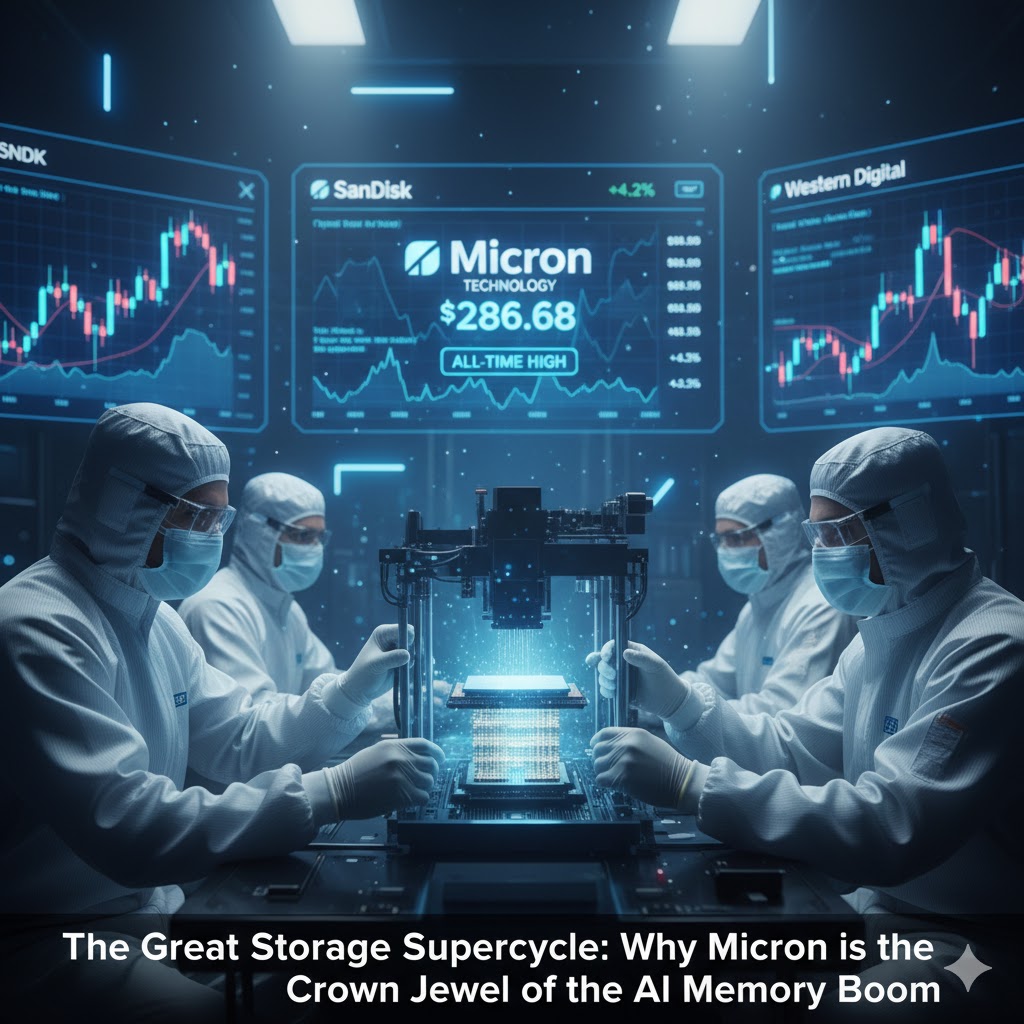
Micron: The High-Margin Leader of HBM
Micron’s record-breaking stock price is supported by a fundamental pivot in its product mix. The company has successfully transitioned a significant portion of its fabrication lines to HBM3E, the ultra-high-speed memory required by NVIDIA’s latest Blackwell chips. This shift has had a two-fold benefit: it captures the highest margins in the industry and simultaneously reduces the supply of standard DRAM for PCs and smartphones, driving up prices across the board.
The financial data paints a picture of a company in its prime. For fiscal Q1 2026, Micron reported GAAP gross margins in the mid-50% range, a massive leap from the 30% range seen just a year ago. Despite the stock’s triple-digit climb this year, its Forward P/E ratio sits at approximately 26x. While higher than its historical average, this valuation is actually conservative when compared to the broader AI sector. When you consider that Micron’s earnings per share (EPS) for the trailing twelve months (TTM) has surged to $10.63, the “all-time high” price is effectively a reflection of “all-time high” earnings power.
SanDisk and Western Digital: The Spinoff Success
The market’s enthusiasm for SanDisk and Western Digital stems from their strategic “divorce” in February 2025. By separating the volatile Flash business (SanDisk) from the steady, cash-flow-heavy HDD business (Western Digital), both companies have unlocked significant shareholder value. SanDisk, now a pure-play NAND and SSD powerhouse, has become the top-performing stock in the S&P 500 for 2025, driven by the adoption of its BiCS8 technology in AI data centers.
However, SanDisk’s 570% year-to-date rally has pushed its valuation into a “priced-for-perfection” zone. While it remains a “Zacks Rank #2 (Buy),” the risk of a technical correction is higher for SanDisk than for Micron. Western Digital, meanwhile, has focused on dominating the high-capacity HDD market. With a market share of nearly 63% in the enterprise HDD segment, WDC is the go-to provider for “cold storage”—the massive archives of data that AI models need to train on. Trading at a P/E of 24, Western Digital offers a safer, albeit slower, alternative for value-oriented investors.
Strategic Outlook: Accumulate on the Breakout
The current surge is not a bubble; it is a structural repricing of the storage industry. We are moving from a world that generates data to a world that must store and process every byte of it at lightning speed. Micron’s leadership in the HBM segment and its “fortress balance sheet” make it the clear winner for institutional portfolios. The stock has successfully cleared the $280 resistance level, and many analysts are now setting $330 to $350 as the next psychological targets for early 2026.
Recommendation: Buy Micron (MU). While SanDisk offers higher volatility for traders, Micron provides the most balanced exposure to the AI memory crunch. The recent 4% jump is a signal of “window dressing” by institutional funds who want Micron on their books before the year ends. For the individual investor, any dip toward the $275 level should be viewed as a generational buying opportunity. The storage cycle of 2025 has proved one thing: in the age of AI, memory is the new oil, and Micron owns the biggest refineries.
Leave a Reply