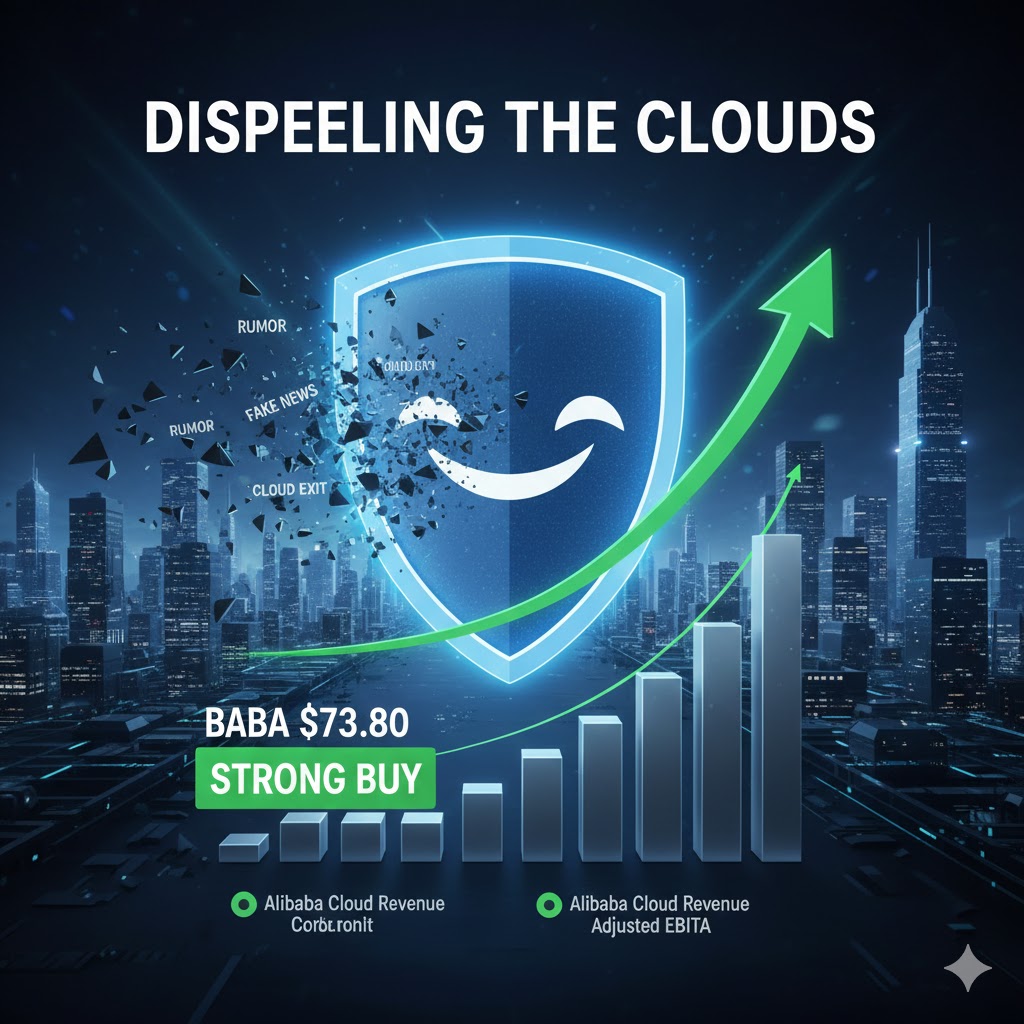
The digital realm thrives on information, yet it’s also prone to misinformation. A recent example saw a blogger claim that Xiaohongshu, a prominent social media and e-commerce platform and a benchmark client for Alibaba Cloud, had “de-clouded”—meaning it had moved its operations off Alibaba’s cloud infrastructure. Alibaba Cloud swiftly responded via Weibo, unequivocally stating, “This is a rumor.” Such incidents, while seemingly minor, underscore the intense scrutiny and competitive pressures faced by tech giants like Alibaba (NYSE: BABA). Far from indicating weakness, this quick and decisive refutation from Alibaba Cloud highlights the critical importance of its cloud business and its commitment to defending its market position and client relationships.
Currently trading at approximately $73.80, Alibaba’s stock presents a fascinating paradox. It’s a global e-commerce and logistics behemoth with significant ventures in cloud computing, digital media, and fintech, yet its valuation has been significantly depressed from its highs. While regulatory crackdowns and geopolitical tensions have undoubtedly cast a long shadow, a deeper look reveals a company undergoing strategic realignment, shedding non-core assets, and focusing on sustainable, high-quality growth. This makes Alibaba not just a “hold,” but a compelling “strong buy” for patient investors willing to look beyond the noise and recognize its long-term potential.
Alibaba’s Valuation: A Deep Discount on Enduring Power
Alibaba’s current market capitalization hovers around $187.3 billion, a stark contrast to its peak of over $800 billion. The stock is trading at a trailing twelve-month Price-to-Earnings (P/E) ratio of approximately 14.5x, significantly lower than its historical average and far below that of many global tech peers. Its Price-to-Sales (P/S) ratio stands at roughly 1.7x, which is remarkably low for a company of its scale and growth prospects, particularly one with dominant market positions in multiple sectors.
This depressed valuation largely stems from a confluence of factors: the aforementioned regulatory tightening in China, fierce domestic competition, and broader macroeconomic headwinds. However, what the market seems to be overlooking is Alibaba’s robust underlying performance and its proactive strategic shifts. In its latest reported quarter (Q3 Fiscal Year 2024), Alibaba reported revenue of RMB 260.3 billion ($36.19 billion), representing a 5% year-over-year increase. More importantly, its adjusted EBITA grew by 2% year-over-year to RMB 52.8 billion ($7.33 billion). While the growth rate may appear modest compared to its hyper-growth years, it signifies resilience and efficiency in a challenging environment.
The Cloud Powerhouse: Dispelling FUD and Building for the Future
The “Xiaohongshu de-clouded” rumor directly attacked one of Alibaba’s crown jewels: Alibaba Cloud. As the third-largest cloud provider globally and the largest in Asia-Pacific, Alibaba Cloud is a critical growth engine and a high-margin business. While its revenue growth has moderated in recent quarters, reaching 3% year-over-year in Q3 FY2024, it achieved adjusted EBITA of RMB 2.36 billion ($328 million), marking its eleventh consecutive profitable quarter. This profitability is a testament to its operational efficiency and robust customer base.
The swift debunking of the Xiaohongshu rumor is crucial. Xiaohongshu is indeed a flagship client, representing the kind of sophisticated, high-traffic platform that demonstrates Alibaba Cloud’s capabilities. Losing such a client, or even the perception of it, could severely impact investor confidence. By immediately addressing the misinformation, Alibaba reinforced the stability and reliability of its cloud services, which underpin a significant portion of the digital economy in China and increasingly abroad. The long-term trend in cloud computing, driven by AI, big data, and digital transformation, remains unequivocally upward, and Alibaba Cloud is strategically positioned to capture a substantial share of this growth.
| Key Metric (Q3 FY2024) | Value (RMB) | Value (USD) | YoY Growth |
| Total Revenue | 260.3 Billion | 36.19 Billion | +5% |
| Adjusted EBITA | 52.8 Billion | 7.33 Billion | +2% |
| Alibaba Cloud Revenue | 28.06 Billion | 3.90 Billion | +3% |
| Alibaba Cloud Adjusted EBITA | 2.36 Billion | 328 Million | N/A (Profitable) |
Strategic Streamlining and Unlocking Shareholder Value
Beyond cloud, Alibaba is actively optimizing its sprawling empire. The much-anticipated spin-off of its logistics arm, Cainiao, and the potential IPO of its fresh grocery business, Freshippo, signal a clear intent to unlock value from its various segments. These moves, coupled with a record share buyback program (the board recently approved an increase of $25 billion to its buyback program, extending it through March 2027), demonstrate a strong commitment to shareholder returns.
Alibaba’s core e-commerce platforms, Taobao and Tmall, continue to evolve, focusing on user experience, content creation, and an improved merchant ecosystem to fend off fierce competition from platforms like PDD Holdings (Pinduoduo). International commerce, driven by AliExpress and Lazada, also presents significant long-term growth avenues, especially as global digital adoption accelerates.
Investment Verdict: A Deeply Undervalued Opportunity
The market’s current narrative surrounding Alibaba often fixates on past challenges rather than future opportunities. While headwinds persist, the company’s aggressive buyback program, sustained profitability across its key segments (especially cloud), and strategic divestitures are painting a picture of a leaner, more focused, and ultimately more valuable enterprise.
Independent analyst models, factoring in the current market dynamics and Alibaba’s restructuring efforts, often project a fair value significantly higher than its current trading price, ranging from $95 to $130 per share. At approximately $73.80, investors are being offered a substantial discount on a company with undeniable market leadership, robust financials, and a clear path toward unlocking shareholder value. The cloud rumor, quickly debunked, serves as a mere ripple in the vast ocean of Alibaba’s ambition and capability.
Recommendation: Strong Buy. Target Price: $120.