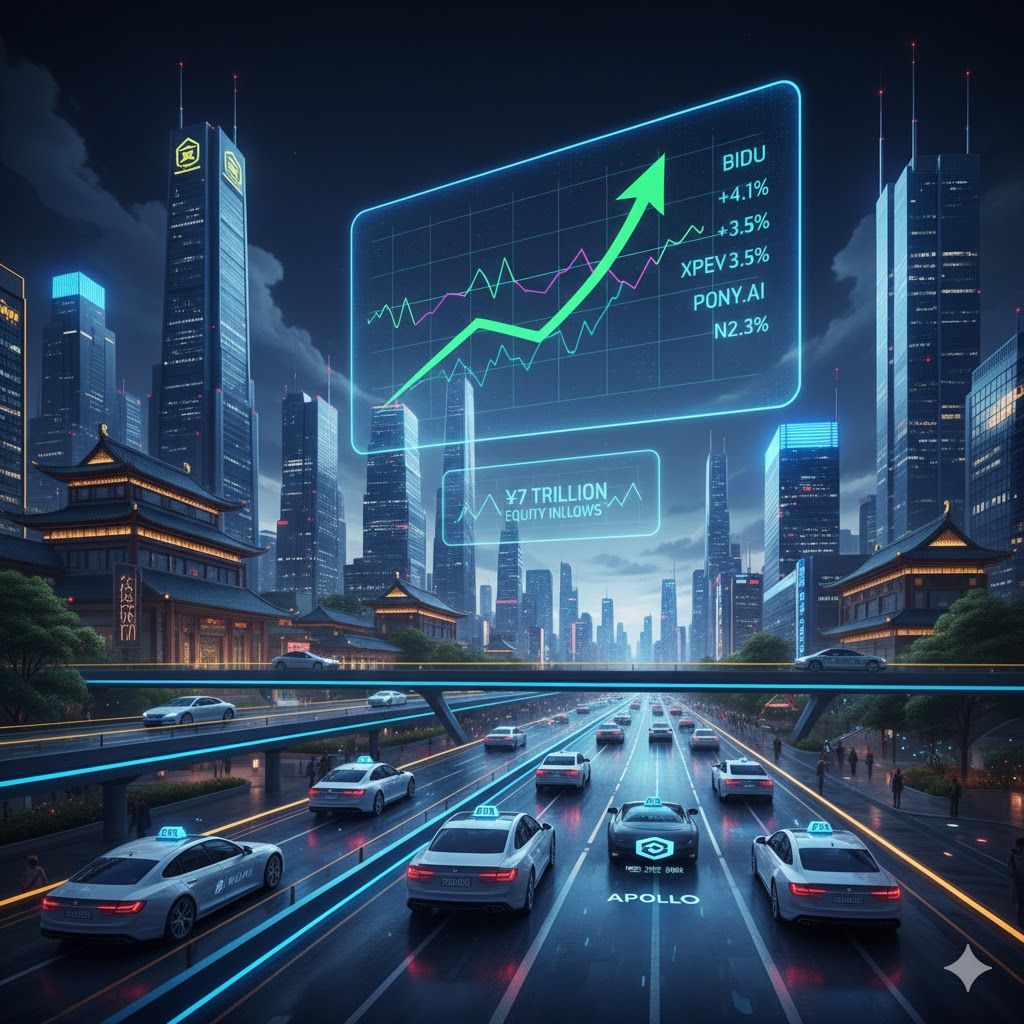
The final trading days of 2025 are witnessing a tectonic shift in investor sentiment toward Chinese equities. On December 30, the market opened with a decisive upward thrust, led by the heavyweights of the “New Economy.” Baidu (BIDU) jumped nearly 6%, NIO (NIO) soared over 4%, while XPeng (XPEV), Pony.ai, and NetEase (NTES) all registered gains between 2% and 4%. This is not merely a year-end “Santa Claus” rally; it is the culmination of a “Breakthrough Year” for Chinese innovation and a fundamental re-rating of the sector’s valuation.
The narrative surrounding Chinese stocks has evolved from “uninvestable” to “unavoidable.” As of late December 2025, the MSCI China Index and the CSI 300 have returned roughly 25% to 29% year-to-date, outperforming many global peers. The catalyst for this latest surge is a “Perfect Storm” of three factors: the global validation of Chinese AI (highlighted by the DeepSeek R1 model), a massive expansion of autonomous mobility into international markets, and the anticipated deployment of a $7 trillion pool of excess Chinese household savings into the equity markets.
The AI Sovereignty Play: Baidu’s Global Ambitions
Baidu’s nearly 6% gain on December 30 is a direct reflection of its transformation from a search engine into a global AI infrastructure provider. Trading around $118.40, Baidu is benefiting from the “DeepSeek Effect”—a market realization that Chinese LLMs (Large Language Models) are now operating at the frontier of global AI.
However, the real “alpha” for Baidu lies in its Apollo Go robotaxi service. In late December 2025, Baidu announced a landmark partnership with Switzerland’s PostBus to deploy its Level 4 autonomous RT6 vehicles in Eastern Switzerland, followed by similar tie-ups with Uber and Lyft for a London launch in 2026. With over 250,000 trips per week globally and a fleet expansion plan targeting thousands of cars across Europe, Baidu is no longer just a domestic player; it is the Western world’s most formidable competitor to Alphabet’s Waymo.
The EV Export Explosion: NIO and XPeng’s Global Pivot
The 4% jump in NIO and 3% rise in XPeng are fueled by staggering export data. In November 2025, China’s electric vehicle exports surged 87% year-over-year, reaching nearly 200,000 vehicles in a single month. For NIO, which is trading near $6.90, the market is finally rewarding its “Battery-as-a-Service” (BaaS) infrastructure, which is proving to be a critical differentiator in the European market.
XPeng, trading at $15.20, is riding high on the success of its 2026 P7+ global model. Featuring three “Turing” AI chips with a combined computing power of 2,250 TOPS, the P7+ is being marketed as the world’s longest-range EREV (Extended Range Electric Vehicle) sedan. The company’s cumulative deliveries hit 391,937 units in the first eleven months of 2025—a 156% year-on-year increase—proving that its “Physical AI” strategy (merging robotics, AI, and mobility) is resonating with a global audience.
Liquidity and Policy: The $7 Trillion Tailwind
Beyond individual stock performance, the broader sector is being lifted by a structural shift in Chinese domestic finance. For the first time in history, China’s annual A-share trading turnover exceeded 405 trillion yuan ($57.6 trillion) in 2025.
The most potent argument for a continued rally in 2026 is the “Patient Capital” initiative. Beijing is now encouraging insurance companies to invest up to 30% of new premiums into equities. More importantly, there is an estimated $7 trillion (RMB 164 trillion) in excess household deposits sitting on the sidelines. Analysts estimate that if even 5% of this capital shifts into the stock market, it would represent an inflow equivalent to 6% of the total market capitalization of all listed Chinese firms.
Valuation: Still a Bargain in a High-Growth World
Despite the 2025 recovery, Chinese tech stocks remain historically cheap. While the “Magnificent Seven” in the U.S. trade at multiples often exceeding 35x forward earnings, the leading Chinese tech firms are still trading at an average forward P/E of 18x to 22x.
Goldman Sachs and UBS have both issued constructive outlooks for 2026, forecasting an additional 38% upside by the end of 2027. This growth is expected to be driven by a transition from “valuation recovery” to “earnings acceleration,” with corporate earnings growth projected to hit 8% to 14% in the coming two fiscal years.
Sector Outlook: The 15th Five-Year Plan
As we move into 2026, the market is already positioning for the 15th Five-Year Plan (2026-2030). Early signals from Beijing suggest an unprecedented level of support for “Frontier Technologies”—specifically semiconductors, AI infrastructure, and humanoid robotics.
NetEase’s 2% rise on December 30 reflects this trend, as the company leverages AI to lower game development costs while expanding its high-margin international publishing wing. Similarly, the debut of Pony.ai on public markets has added a fresh layer of “pure-play” autonomous driving excitement to the index.
Conclusion: A Strategic Window of Opportunity
The December 30 rally is a signal that the “China Discount” is evaporating. Investors are no longer just looking at the risks of regulation or geopolitics; they are looking at the technological leadership in EV exports, the dominance in AI infrastructure, and the massive domestic liquidity ready to be unleashed.
For the global investor, the message is clear: the volatility of the past three years has created a entry point into some of the most innovative companies on the planet at valuations that are fundamentally disconnected from their growth potential. As Baidu’s robotaxis begin to roam the streets of London and Zurich, and as XPeng’s AI-powered sedans hit 36 different countries, the “China Tech” story is entering its most profitable chapter yet.
Leave a Reply