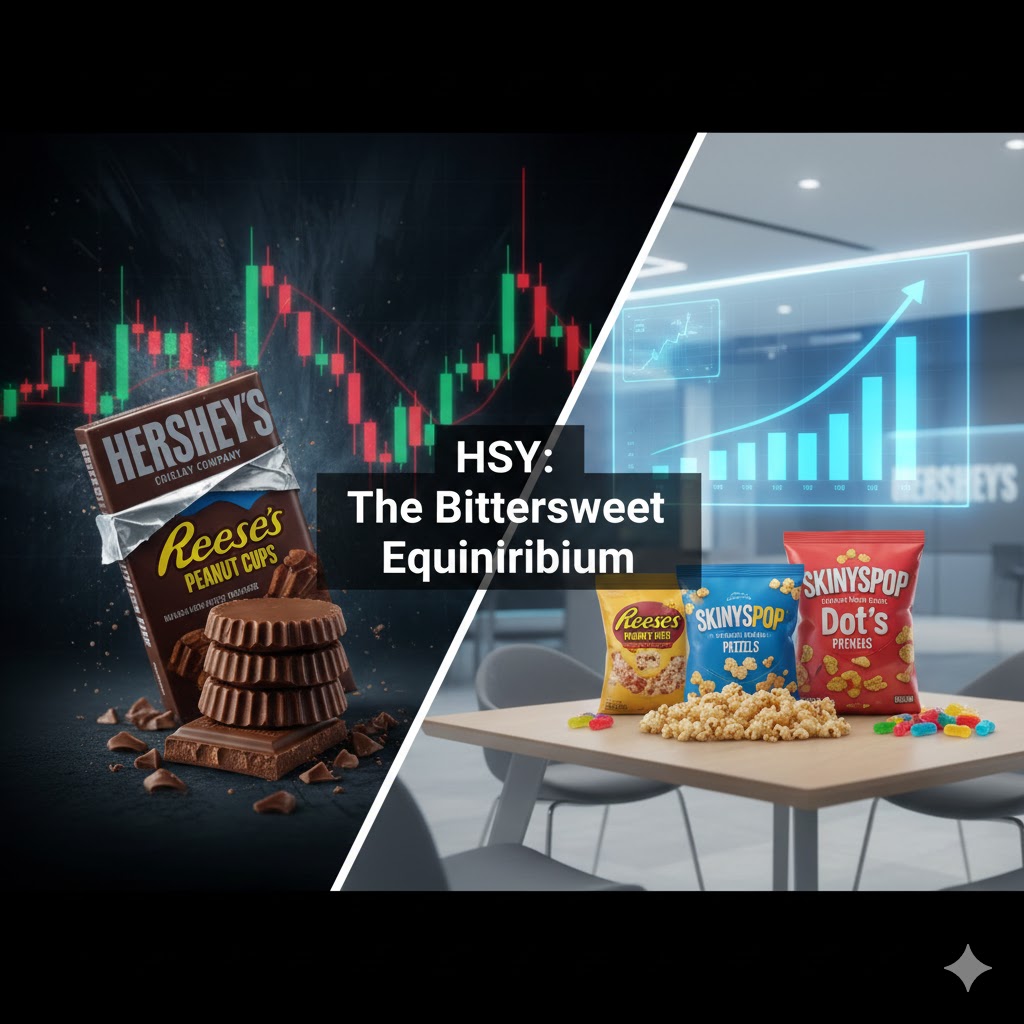
s of early January 2026, the global confectionery landscape is navigating a period of unprecedented volatility, with The Hershey Company (NYSE: HSY) positioned at the epicenter of a structural shift in consumer staples. For over a century, Hershey has served as a defensive cornerstone for institutional portfolios, prized for its inelastic demand and storied brand equity. However, as the 2026 fiscal year commences, the “Three-Bar” giant faces a dual-threat environment: the tail end of a historic surge in cocoa prices and a rapidly evolving retail landscape where “salty-sweet” diversification is no longer an option, but a survival mandate.
The current market price for HSY stands at approximately $189.02 (as of January 9, 2026), reflecting a resilient start to the year. This follows a transformative 2025 in which the stock recovered from multi-year lows near $140, driven by a strategic pivot toward non-chocolate categories and aggressive supply-chain hedging. As analysts debate whether the current price reflects “fair value” or “irrational exuberance,” this report provides an exhaustive look into the financial machinery, product pipeline, and market expansion strategies that will define Hershey’s trajectory through 2026.
Financial Statement Analysis: Margin Recovery in a Post-Inflationary Era
To understand Hershey’s 2026 valuation, one must first look at the wreckage—and subsequent repair—of its gross margins over the preceding twenty-four months. The primary headwind has been the cost of cocoa, which reached astronomical highs in late 2024 and early 2025.
Profitability Metrics and Revenue Streams
For the trailing twelve months (TTM) ending in late 2025, Hershey reported total revenue of approximately $11.49 billion, marking a year-over-year growth of 4.71%. While this top-line growth appears modest, it was achieved through a surgical application of “price-pack architecture”—decreasing product sizes while maintaining price points to protect the bottom line.
The Reported Gross Margin for the most recent quarter sat at 32.6%. While this is a decrease from the mid-40% range seen in the pre-cocoa-crisis era, it represents a stabilizing “floor.” More importantly, the Operating Margin remains elite for the sector at 13.7%, fueled by a company-wide productivity initiative aimed at stripping $300 million in administrative and supply-chain costs by the end of 2026.
Valuation Multiples: The Premium Debate
Hershey currently trades at a trailing P/E ratio of approximately 32.25, while its forward P/E for 2026 is estimated at 27.5x by some institutional desks. This is a significant premium compared to the broader consumer staples sector, which typically hovers around 18x to 20x. The “Hershey Premium” is traditionally justified by its Return on Equity (ROE), which peaked at a staggering 57.2% in recent years and currently tracks at a robust 32%.
However, some discounted cash flow (DCF) models suggest an intrinsic value closer to $143, implying the stock may be overvalued by as much as 21% to 26% at current levels. The gap between Wall Street’s “Overweight” ratings (with price targets reaching $213) and these conservative DCF models hinges entirely on the pace of cocoa price normalization and the success of the company’s “Salty Snacks” expansion.
Business Development: The Strategic Pivot Beyond the Cocoa Bean
Under the leadership of CEO Michele Buck (and the evolving 2026 executive team), Hershey has transitioned from a “Chocolate Company” to a “Leading Snacking Powerhouse.” This is not just marketing jargon; it is a fundamental shift in capital allocation.
The Salty Snacks Integration
The North America Salty Snacks segment, headlined by SkinnyPop and Dot’s Homestyle Pretzels, now contributes over $1.14 billion in annual revenue. This segment is critical because it offers a hedge against cocoa price volatility. In 2025, while the confectionery segment struggled with ingredient costs, Salty Snacks maintained double-digit organic growth, leveraging Hershey’s existing distribution networks to secure prime shelf space in convenience stores (C-stores) and gas stations.
Operational Efficiency: The 2026 Roadmap
The company is currently in the “harvest phase” of its SAP S/4HANA digital transformation. This multi-year investment is finally yielding real-time inventory insights, allowing Hershey to reduce waste and optimize its promotional spending. For 2026, management has signaled that approximately 80% of the profit benefit from recent pricing actions will be realized this year, providing a significant tailwind for EPS growth that consensus forecasts may still be underestimating.
New Product Development: Innovation at the Speed of Gen Z
Innovation in 2026 is bifurcated: protecting the “core” (Reese’s and Hershey’s) while capturing the “fringe” (sweets, gummies, and protein).
The “Gummy” Revolution and Shaq-a-licious
The non-chocolate confectionery category is currently the fastest-growing segment in the U.S. “sweets” market. Hershey has capitalized on this with the Shaq-a-licious XL Gummies—a collaboration with Shaquille O’Neal—which became the third-fastest growing sweets brand since its debut. For 2026, the company is expanding the Jolly Rancher Ropes lineup and accelerating the distribution of Sour Strips, a strategic acquisition aimed directly at the Gen Z demographic who prioritize “texture and sourness” over traditional milk chocolate.
Performance-Driven Treats
The acquisition of ONE Brands and Fulfil has integrated Hershey into the high-growth protein bar category. In 2026, Hershey plans to launch a series of “co-branded” protein snacks, blending the flavor profiles of its iconic confectionery brands with the macro-nutrient profiles demanded by health-conscious consumers. This “permissible indulgence” category is expected to be a primary driver of shelf-space expansion in the “Front of Store” retail locations.
Market Expansion: Defending the Turf and Selective Global Growth
While Hershey remains a primarily North American-centric business, its international strategy for 2026 is focused on “selective scale” rather than blanket global presence.
North American Dominance and the C-Store Strategy
The U.S. market remains Hershey’s fortress. At the 2025 NACS Show Expo, Hershey unveiled data-driven “bundling” strategies for retailers, encouraging the pairing of salty snacks with confectionery. By leveraging their “Everyday Multiples” (EDM) strategy, Hershey is helping retailers increase “basket size,” ensuring that even as consumers face inflationary pressure, Hershey brands remain the “last luxury” they refuse to cut from their budget.
International Recovery: Brazil, Mexico, and Beyond
International net sales saw a 12% increase to $244 million in the most recent reported quarter. However, this growth came with a net income loss due to high manufacturing costs. For 2026, Hershey is shifting its international focus to “Premiumization” in Europe and Brazil. By positioning products like Reese’s as a premium import, Hershey can command higher margins that offset the lack of local manufacturing scale in certain regions.
Key Risks and External Catalysts: The Cocoa Conundrum
The single greatest “threat” to Hershey’s 2026 valuation remains the structural floor of cocoa prices. While prices have “plunged” from their $12,000/tonne highs to approximately $6,000 – $8,000/tonne, this is still double the historical average.
The Tariff and Supply Chain Variable
As a major importer, Hershey is sensitive to shifting U.S. trade policies and tariffs. Management has been optimistic about cocoa inflation turning deflationary in 2026, but any geopolitical instability in West Africa (specifically Côte d’Ivoire and Ghana) could reignite price spikes. Furthermore, the company is monitoring the impact of GLP-1 medications (weight-loss drugs). While management asserts that the impact has been “immaterial” through 2025, a wider adoption of these medications could structurally lower the “volume ceiling” for indulgent snacking categories over the next decade.
Conclusion: A Valuation Defined by Visibility
The 2026 analysis of HSY presents a company that has successfully navigated a “perfect storm.” The valuation of $189.02 is neither a clear bargain nor a speculative bubble. Instead, it represents a “Visibility Premium.” In an era where much of the consumer staples sector is grappling with fading pricing power, Hershey offers a rare degree of certainty: a clear path to EPS acceleration as cocoa costs moderate and salty snack margins expand.
For the stock to justify a move toward the $213 analyst targets, Hershey must prove that its “Gummy” and “Salty” innovations can sustain double-digit growth even as it laps tough year-over-year comparisons in Q4. Conversely, if cocoa prices remain structurally “higher for longer,” the current P/E multiple of 32x may face a painful de-rating toward the sector mean.
The story of Hershey in 2026 is one of balanced growth. It is no longer just the story of a chocolate bar; it is the story of a data-driven snacking conglomerate that has learned to thrive in an era of scarcity.
Leave a Reply