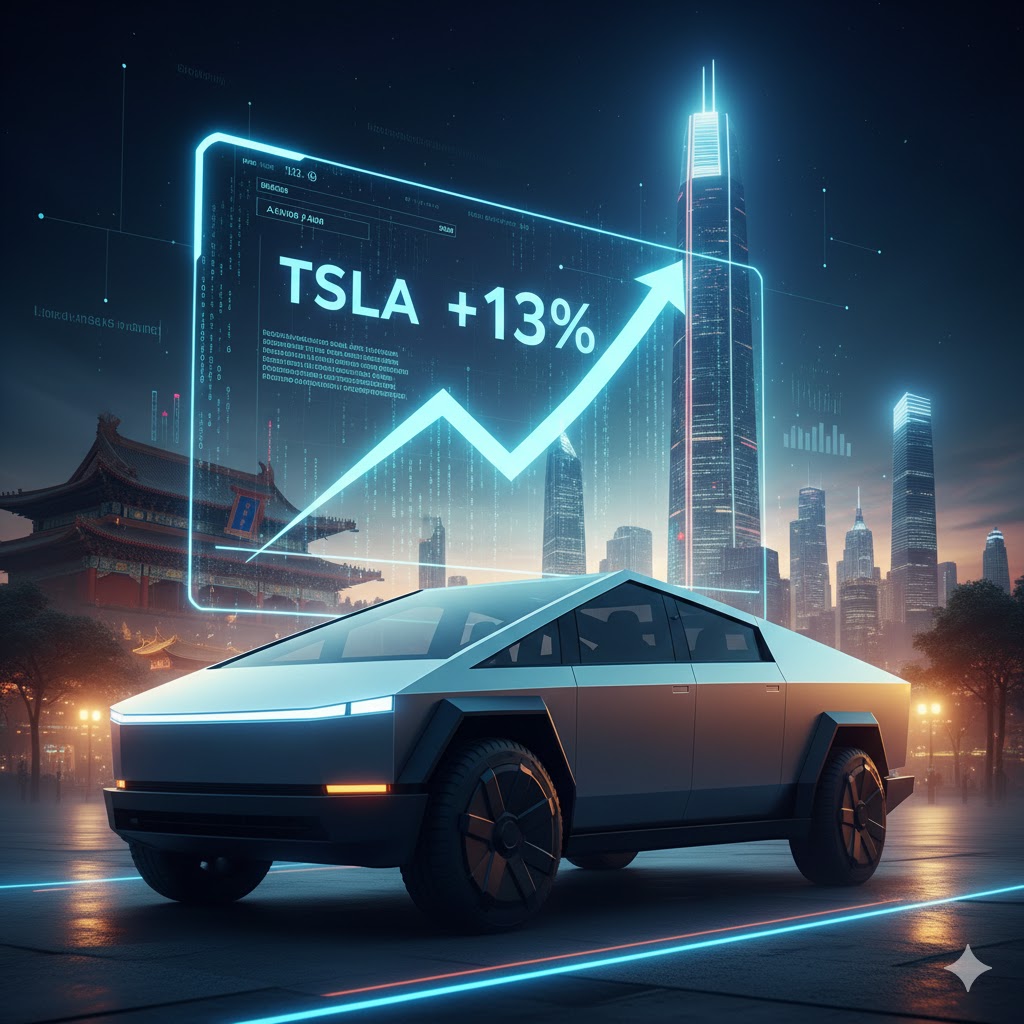
The global automotive landscape in early 2026 is witnessing a profound realignment of power, strategy, and technological dominance. At the heart of this transformation is Tesla, Inc. (NASDAQ: TSLA), whose stock recently experienced a dramatic 13% surge in pre-market trading—a volatility event triggered by a high-stakes, strategic visit to Beijing by CEO Elon Musk. This surge is not merely a technical reaction to a high-profile itinerary; it represents a significant market recalibration as investors weigh the implications of Tesla’s deepening integration into the Chinese digital and physical infrastructure. As we navigate this complex fiscal year, the “China factor” has evolved from a manufacturing necessity into the cornerstone of Tesla’s quest for autonomous vehicle supremacy.
The momentum behind the recent rally is rooted in the intersection of regulatory breakthroughs and the rapid maturation of Full Self-Driving (FSD) technology. For years, the deployment of Tesla’s advanced driver-assistance systems in China was hindered by stringent data security protocols and mapping restrictions. However, the latest diplomatic and commercial maneuvers suggest that these barriers are dissolving. By aligning with local tech giants for mapping solutions and adhering to rigorous data localization requirements, Tesla has paved a clear path for the official rollout of supervised and unsupervised FSD in the world’s largest electric vehicle market. This analysis explores how this visit has revitalized Tesla’s valuation, the financial health of its Chinese operations, and the long-term strategic roadmap for its next-generation products.
The Diplomatic Catalyst: Decoupling the Risks
In the current geopolitical climate, a CEO’s visit to a major world power is rarely just about business. For Elon Musk, the timing of the Beijing visit was surgical. As Tesla faces mounting competition from domestic Chinese champions like BYD and Xiaomi, the company needed a “reset” to maintain its premium brand status. The market’s 13% pre-market reaction reflects a collective sigh of relief that the “decoupling” narrative between Western tech and Chinese markets has reached a pragmatic equilibrium.
Financial analysts noted that the surge was fueled by reports of tentative approvals for Tesla’s data-transfer protocols. This is a critical development because the efficacy of Tesla’s AI-driven FSD depends on its ability to train algorithms using vast, diverse datasets. Access to the high-density, complex traffic data of Chinese megacities provides Tesla with an unparalleled laboratory for refining its neural networks. For shareholders, this represents a “moat” that is difficult for US-centric competitors to replicate. By securing the blessing of Chinese regulators, Tesla is not just selling cars; it is establishing its software ecosystem as a standard in a market that accounts for nearly a third of its global revenue.
Financial Performance and the China Margin Advantage
To understand the weight of the pre-market surge, one must examine the specific role Giga Shanghai plays in Tesla’s financial architecture. In the 2025 fiscal year, Giga Shanghai remained the company’s most efficient production hub, consistently delivering gross margins that outperformed its counterparts in Texas and Berlin. Despite the price wars that dominated the early part of the year, Tesla’s cost-optimization strategies in China—leveraging local supply chains for batteries and components—have allowed it to maintain a competitive edge.
The recent surge in stock price is also a reflection of improved delivery forecasts. In late 2025, Tesla reported record quarterly deliveries of nearly 500,000 units globally, with a significant portion of that growth originating from the refreshed Model 3 and Model Y variants produced in Shanghai. While total automotive revenue grew by approximately 12% year-over-year, it was the “Services and Other” segment, which includes FSD subscriptions and energy storage, that showed the most promising trajectory. Investors are betting that the Musk visit will accelerate the conversion rate of Chinese owners into FSD subscribers, a high-margin revenue stream that could significantly boost the company’s bottom-line profitability in 2026.
Product Roadmap: From Giga Shanghai to the Cybercab
The strategic discussions in China have also shed light on Tesla’s product roadmap for 2026 and 2027. Central to this is the development of the “Cybercab” or Robotaxi, which Musk has described as the company’s most important project. The 13% surge was partly driven by speculation that Giga Shanghai will be the primary manufacturing site for a new, low-cost platform designed specifically for the global ride-hailing market.
This “Model 2” or next-generation vehicle is essential for Tesla to achieve its long-term goal of 20 million vehicles per year. By utilizing the “Unboxed” manufacturing process in China, Tesla aims to reduce production costs by as much as 50%. The visit to Beijing likely involved discussions around the regulatory frameworks necessary for launching a dedicated autonomous fleet. In a market where ride-hailing is already highly digitized and integrated into daily life, China provides the ideal environment for the first large-scale deployment of Tesla’s autonomous network.
Competitive Dynamics: The BYD Factor and Market Share
While the 13% pre-market surge provided a much-needed boost, it occurred against a backdrop of intense competition. In 2025, BYD officially overtook Tesla in total annual electric vehicle sales, signaling a shift in market leadership. Tesla’s response has been a pivot from pure manufacturing volume to technological differentiation. The “Musk Visit” was a signal to the Chinese consumer that Tesla remains at the cutting edge of AI and software.
Market share data from late 2025 suggests that while Tesla’s share of the “mass market” in China has faced pressure, its dominance in the premium segment (vehicles priced above 250,000 RMB) remains robust. The strategy is clear: rather than engaging in a race to the bottom on price, Tesla is doubling down on the “intelligence” of its vehicles. The approval of FSD in China would allow Tesla to offer a feature set that many of its domestic competitors are still struggling to perfect at scale. This “software-first” approach is what institutional investors are currently valuing, moving away from the traditional “metal-bending” automotive multiples.
Operational Milestones and the Energy Business
Often overshadowed by the automotive headlines is Tesla’s energy division, which has seen explosive growth in China. The Megapack factory in Shanghai is currently ramping up production to meet the soaring demand for industrial-scale energy storage in the Asia-Pacific region. During his visit, Musk likely discussed the role of Tesla’s energy products in China’s transition to renewable energy.
The synergy between the automotive and energy divisions is a key component of the Tesla investment thesis. As the fleet of Tesla vehicles in China grows, so does the potential for a “Virtual Power Plant” (VPP) network, where Tesla owners can contribute stored energy back to the grid during peak demand. This integrated ecosystem—encompassing generation, storage, and autonomous mobility—is what justifies Tesla’s premium valuation compared to legacy automakers. The recent stock surge reflects the market’s realization that the China visit was not just about selling cars, but about securing Tesla’s role in the entire energy and mobility infrastructure of the future.
Risk Factors and Macroeconomic Considerations
Despite the optimism, several risk factors remain on the horizon. The 13% surge is a technical achievement, but sustaining those gains will require flawless execution. Geopolitical tensions between the US and China regarding high-end AI chips and data privacy continue to pose a threat. Any sudden shift in trade policy or a tightening of export controls could disrupt the software-training pipeline that is so vital to Tesla’s FSD ambitions.
Furthermore, the European market remains a challenge for Tesla, as Giga Berlin faces local regulatory hurdles and a cooling interest in EVs. The “China-centric” growth strategy carries the risk of over-concentration. If the Chinese economy experiences a significant slowdown or if consumer sentiment shifts away from Western brands, Tesla’s most efficient production and growth engine could become its greatest vulnerability. However, the current consensus among analysts is that the rewards of deep China integration currently outweigh these systemic risks.
The Institutional Perspective: Valuation and Price Targets
Institutional sentiment following the China visit has been overwhelmingly positive, though tempered by a focus on “show me” metrics. Leading investment banks have maintained their “Outperform” ratings, with 2026 price targets for TSLA ranging from $350 to $420, depending on the speed of FSD rollout. The 13% pre-market jump helped erase some of the losses sustained in earlier quarters, bringing the stock’s year-to-date performance back into positive territory.
The primary driver for the next 12 months will be the “FSD attach rate.” If Tesla can successfully monetize its software in China, it will prove that the company is indeed a software-as-a-service (SaaS) business masquerading as an automaker. This transition is essential for Tesla to maintain its trillion-dollar market cap aspirations. The Musk visit provided the catalyst; now the market awaits the quarterly earnings calls to see if the rhetoric translates into revenue.
Conclusion: A Watershed Moment for the AI-EV Era
The headline “Tesla Tsla Us Surges 13 Pre Market As Musk Visit China” will likely be remembered as a watershed moment in the company’s history. It marked the point where Tesla’s future became inextricably linked to its success as an AI company on the global stage. By navigating the complex regulatory waters of Beijing, Elon Musk has secured a vital lifeline for Tesla’s autonomous ambitions.
As we look toward the remainder of 2026, the focus will shift from “deliveries” to “miles driven on FSD.” The infrastructure laid during this visit—the data agreements, the mapping partnerships, and the political goodwill—will be the foundation upon which Tesla builds its autonomous empire. While the 13% surge was a welcome relief for shareholders, the true value of the visit will be measured in the years to come, as the first fleet of Tesla Robotaxis begins to navigate the streets of Shanghai, Beijing, and Shenzhen. Tesla is no longer just an American car company; it is a global AI powerhouse, and its heart, for now, beats in the rhythm of the Chinese market.
Leave a Reply