The intersection of individual corporate ambition and the collective power of institutional capital has rarely found a more high-stakes arena than the ongoing dialogue between Tesla, Inc. (NASDAQ:TSLA) and the Norges Bank Investment Management (NBIM). As the manager of Norway’s $1.7 trillion sovereign wealth fund—the world’s largest—NBIM holds a position of unparalleled influence in the global equities market. The recent series of meetings between Tesla CEO Elon Musk and Nicolai Tangen, the CEO of NBIM, represents a pivotal moment for the electric vehicle pioneer as it navigates a complex matrix of governance scrutiny, shifting automotive demand, and its transformation into an artificial intelligence powerhouse.
The backdrop of these discussions is rooted in a fundamental tension over corporate governance and executive compensation. Norway’s sovereign wealth fund has historically been a vocal critic of Musk’s record-breaking 2018 pay package, which was valued at approximately $56 billion before being struck down by a Delaware judge and subsequently re-ratified by shareholders in 2024. For Tesla (NASDAQ:TSLA), the support of NBIM—which holds a roughly 0.98% stake in the company worth nearly $8 billion—is not merely a matter of vote counting. It is a validation of the company’s long-term strategic direction. As Musk seeks to pivot Tesla from a traditional automaker into a robotics and autonomous driving entity, the “buy-in” from long-term, ESG-conscious (Environmental, Social, and Governance) institutional investors is critical to maintaining a valuation that remains largely decoupled from the fundamental multiples of the legacy automotive sector.
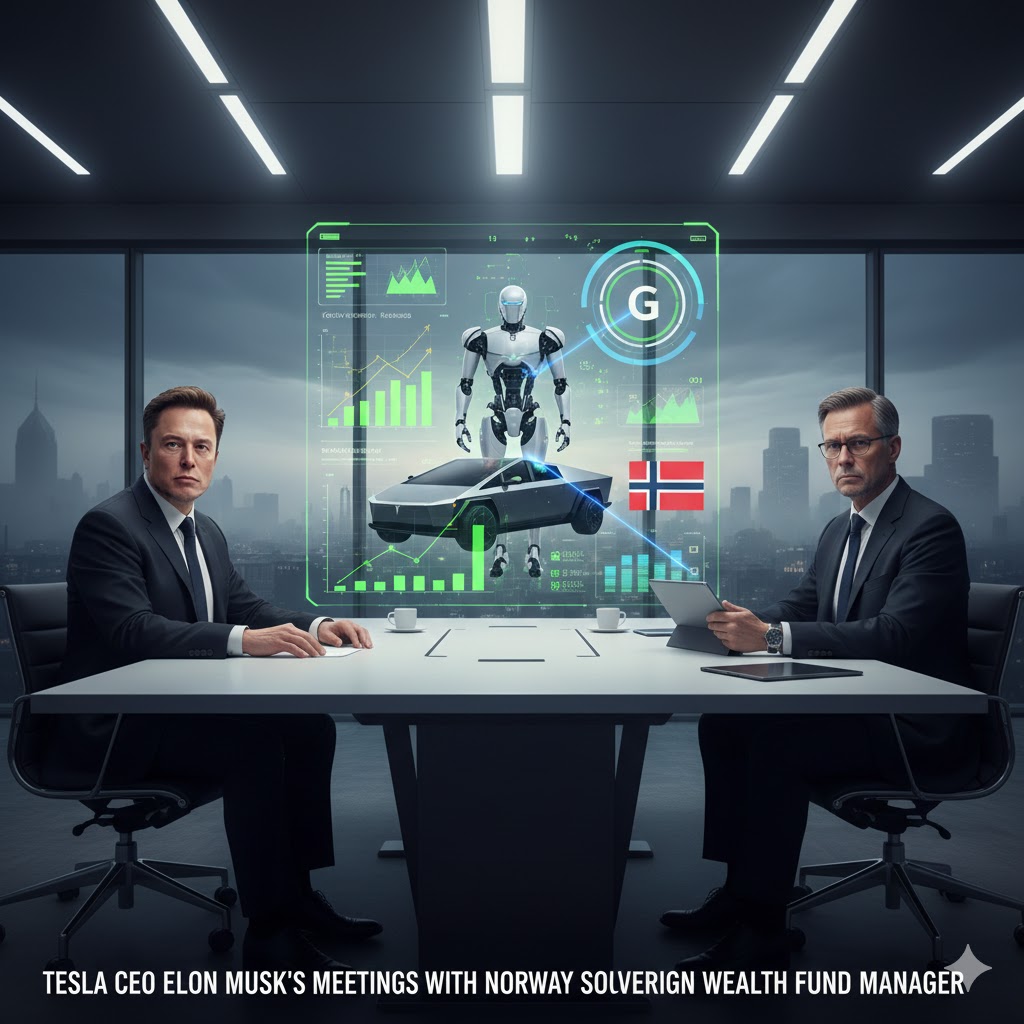
From a financial perspective, Tesla’s recent performance provides the necessary context for why these meetings carry such weight. In the fiscal reports for the latter half of 2025, Tesla showcased a company at a crossroads. While total revenue for the year approached the $110 billion mark, the automotive gross margin—once the envy of the industry at over 25%—has stabilized in the 17% to 19% range following aggressive price cuts throughout 2024 and 2025. This margin compression is a primary point of discussion for fund managers like Tangen, who must balance the fund’s commitment to sustainable energy with its fiduciary duty to maximize returns for the Norwegian people. The fund’s interest lies in whether Tesla can successfully monetize its Full Self-Driving (FSD) software and the “Optimus” humanoid robot to recover the high-margin profile that justified its trillion-dollar valuation peaks.
The operational focus of these high-level meetings also touches upon Tesla’s expansion in Europe, where the Giga Berlin-Brandenburg facility has faced significant labor hurdles. Norway, being the global leader in EV adoption per capita, serves as a critical barometer for Tesla’s market health. However, the Nordic region has also been the site of intense collective bargaining disputes. Musk’s well-known stance against labor unions has clashed with the social democratic values of the Norwegian and Swedish investment communities. NBIM has a clear mandate to promote responsible business practices, and Tangen’s role is to ensure that Tesla’s operational efficiency does not come at the cost of long-term social stability, which could pose a systemic risk to the fund’s diversified portfolio.
Beyond governance, the technological roadmap discussed in these private sessions likely involves Tesla’s “unboxed” manufacturing process and the integration of its Dojo supercomputer. For a sovereign wealth fund with a decades-long horizon, the shift toward AI is the most compelling part of the Tesla narrative. NVIDIA Corporation (NASDAQ:NVDA) has recently seen its valuation soar due to the AI infrastructure boom, and Musk is keen to position Tesla as a primary beneficiary of this trend. By demonstrating the progress of FSD v13 and the training efficiency of the Dojo cluster, Musk is attempting to convince Tangen and other institutional titans that Tesla’s R&D spending—which hit a record $4.8 billion in 2025—is an investment in a global autonomous network rather than just a car company.
The competitive landscape in 2026 makes this institutional support even more vital. Chinese competitors such as BYD Co. Ltd. (OTC:BYDDF) and Xiaomi Corporation (OTC:XIACY) have narrowed the gap in battery technology and software integration, often at a lower price point. Meanwhile, traditional luxury brands like Porsche Automobil Holding SE (OTC:POAHY) and Mercedes-Benz Group AG (OTC:MBGYY) are finally seeing significant traction with their high-end EV offerings. In this environment, Tesla (NASDAQ:TSLA) must rely on its “brand moat” and its energy storage business. Tesla Energy has become the “quiet hero” of the balance sheet, with Megapack deployments growing at an annual rate of over 70%, contributing a larger share of the net income than ever before. This diversification into energy infrastructure aligns perfectly with the Norway fund’s long-term sustainability goals, providing a common ground for Musk and Tangen.
Another critical topic in the Musk-Tangen dialogue is the future of Tesla’s board of directors. Institutional investors have frequently expressed concern over the board’s independence, given Musk’s multiple commitments across SpaceX, X (formerly Twitter), and xAI. The recent addition of new independent directors in 2025 was seen as a concession to the demands of large shareholders like NBIM and The Vanguard Group. However, the market remains wary of “key-man risk.” Musk’s meetings with the Norway fund manager are part of a broader “charm offensive” to prove that he remains fully committed to Tesla’s mission despite his myriad of other ventures. The stability of Tesla’s leadership is a prerequisite for the fund to maintain, or potentially increase, its multi-billion-dollar position.
The financial data supports a cautious optimism. Tesla’s free cash flow remained robust at approximately $8.5 billion for the 2025 fiscal year, even as it ramped up capital expenditure for the “Cybercab” production lines. For NBIM, which prioritizes companies with strong cash flow to fund its annual withdrawals for the Norwegian government, Tesla’s ability to self-fund its AI revolution without significant dilution is a key metric. This capital discipline is a recurring theme in Tangen’s public statements on portfolio companies, and Musk’s recent pivot toward “fiscally responsible innovation” appears to be a direct response to such institutional pressures.
Market sentiment in early 2026 has been heavily influenced by the “sovereign wealth effect.” When the Norges Bank Investment Management publishes its annual holdings report, the inclusion or exclusion of certain names can trigger significant capital movements globally. By engaging in direct, transparent dialogue with Tangen, Musk is attempting to secure Tesla’s place as a “core holding” in the world’s most important portfolios. This is especially important as the fund moves toward more rigorous carbon-accounting standards. Tesla (NASDAQ:TSLA), by its very nature, helps the fund meet its net-zero objectives, but it must also meet the “G” in ESG to remain a preferred investment.
Furthermore, the business development aspect of these meetings cannot be overlooked. Norway’s sovereign wealth fund is not just an investor; it is a gateway to the broader European political and economic ecosystem. As Tesla considers locations for its next European Gigafactory—with Spain, France, and Italy all competing for the investment—the insights from a manager of a fund that owns nearly 1.5% of all listed companies globally are invaluable. Tangen provides Musk with a high-level perspective on European regulatory trends, particularly the EU’s “Artificial Intelligence Act” and its impact on autonomous vehicle deployment.
Tesla’s expansion into the “Cybercab” and Robotaxi market, scheduled for a mass rollout in late 2026, requires not just technological readiness but regulatory and social acceptance. The meetings in Oslo likely touched upon how Tesla can work with European municipalities to integrate autonomous fleets into existing public transport frameworks. For NBIM, which also holds significant stakes in traditional transport and logistics companies like Deutsche Post AG (OTC:DPSGY) and A.P. Møller – Mærsk A/S (OTC:AMKBY), Tesla’s disruption of the mobility sector has far-reaching consequences for its entire portfolio.
The data-driven approach of the Norway fund means that Musk must come to the table with more than just vision; he must bring evidence. The 2025 impact report from Tesla (NASDAQ:TSLA) highlighted a 30% reduction in the cost-per-mile of FSD training, a figure that is central to the “Tesla as a Service” (TaaS) bull case. If Tesla can prove that its software margins will eventually mirror those of Microsoft Corporation (NASDAQ:MSFT) or Oracle Corporation (NYSE:ORCL), the current volatility in its stock price will be seen as a mere footnote in its long-term ascent. Tangen’s job is to verify these claims through rigorous analysis of Tesla’s technical debt and competitive positioning.
In the broader context of the 2026 global economy, characterized by “higher-for-longer” interest rates and geopolitical shifts, the alliance between visionary founders and stable, long-term capital providers is the new cornerstone of market stability. The Musk-Tangen meetings symbolize the “new diplomacy” of the corporate world, where CEOs of multinational giants must negotiate with sovereign entities as peers. For Tesla (NASDAQ:TSLA), the road to $2 trillion in market capitalization passes through the boardroom in Oslo. By aligning Tesla’s AI-driven future with the Norges Bank’s sustainability and governance requirements, Musk is attempting to build a foundation that can withstand the inevitable cycles of the automotive industry.
The fiscal year 2026 will likely be remembered as the year Tesla transitioned from an “EV company” to an “AI and Energy” conglomerate. The success of this transition depends on the continued support of the world’s most powerful institutional investors. As the Norway fund manager continues to evaluate Tesla’s performance against its strict ESG and financial benchmarks, the ongoing dialogue between Musk and Tangen will remain a focal point for the global investment community. For the average investor, these meetings are a signal that even the most disruptive figures in tech must eventually answer to the patient, disciplined power of sovereign capital.
As Tesla (NASDAQ:TSLA) prepares for its next phase of growth—including the launch of the Model 2 and the scaling of the 4680 battery cells—the feedback from NBIM will be instrumental in shaping its capital allocation strategy. Whether it is through share buybacks, which the fund generally encourages when companies have excess cash and undervalued stock, or through continued aggressive R&D, Tesla’s path is now inextricably linked to the expectations of the Norwegian people’s wealth. The meetings in Oslo are not just about a pay package or a board seat; they are about the future of the global energy and transportation paradigm.
Looking ahead, the market will be watching for the next filing from the Norges Bank to see if their position in Tesla has shifted. A significant increase in their stake would be the ultimate “green light” for the market, suggesting that Musk has successfully addressed the fund’s governance concerns. Conversely, a reduction would signal that the gap between Musk’s vision and the fund’s requirements remains too wide to bridge. For now, the “diplomacy of the sovereign” continues, with Elon Musk and Nicolai Tangen at the center of a conversation that defines the future of 21st-century capitalism.
Tesla’s ability to maintain its lead in the “Auto-AI” space while satisfying the demands of the world’s most rigorous ESG investor is perhaps the greatest challenge of Musk’s career. It requires a balance of innovation and institutional humility—a combination that has not always been Musk’s strongest suit. However, the sheer scale of the Norway fund’s influence makes it an unavoidable partner. As the 2026 proxy season approaches, the fruits of these private meetings will become public, manifesting in voting patterns and strategic shifts that will ripple through the NASDAQ and beyond.
Ultimately, the story of Tesla CEO Elon Musk’s meetings with the Norway sovereign wealth fund manager is a story of accountability. In a world of fleeting “meme stocks” and quarterly-earnings obsession, NBIM represents the “long money” that demands sustainable, ethical, and predictable growth. If Musk can convince Tangen that Tesla is the ultimate long-term vehicle for both profit and planetary health, he will have secured the most important ally in his quest to change the world. The outcome of this “summit” in Oslo may well be the most important indicator for Tesla’s stock performance in the second half of the decade.
Leave a Reply