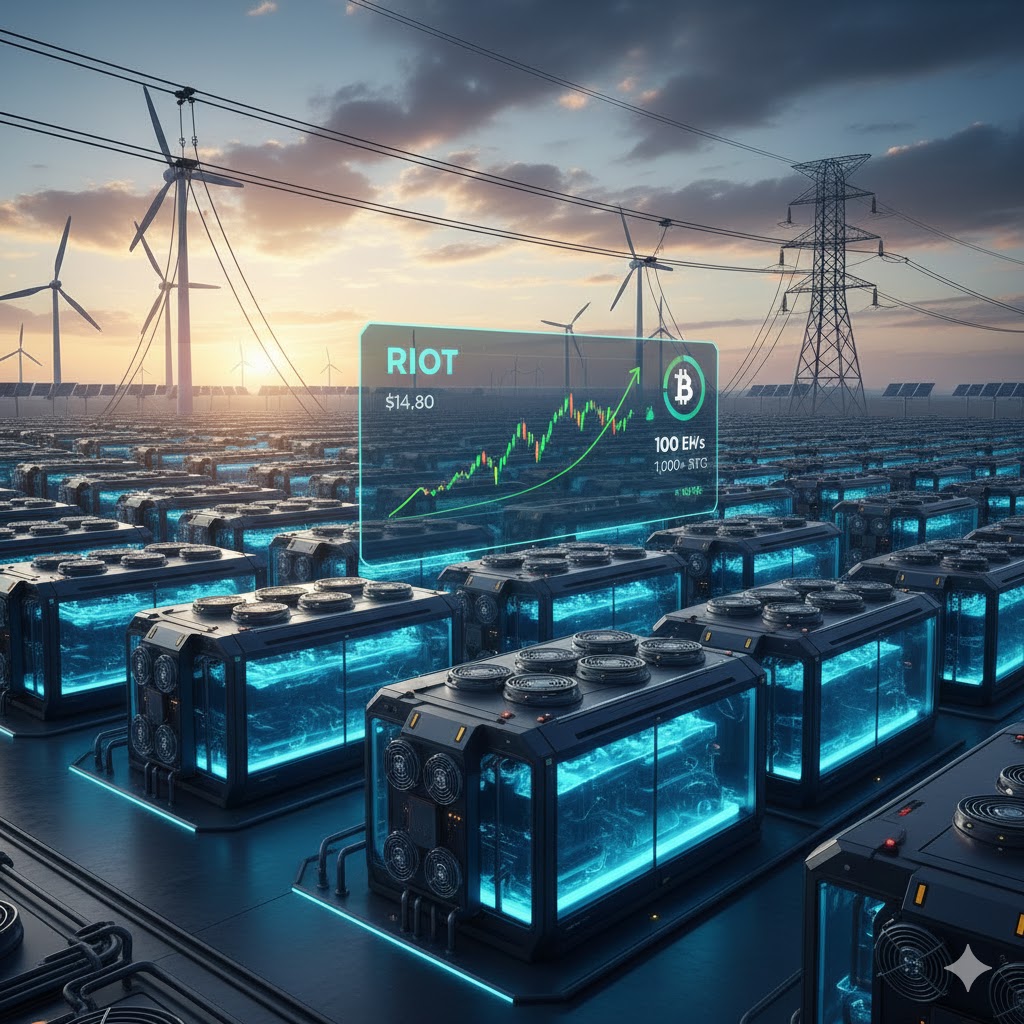
The final trading sessions of 2025 have delivered a surge of volatility and optimism across the digital asset landscape. On December 30, Bitcoin (BTC) staged a rapid short-term rally, gaining nearly 2% and inching closer to the psychological milestone of $89,000. This momentum immediately cascaded into the equity markets, where crypto-proxies and blockchain infrastructure stocks witnessed significant upward movement. Circle rose over 2.5%, while MicroStrategy and Riot Platforms (NASDAQ: RIOT) both climbed nearly 2% in early trading. As Riot Platforms trades around $14.80, the company stands at a pivotal junction, transitioning from a pure-play Bitcoin miner into a vertically integrated energy and infrastructure powerhouse.
This analysis provides an exhaustive deep dive into Riot Platforms’ operational machinery. We will examine the company’s financial standing, its aggressive hash rate expansion targets, its unique energy strategy in Texas, and the technological shifts that are redefining its competitive moat in an increasingly crowded sector. By dissecting the balance sheet and the operational roadmap, this report aims to provide institutional-level clarity on one of the most significant players in the global decentralized compute industry.
Financial Foundation: Liquidity as a Strategic Weapon
Riot Platforms has consistently maintained one of the most robust balance sheets in the Bitcoin mining sub-sector. As of late 2025, the company holds zero long-term debt, a rarity in a capital-intensive industry known for high leverage. This “fortress balance sheet” strategy was validated throughout the post-2024 halving cycle, allowing Riot to acquire distressed assets and invest in new capacity while competitors struggled with debt servicing.
According to the company’s most recent quarterly disclosures, Riot maintains over $600 million in cash and cash equivalents, supplemented by a Bitcoin treasury exceeding 10,000 BTC. With Bitcoin prices nearing $89,000, the fair market value of Riot’s digital holdings alone is approaching $900 million, providing a massive liquidity cushion. The company’s revenue for the fiscal year 2025 is projected to grow by 35% to 40% year-over-year, driven not only by Bitcoin production but also by its significant “Energy Credit” revenue stream. Riot’s ability to generate cash flow in a high-interest-rate environment stems from its low direct cost of production, which remains below the industry average due to its long-term power purchase agreements (PPAs).
Operational Scaling: The Path to 100 EH/s
Riot’s core business development is defined by its “Vision 2027” roadmap, which targets a total self-mining hash rate capacity of 100 EH/s (Exahashes per second). As of December 30, 2025, Riot’s operational hash rate has successfully crossed the 32 EH/s mark, a massive leap from the 12.4 EH/s recorded just eighteen months prior. This growth is centered around the massive development of the Corsicana Facility.
The Corsicana project is currently the largest dedicated Bitcoin mining facility in the world. Once fully developed, it is expected to have a capacity of 1 gigawatt (1,000 megawatts). The first phase of this facility has already brought hundreds of megawatts online, utilizing the latest MicroBT Whatsminer M60 series rigs. These machines are significantly more energy-efficient than previous generations, operating at an efficiency of roughly 18.5 J/TH (Joules per Terahash). By upgrading its fleet to these high-spec miners, Riot is effectively lowering its “all-in” mining cost, ensuring that the company remains profitable even if Bitcoin price volatility increases or global network difficulty spikes.
The Energy Arbitrage Engine: The Texas Advantage
Perhaps the most misunderstood aspect of Riot Platforms is its role as an energy infrastructure player. Operating primarily within the ERCOT (Electric Reliability Council of Texas) grid, Riot employs a sophisticated “Demand Response” strategy. When electricity demand in Texas peaks—such as during extreme weather events—Riot curtails its power consumption and sells its pre-purchased energy back to the grid at spot prices.
In 2025, this energy strategy has become a primary driver of financial performance. In months where Bitcoin prices were stagnant, Riot frequently earned $15 million to $30 million in power credits, which effectively act as a negative cost of production. This symbiotic relationship with the Texas grid makes Riot a critical stabilizer for the state’s energy infrastructure. For investors, this provides a unique “hedge”: the stock benefits from Bitcoin price appreciation but also gains from energy market volatility. This dual-revenue model is a cornerstone of Riot’s market expansion strategy as it looks to replicate this infrastructure model in other jurisdictions.
Technological Development: Immersion Cooling and Beyond
Riot is at the forefront of the shift from traditional air-cooling to liquid immersion cooling. In an immersion setup, mining rigs are submerged in a specialized dielectric fluid that removes heat more efficiently than air. This allows the machines to be “overclocked” for higher performance without the risk of thermal degradation.
The company has successfully transitioned a significant portion of its Rockdale facility to immersion cooling, reporting a 25% to 30% increase in hash rate per machine and a substantial reduction in failure rates. This technological advancement is not just about mining more Bitcoin; it is about extending the lifecycle of multimillion-dollar hardware. As Riot moves into 2026, the company is exploring the use of these cooling systems for high-performance computing (HPC) and AI data centers, signaling a potential pivot into the broader “Compute-as-a-Service” market.
Market Dynamics and Regulatory Landscape
The market for Bitcoin mining stocks has matured significantly. Riot is no longer being traded purely as a “leveraged bet on Bitcoin.” Instead, institutional analysts are increasingly valuing the company based on its “infrastructure value”—the worth of its power substations, land, and data center shells.
On the regulatory front, Riot has been a leader in the “Clean Energy” mining movement. The company has actively participated in industry-led initiatives to increase transparency regarding carbon footprints. By utilizing a mix of renewable energy sources and participating in grid stabilization, Riot is positioning itself to be compliant with potential future ESG (Environmental, Social, and Governance) mandates from the SEC. This proactive stance is essential for attracting long-term institutional capital that requires strict adherence to sustainability standards.
Strategic Risks and Performance Metrics
While the outlook is positive, Riot faces several structural risks. The primary concern is the Global Hash Rate. As more miners worldwide upgrade their hardware, the difficulty of mining a single Bitcoin increases. Riot must continue its aggressive CapEx (Capital Expenditure) cycle just to maintain its share of the total network.
Furthermore, the “Halving” cycles of Bitcoin remain the ultimate test of survival. The 2024 halving cut the block reward from 6.25 BTC to 3.125 BTC, putting immense pressure on margins. Riot’s response—expanding scale to achieve lower unit costs—is the only viable long-term strategy. Analysts will be closely watching the company’s Direct Cost per Bitcoin Mined, which is expected to stay in the $20,000 to $25,000 range throughout 2026, assuming power prices remain stable.
Conclusion: A Macro Pillar of the Digital Economy
Riot Platforms has evolved far beyond its origins as a small-scale mining operation. As of the end of 2025, it is a sophisticated energy-tech conglomerate that uses Bitcoin mining as a way to monetize electricity at maximum efficiency. The December 30 price action, seeing the stock rise alongside Bitcoin’s approach to $89,000, is a testament to its status as the “Gold Standard” for crypto-equity exposure.
With the Corsicana facility scaling up, a fleet of state-of-the-art M60 miners, and a debt-free balance sheet, Riot is uniquely positioned to dominate the next phase of the digital asset era. Whether it continues to focus solely on Bitcoin or eventually expands its high-density data centers to serve the AI revolution, the company’s infrastructure is its most valuable asset. For those monitoring the intersection of energy, finance, and decentralized technology, Riot Platforms remains the quintessential case study in vertical integration.
Leave a Reply