The digital infrastructure of the 2020s has been characterized by a fierce race for ecosystem dominance, moving from the mobile screens of the last decade to the immersive, spatial interfaces of the next. At the forefront of this evolution is Meta Platforms (NASDAQ: META), a company that has undergone one of the most significant rebrandings in corporate history to align itself with the “metaverse” vision. As of early 2026, a critical component of this strategy has matured: the opening of its operating system to third-party manufacturers.
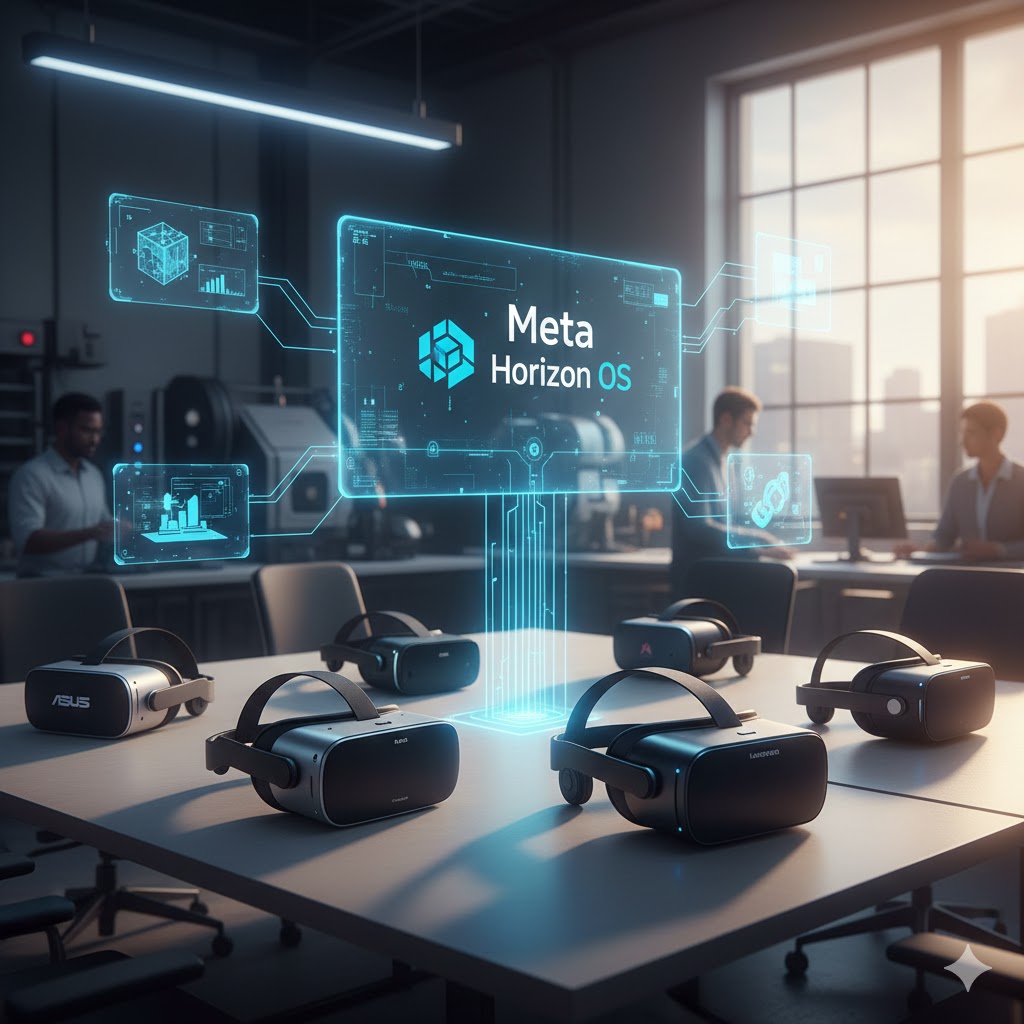
This strategic pivot is designed to foster a diversified hardware ecosystem powered by Meta Horizon OS. By collaborating with global hardware titans such as ASUS, Lenovo, and LG, Meta is attempting to commoditize the virtual reality (VR) and mixed reality (MR) hardware market while maintaining control over the software layer and the high-margin “Horizon Store” digital marketplace. For investors and market analysts, this move is a high-stakes play to achieve scale in the spatial computing era, directly challenging the “walled garden” approach of Apple’s VisionOS and the emerging Android XR ecosystem.
The Financial Rationale: Scaling Beyond First-Party Hardware
For years, Meta’s Reality Labs division has been the subject of intense scrutiny on Wall Street. Despite generating billions in revenue—primarily through the Quest headset lineup—the division has consistently reported quarterly operating losses ranging between $3.8 billion and $4.8 billion throughout 2024 and 2025. These losses are largely attributed to the massive R&D costs required to develop leading-edge hardware like the Quest 3 and the high-end Quest Pro series.
By collaborating with third-party hardware companies, Meta is effectively outsourcing the capital-intensive manufacturing and logistics risks of hardware production. In the 2025 fiscal year, Meta’s capital expenditures reached a staggering $70 billion, driven heavily by AI infrastructure and the build-out of metaverse technologies. Transitioning to a licensing model for Meta Horizon OS allows the company to focus its resources on software innovation and AI integration—areas where it enjoys significantly higher margins.
The revenue model for this new ecosystem is two-pronged. First, Meta earns licensing fees from partners who use Horizon OS to power their devices. Second, and more importantly, every third-party headset sold becomes a gateway into the Meta Horizon Store. Similar to how Google doesn’t need to manufacture every Android phone to profit from the Play Store, Meta is positioning itself to take a 30% cut of digital software sales across an exponentially larger fleet of devices than it could produce on its own.
Strategic Partnerships: Specialized Hardware for Diverse Use Cases
The collaborations mentioned in the “Meta Horizon” initiative are not generic; they are targeted at specific market segments where Meta’s first-party Quest devices have faced limitations.
- ASUS Republic of Gamers (ROG): The partnership with ASUS is specifically focused on the high-performance gaming segment. ROG is expected to develop a “Performance Gaming Headset” that leverages its expertise in thermal management and high-refresh-rate displays. By catering to “hardcore” gamers who find the standalone Quest 3 insufficient for long-duration, high-fidelity VR gaming, Meta ensures its OS remains the standard for the gaming community.
- Lenovo Group: Lenovo’s role is centered on “Productivity and Learning.” Leveraging its dominance in the global PC market and its established relationships with enterprise and educational institutions, Lenovo is developing Horizon OS devices optimized for virtual workstations and remote collaboration. This is a direct counter to the productivity-first narrative of the Apple Vision Pro.
- LG Electronics: Although the partnership has seen various phases of “calibration,” LG’s contribution is expected to involve high-end OLED-on-Silicon (OLEDoS) display technology, potentially for a “Premium” tier of Horizon OS devices.
These partnerships allow Meta to penetrate specialized markets without having to design multiple, distinct hardware versions of the Quest. This “platform-as-a-service” approach is a classic move to achieve market share dominance in the early stages of a new computing paradigm.
Product Development and the Integration of AI
A major theme for Meta in 2026 is the convergence of VR hardware and artificial intelligence. The new generation of headsets developed under the “Meta Horizon” banner are expected to feature integrated Meta AI agents. These agents utilize the device’s outward-facing cameras and microphones to provide real-time contextual assistance, such as translating foreign text in the user’s view or providing instructions for complex manual tasks in mixed reality.
Technically, these devices are increasingly reliant on the Snapdragon XR2 Gen 3 platform, developed in close partnership with Qualcomm. This chipset is optimized for “Spatial Intelligence,” allowing third-party headsets to perform high-fidelity passthrough and hand-tracking with lower latency and power consumption. The progress of the Meta Quest 4, expected to be the flagship reference device for the ecosystem in late 2026, will likely set the benchmark for these third-party collaborations.
Market Dynamics: The Android of the Metaverse?
The competitive landscape in 2026 is markedly different from the early days of the Oculus Rift. Meta is no longer just competing against gaming consoles; it is competing against the entire mobile ecosystem. The primary threat to Meta Horizon OS is not Apple—which remains a luxury, low-volume player—but rather Android XR. Google’s recent aggressive push into spatial computing, in partnership with Samsung and Sony, mirrors the smartphone wars of 2010.
By opening up Horizon OS now, Meta is racing to establish a “critical mass” of users and developers before Android XR can achieve a foothold. The “Horizon Store” already boasts over 3,000 apps and games, a massive lead in terms of content. For a developer, the decision to build for Horizon OS is becoming increasingly easy: if the OS is available on ASUS, Lenovo, and Meta hardware, the potential reach is significantly higher than any single-manufacturer platform.
Financial Health and Reality Labs Revenue Growth
While Reality Labs continues to operate at a loss, the revenue trajectory is showing signs of acceleration. In the third quarter of 2025, Reality Labs revenue surpassed $1.1 billion, representing a 45% year-over-year increase. This growth was driven by strong sales of the Quest 3S and the surprising success of the Ray-Ban Meta smart glasses.
The move to collaborate with third parties is expected to further boost this revenue. Analysts predict that by 2027, “Software and Service” revenue from third-party devices could account for 15-20% of Reality Labs’ total top line. This shift toward a recurring, high-margin revenue stream is what long-term investors are looking for to justify Meta’s continued “all-in” metaverse spending.
Risks and Challenges in the Licensing Model
Despite the strategic benefits, the “Meta Horizon” collaboration model is not without risks. Managing a fragmented hardware ecosystem is notoriously difficult. Meta must ensure that the user experience remains consistent across devices with different screen resolutions, sensor arrays, and processing power. If an ASUS headset provides a subpar experience compared to a Lenovo one, it could damage the “Horizon” brand.
Furthermore, there is the risk of “cannibalization.” If Lenovo produces a productivity headset that is significantly better than Meta’s own offerings, it could sap sales from Meta’s hardware division. However, from Mark Zuckerberg’s perspective, it is better to have a user on a Lenovo headset running Meta software than to lose that user entirely to an Apple or Samsung ecosystem.
Conclusion: A Platform-First Future
The headline, “Meta Meta Collaborates With Hardware Companies To Develop Vr Headsets For Meta Horizon,” signals the end of the “experimentation” phase of the metaverse and the beginning of the “ecosystem” phase. Meta is no longer trying to be the only company making the metaverse; it is trying to be the company that runs it.
For the 2026 fiscal year and beyond, the success of Meta will be measured not just by how many Quest headsets it sells, but by how many third-party devices are activated on the Horizon platform. If Meta can successfully navigate the complexities of hardware licensing and maintain its lead in AI-integrated software, it may very well become the “Windows of Spatial Computing.” While the financial “burn” of Reality Labs remains a concern, the transition to a platform model offers a clearer, more scalable path to profitability. Investors will be watching the late-2026 launch of these partner devices as the ultimate proof of concept for Meta’s grand platform strategy.
Leave a Reply