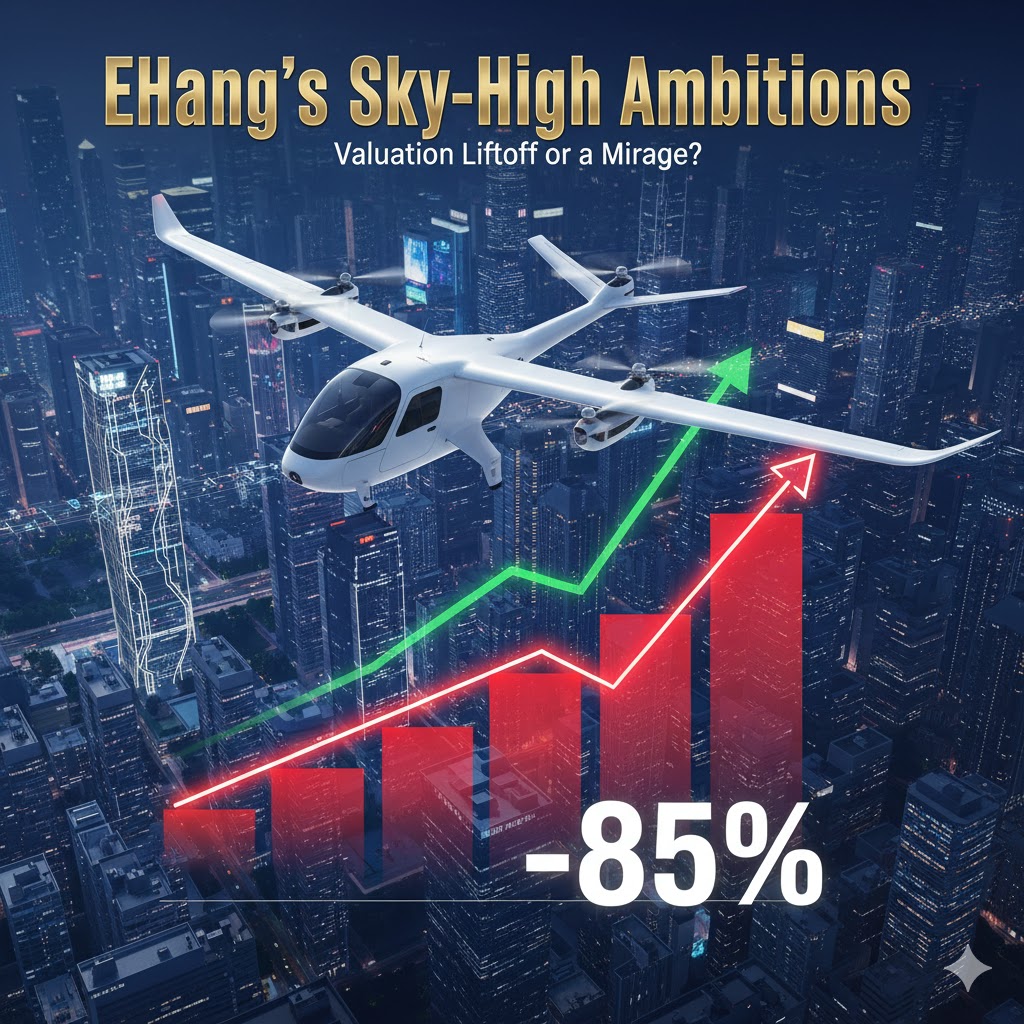
The future of urban air mobility (UAM) has long been a domain of ambitious startups and visionary engineers. Yet, few companies embody the volatile promise and profound risks of this nascent sector as vividly as EHang Holdings Ltd. (NASDAQ: EH). On December 28, 2025, the company announced a significant milestone: the successful public maiden flight of its new generation long-range compound wing unmanned eVTOL (electric Vertical Take-off and Landing) aircraft, the VT35, at Feidong Bailong Airport in Hefei, Anhui Province. This event, heralded by EHang as a leap forward, reignites the perennial debate among investors: Is EHang’s current valuation an astronomical overestimation of a distant dream, or is it an astute bet on a company poised to dominate the skies of tomorrow?
While the market often reacts with euphoria to such technological demonstrations, a deeper, more rigorous financial analysis suggests that EHang remains a highly speculative “Sell” at its current price levels. Despite impressive engineering feats, the path to commercial viability is fraught with regulatory hurdles, intense competition, and a business model that, for now, remains more theoretical than proven. The VT35’s flight, while technically significant, does not fundamentally alter the precarious financial foundation upon which EHang’s lofty valuation rests.
The Specter of Regulatory Realities
EHang’s core ambition is to deploy autonomous eVTOLs for passenger transport and logistics. The successful flight of the VT35—a compound wing design implying longer range and higher speed than its earlier multicopter designs—underscores its engineering prowess. However, the operational environment for autonomous passenger aircraft is perhaps the most complex regulatory challenge facing any industry today.
In China, EHang has been a pioneer in securing Type Certificate (TC) and Standard Airworthiness Certificate (SAC) for its EH216-S model for specific low-altitude tourism routes. While this is a critical first step, the VT35 aims for longer-range capabilities, pushing into airspaces that are currently governed by stringent regulations for piloted aircraft, let alone autonomous ones. The certification process for a new aircraft type, especially one operating in urban environments and at higher altitudes, can take years, if not a decade, and involve billions in R&D and safety testing. The cost and timeline for the VT35 to achieve broad commercial passenger operation are often underestimated by the market, leading to an inflated perception of near-term revenue potential.
A Look at the Numbers: The Valuation Overhang
As of late December 2025, EHang’s stock has experienced significant volatility, often spiking on news of successful test flights or regulatory progress before retreating. Its market capitalization fluctuates, but even at modest levels, it appears detached from its current revenue and profitability metrics.
EHang’s financials reveal a company in the very early stages of commercialization. While revenues have shown growth, they remain negligible when compared to the company’s valuation. Operating expenses, particularly in R&D and certification, are substantial. The company is, by definition, pre-profitability, and its cash burn remains a significant concern.
- Revenue: EHang’s quarterly revenues are in the low tens of millions of USD, primarily from initial EH216-S deliveries and associated services. This pales in comparison to the billions of dollars in market capitalization it has commanded at various points.
- Net Income/Loss: Consistently negative, reflecting heavy investment in R&D and operational scale-up without commensurate revenue generation.
- Cash Flow: The company relies heavily on financing activities to fund its operations, raising questions about its long-term financial sustainability without significant external capital injections.
- Price-to-Sales (P/S) Ratio: Often in the hundreds or even thousands, indicating that investors are betting almost entirely on future growth with little regard for current sales. This is typical for pre-revenue growth stocks but becomes problematic when the path to revenue is unclear or prolonged.
The VT35’s flight does not immediately translate into a new revenue stream. It is a technological proof-of-concept. The market, however, tends to price in these future possibilities as if they are imminent certainties, leading to a significant overvaluation based on current financial realities.
The Competition Crucible: A Crowded Sky
EHang is not alone in the eVTOL race. The UAM sector is a magnet for innovation and capital, attracting a formidable roster of competitors, many of whom possess deeper pockets and more established aerospace expertise.
- Joby Aviation (NYSE: JOBY): Backed by Toyota and Delta Air Lines, Joby is targeting FAA certification in the U.S. and has a clear focus on piloted operations initially. Its strategic partnerships offer a robust commercialization pathway.
- Archer Aviation (NYSE: ACHR): Partnered with Stellantis and United Airlines, Archer is also pursuing U.S. certification with a focus on ride-sharing in major cities.
- Lilium (NASDAQ: LILM): A European player with a unique “ducted fan” design, focused on regional air mobility and backed by significant aerospace investment.
- Hyundai Supernal, Volocopter, Beta Technologies: Each brings its own technological approach and strategic alliances, forming a crowded field where EHang must constantly innovate to maintain its edge.
EHang’s advantage lies in its focus on autonomy and its progress within the Chinese regulatory framework. However, the autonomous passenger eVTOL market faces a higher bar for public acceptance and regulatory approval globally. While the VT35 promises longer ranges, so do some of its competitors, often with more conservative, phased approaches to autonomy (starting with pilots). EHang’s “first-mover” advantage in Chinese certification for a specific use case does not guarantee dominance in the broader, more complex global UAM market that the VT35 hints at.
Technology vs. Commercialization: Bridging the Chasm
The VT35 is described as a “long-range compound wing” eVTOL. This design choice is critical. Compound wings typically offer greater efficiency at higher speeds and longer ranges than pure multi-copters (like EHang’s EH216-S). This is essential for moving beyond short-hop tourism and into inter-city or more substantial logistics applications.
However, moving from a successful test flight to mass production and commercial deployment involves overcoming a monumental chasm:
- Manufacturing Scale: Building hundreds or thousands of these sophisticated aircraft requires industrial-scale manufacturing capabilities, a robust supply chain, and stringent quality control, all of which demand massive capital investment.
- Infrastructure Development: eVTOLs require specialized “vertiports” for take-off, landing, charging, and maintenance. Building this infrastructure in urban areas is a significant logistical and financial challenge, requiring collaboration with local governments and real estate developers.
- Public Acceptance: Convincing the public that autonomous aircraft are safe, reliable, and necessary requires an extensive public education campaign and an impeccable safety record. Even a single incident could set the industry back years.
The VT35’s flight, while impressive from an engineering standpoint, does not provide any new data on these critical commercialization hurdles. The market continues to conflate technological progress with imminent commercial success, leading to an overblown valuation for EHang.
The Elephant in the Room: Deliveries vs. Orders
EHang has historically announced numerous “pre-orders” or “strategic partnerships” that, while encouraging, often do not translate directly into immediate, binding deliveries or substantial revenue. The true test of EHang’s commercial viability will be its ability to convert these agreements into consistently increasing aircraft deliveries and, more importantly, recurring service revenues from operating routes.
The VT35 is currently a prototype. Its certification and eventual entry into service are years away. Investors who buy EHang today are betting on a very distant future, accepting substantial risk without the commensurate near-term financial visibility that would justify its current market cap. The company’s communication strategy often focuses on these early-stage achievements, sometimes overshadowing the immense execution risk that remains.
Investment Verdict: A Risky Bet on a Distant Horizon
For investors seeking high-growth opportunities, the allure of EHang’s vision is undeniable. The idea of autonomous air taxis transforming urban transport is compelling. However, the investment proposition for EHang Holdings Ltd. at its current valuation remains skewed heavily towards risk.
The successful flight of the VT35 is a technological achievement, but it does not fundamentally alter the financial calculus. EHang remains a pre-profitability company operating in a nascent, highly regulated, and fiercely competitive sector. The path to significant, sustainable revenue generation is long, expensive, and filled with uncertainties.
Therefore, the recommendation for EHang Holdings Ltd. is a “Sell.” Investors should either liquidate their positions or, if they insist on exposure to UAM, seek out companies with more diversified revenue streams, clearer certification pathways (e.g., piloted operations first), stronger balance sheets, or more concrete strategic partnerships that mitigate some of the immense execution risk.
While EHang’s engineers continue to push the boundaries of aviation, its stock price continues to fly in speculative territory, detached from the grounded realities of commercialization. Until there is clearer evidence of large-scale production, substantial revenue growth, and robust profitability, the smart money should remain on the ground. The dream of autonomous air taxis is real, but EHang’s journey to profitability is still a very long flight away.
Leave a Reply