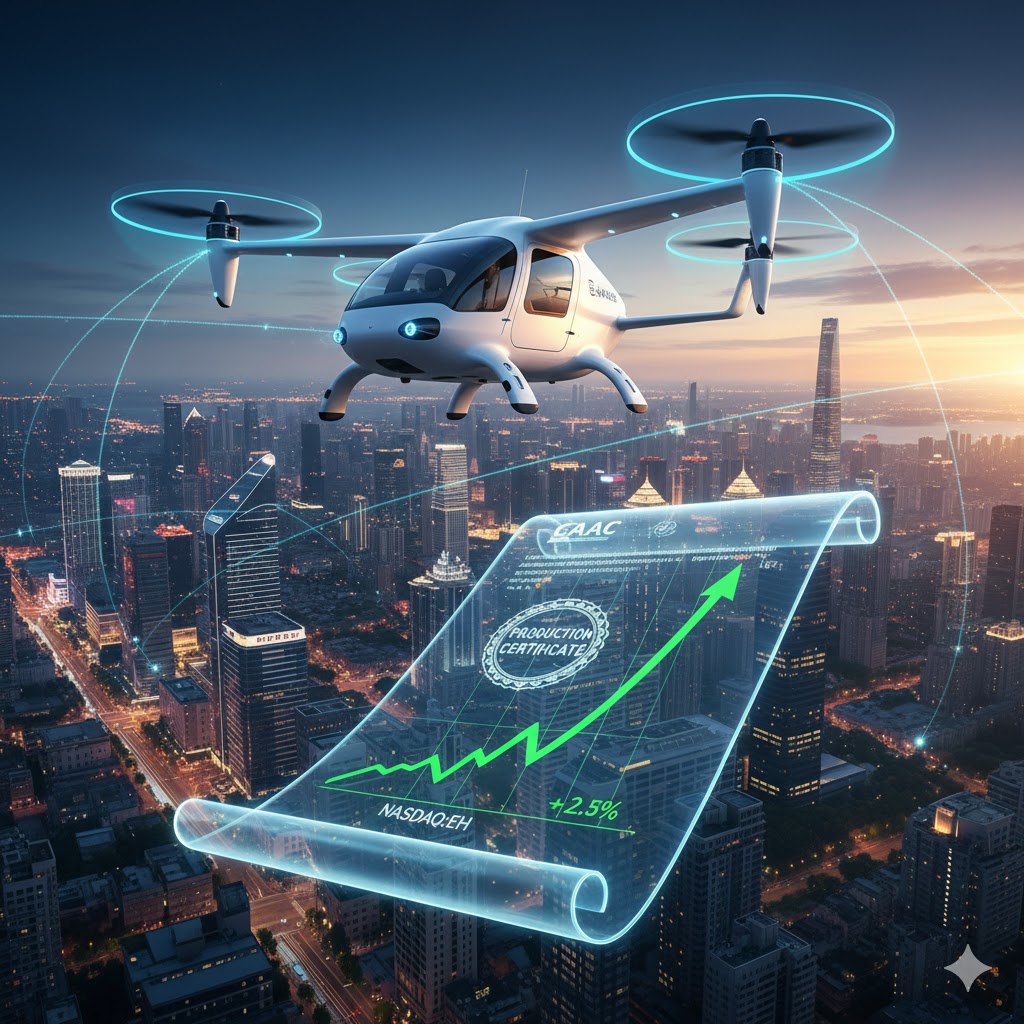
The global landscape of urban air mobility (UAM) shifted irrevocably in 2024 and 2025, but it is in early 2026 that the commercial reality of pilotless flight has finally taken flight at scale. At the epicenter of this industrial revolution is EHang Holdings Limited (NASDAQ:EH), which has fundamentally transitioned from a high-tech pioneer to a mass-production powerhouse. The defining moment for the company, and the broader sector, was the successful acquisition of the world’s first Production Certificate (PC) for a passenger-carrying pilotless electric vertical takeoff and landing (eVTOL) aircraft, issued by the Civil Aviation Administration of China (CAAC). This milestone, specifically for the EH216-S model, has catalyzed what is now being recognized as a vertical gold rush in China’s burgeoning “low-altitude economy.”
For institutional investors and global analysts, the significance of the production license cannot be overstated. While a Type Certificate (TC) proves that an aircraft design is safe, the Production Certificate proves that the manufacturer possesses the quality management and industrial rigor to replicate that safety across thousands of units. By securing this license, EHang (NASDAQ:EH) effectively cleared the most significant regulatory hurdle preventing the commercialization of autonomous air taxis. Consequently, the company’s manufacturing facility in Yunfu, Guangdong province, and its newer joint venture facility in Hefei, Anhui province, have moved into high gear, aiming for a combined annual capacity that targets nearly 1,000 units by the end of the current fiscal year.
The Macroeconomic Engine: China’s Strategic Low-Altitude Mandate
The “boom” in China’s low-altitude economy is not an accidental market trend but a result of a highly coordinated national strategy. In 2024, the low-altitude economy was officially designated as a “new productive force” in the Chinese central government’s work report, signaling a massive influx of state-led infrastructure investment and favorable policy adjustments. By 2026, the market scale of this sector in China is projected to exceed RMB 1 trillion (approximately $140 billion), with some forecasts from the CAAC suggesting it could reach RMB 3.5 trillion by 2035.
Local governments have been the primary drivers of this expansion. Shenzhen, for instance, has implemented the “Shenzhen Low-Altitude Economy Promotion Regulations,” providing a legislative framework for the integration of eVTOLs into city public transportation. Meanwhile, Guangzhou and Hefei have emerged as “smart city” hubs where EHang (NASDAQ:EH) has launched trial commercial operations. These municipalities are not merely providing permits; they are investing in the “digital skin” of the sky—the low-altitude service platforms and communication networks required to manage thousands of autonomous drones and air taxis simultaneously. For diversified technology firms like Baidu, Inc. (NASDAQ:BIDU), which provides mapping and AI infrastructure, and telecommunications giants like China Mobile Limited, the build-out of this infrastructure represents a massive new utility-scale opportunity.
Financial Performance: Revenue Surges and the Path to Profitability
EHang’s (NASDAQ:EH) financial trajectory throughout 2025 has mirrored the rapid scaling of its production capabilities. In its most recent quarterly financial report for the period ending September 30, 2025, the company reported total revenues of RMB 92.5 million, reflecting a significant year-over-year growth despite seasonal fluctuations and deferred deliveries. For the full year of 2025, the company maintained revenue guidance of RMB 500 million, a figure that analysts expect to be eclipsed in 2026 as the production backlog is converted into realized deliveries.
One of the most impressive aspects of EHang’s financial model is its gross margin, which has consistently hovered around the 60% mark. This high margin is a direct result of the company’s “first-mover” advantage and its vertical integration. Unlike Western competitors such as Joby Aviation, Inc. (NYSE:JOBY) or Archer Aviation Inc. (NYSE:ACHR), which are still navigating the rigorous FAA certification processes for piloted aircraft, EHang has already moved into the monetization phase for pilotless systems. This allows the company to avoid the massive ongoing pilot training and labor costs that are expected to burden Western UAM operators in their early years of service.
The company’s liquidity position also saw a strategic boost in late 2025 through an at-the-market (ATM) equity offering, which raised approximately $23.8 million. This capital has been earmarked for the continued development of the VT35, EHang’s longer-range model designed for inter-city travel. As of the start of 2026, EHang (NASDAQ:EH) maintains a cash and investments balance of roughly RMB 1.13 billion, providing a comfortable runway to reach non-GAAP profitability, which DBS Research predicts will occur by late 2026 or early 2027.
Diversifying the Product Portfolio: From Sightseeing to Inter-City Transit
While the EH216-S remains the flagship product for urban sightseeing and “last-mile” intra-city transport, 2026 is the year of the VT35. The VT35 is a long-range eVTOL with a flight distance of up to 300 kilometers, specifically designed to connect cities within major clusters like the Guangdong-Hong Kong-Macao Greater Bay Area. The initial delivery of the VT35 occurred in late 2025, and the company is now focused on the rigorous Type Certification process for this larger model.
EHang (NASDAQ:EH) has also strategically expanded the use cases for its existing EH216 platform. The EH216-F (firefighting version) and EH216-L (logistics version) have found significant traction among municipal emergency services. In mountainous regions or densely packed urban centers where traditional fire trucks or delivery vans struggle with congestion, these specialized AAVs (Autonomous Aerial Vehicles) offer a high-speed, high-efficiency alternative. By diversifying the application scenarios, EHang has insulated itself against potential slowdowns in any single market segment, such as tourism.
Global Expansion: Exporting the Low-Altitude Blueprint
Despite the “domestic-first” focus of its initial production license, EHang (NASDAQ:EH) has spent 2025 and early 2026 aggressively expanding its global footprint. The company has established a strategic partnership with the China Road and Bridge Corporation (CRBC) to act as a global agent, leveraging CRBC’s massive international infrastructure network to promote EHang’s products in Africa, the Middle East, and Southeast Asia. Recent successful human-carrying flight demonstrations in Qatar, Thailand, and Rwanda have demonstrated that the “Chinese model” of pilotless UAM is finding a receptive audience globally.
In Thailand, the company launched the “AAM Sandbox Initiative” in collaboration with the Civil Aviation Authority of Thailand (CAAT), aiming to establish commercial air taxi routes in high-traffic tourist areas like Phuket and Koh Samui by late 2026. This international expansion is critical for EHang (NASDAQ:EH) to mitigate the geopolitical risks associated with a China-only revenue stream. By securing operational approvals in diverse jurisdictions, EHang is building a global safety record that will be difficult for late-entering competitors to match.
Risk Factors and Competitive Challenges
Investors must, however, balance this optimism with a realistic assessment of the risks. The “low-altitude economy” is still a nascent sector, and the regulatory environment remains highly dynamic. While the CAAC has been exceptionally supportive, any major safety incident involving a pilotless eVTOL could lead to sudden regulatory tightening. Furthermore, the reliance on high-density lithium-ion batteries means that EHang (NASDAQ:EH) is exposed to the volatility of battery raw material prices, though partnerships with battery innovators like Anhui Jianghuai Automobile Group Corp., Ltd. (commonly known as JAC Motors) and Gotion High-tech Co., Ltd. (SZSE:002074) provide some supply chain security.
The competitive landscape is also intensifying. Domestic rivals like XPeng Inc. (NYSE:XPEV), through its subsidiary XPeng Aeroht, are making rapid progress with their own “flying car” designs. While EHang’s (NASDAQ:EH) focus remains on pure-play commercial UAVs, the cross-over in technology and talent is undeniable. In the Western markets, the eventual certification of Joby Aviation (NYSE:JOBY) and Lilium N.V. (NASDAQ:LILM) will create a different kind of competition for global export contracts, particularly in Europe and North America where FAA and EASA standards are the benchmark.
Conclusion: The Strategic Inflection Point
The year 2026 marks the definitive transition of the air taxi industry from “science fiction” to “industrial reality.” EHang’s (NASDAQ:EH) first production license was the key that unlocked this door, and the booming low-altitude economy in China has provided the ideal environment for the company to scale. With a record backlog, a high-margin business model, and a diversifying product line that now includes inter-city capabilities, EHang is no longer just a “startup” but a foundational player in the future of transportation.
For the market, the narrative for EHang in 2026 is no longer about whether the technology works—that has been proven over 40,000 test flights—but about how fast the company can convert its massive order book into high-frequency, daily commercial operations. As the skies over Guangzhou and Shenzhen begin to fill with the quiet hum of the EH216-S, the economic impact of the low-altitude economy is becoming visible on the bottom lines of its primary architects. For now, EHang remains the global leader in a race that it largely defined, and its production license stands as a formidable barrier to entry for anyone following in its wake.
Leave a Reply