The global semiconductor industry, often heralded as the bedrock of modern technological advancement, is currently navigating an unprecedented period of cyclical volatility and geopolitical fragmentation. At the vanguard of this complex landscape is ASML Holding N.V. (NASDAQ: ASML), the Dutch lithography giant whose machines are indispensable for manufacturing the world’s most advanced microchips. On Wednesday, April 17, 2024, ASML’s stock experienced a precipitous 7% decline, wiping billions from its market capitalization, following the release of its first-quarter earnings report. The disappointing Q1 results, characterized by a significant drop in net sales and a cautious outlook for the near term, sent shockwaves through the tech sector, forcing investors and analysts to recalibrate their expectations for the “AI supercycle” and the broader semiconductor recovery.
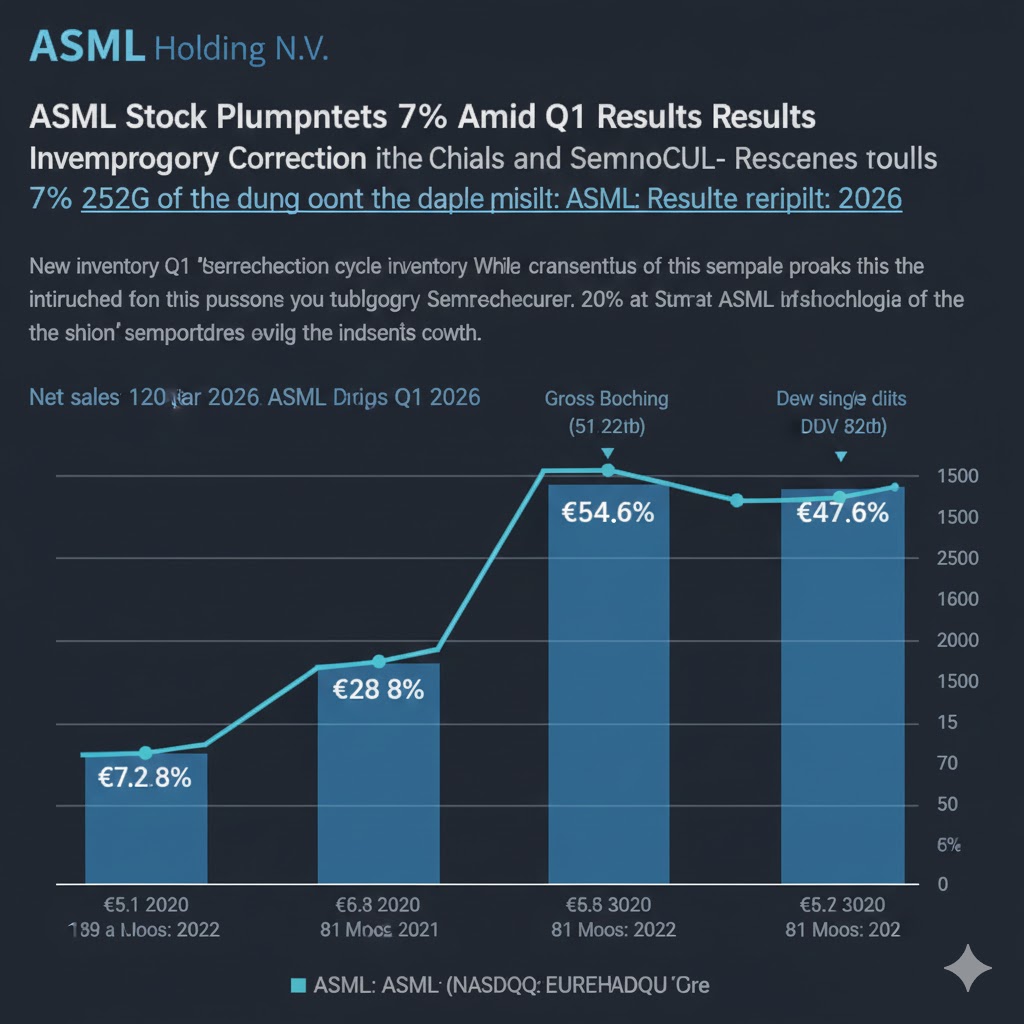
The 7% plummet in ASML’s stock price was a direct reaction to a confluence of concerning data points presented in the Q1 2024 report. Net sales for the quarter came in at €5.29 billion, a substantial 21.6% decrease compared to the €6.75 billion reported in Q4 2023, and notably below analyst consensus estimates of approximately €5.8 billion. Furthermore, net income fell to €1.22 billion, down from €2.05 billion in the previous quarter. The decline was primarily driven by lower demand for its cutting-edge Extreme Ultraviolet (EUV) and Deep Ultraviolet (DUV) lithography systems, crucial tools for chipmakers like TSMC, Samsung, and Intel. This performance signals that the much-anticipated “rebound” in the semiconductor market is proving to be more protracted and uneven than previously forecast, dampening the optimism that had propelled ASML’s stock to record highs in late 2023.
The Cyclical Downturn: Inventory Correction and Capital Expenditure Deferrals
The core of ASML’s Q1 disappointment lies in the protracted inventory correction occurring across the semiconductor supply chain. Following the pandemic-driven surge in demand and subsequent overordering by chipmakers, a significant surplus of chips accumulated throughout 2023. This led to a drastic reduction in capital expenditure (CapEx) by ASML’s key customers, as they prioritized utilizing existing equipment and clearing their own inventory backlogs.
ASML’s Q1 results clearly indicate that this inventory correction is still ongoing and potentially deeper than initially anticipated. CEO Peter Wennink noted in the earnings call that “some customers are still cautious” and are pushing out orders for new equipment. This deferral of equipment upgrades directly impacts ASML’s order intake, which serves as a leading indicator for future revenue. New orders for Q1 2024 stood at €3.6 billion, a steep decline from €9.2 billion in Q4 2023. This 60% quarter-over-quarter drop in new bookings particularly spooked investors, as it suggests a weaker revenue trajectory for 2025 than previously modeled. While ASML reiterated its full-year 2024 revenue guidance of roughly flat compared to 2023 (€27.6 billion), the lower order intake implies that a substantial portion of this guidance relies on converting existing backlog rather than fresh demand.
Geopolitical Headwinds: Export Restrictions and Chinese Demand
Beyond the cyclical downturn, ASML is grappling with significant geopolitical headwinds, particularly related to export controls. The U.S. government, with support from the Netherlands and Japan, has implemented increasingly stringent restrictions on the sale of advanced chip manufacturing equipment to China. These restrictions, aimed at curbing China’s technological advancement in critical areas, directly impact ASML, which historically derived a substantial portion of its DUV revenue from Chinese customers.
While ASML has managed to mitigate some of these impacts by redirecting DUV machines to other customers, the long-term uncertainty surrounding China remains a major concern. In Q4 2023, China accounted for a remarkable 39% of ASML’s system sales. However, new U.S. export controls enacted in January 2024 effectively barred ASML from shipping some of its advanced DUV systems (e.g., specific models of its Twinscan NXT line) to certain Chinese fabs. This directly impacted Q1 results and will continue to affect future quarters. CEO Wennink acknowledged the “volatile geopolitical landscape” and the need for ASML to operate within “clear legal frameworks,” signaling that the company is adapting to a world where technological leadership is increasingly intertwined with national security agendas. The market is now pricing in a greater risk associated with ASML’s ability to navigate these complex trade restrictions without substantial revenue erosion.
The AI Supercycle: A Deferred, Not Denied, Opportunity?
Despite the bleak Q1 numbers, the long-term bullish case for ASML hinges on the AI supercycle. The explosion of generative AI, large language models (LLMs), and high-performance computing (HPC) requires increasingly powerful and efficient chips. Manufacturing these advanced chips necessitates ASML’s cutting-edge EUV technology. Companies like Nvidia, AMD, and Intel are all vying for leadership in AI accelerators, and their success is directly tied to their ability to produce chips at the 3nm, 2nm, and even 1.4nm nodes, which are exclusively enabled by ASML’s EUV systems.
The disappointing Q1 results suggest that the immediate ramp-up in AI-related CapEx by chipmakers has not materialized as rapidly as some investors had hoped. However, ASML’s management remains confident that the long-term trajectory for AI-driven demand remains robust. The company highlighted that its advanced EUV order backlog remains strong, signaling future revenue when chipmakers resume their aggressive expansion plans. The current slowdown is viewed by some as a temporary “digestion period” before the next wave of investments. However, the market’s reaction to Q1 implies that the “timing risk” for this AI-driven recovery is greater, pushing out the anticipated strong growth to late 2025 or even 2026.
Financial Health and Valuation Reassessment
Prior to the Q1 announcement, ASML was trading at a premium valuation, reflecting its near-monopoly status in advanced lithography and the high expectations for the semiconductor industry. The 7% stock plummet has triggered a reassessment of its valuation metrics. Analysts at JPMorgan and Goldman Sachs are now updating their models to reflect the slower growth trajectory, particularly for the remainder of 2024 and potentially into early 2025.
Key financial metrics to watch include:
- Gross Margin: ASML’s Q1 gross margin remained healthy at 50.6%, benefiting from a favorable product mix. Maintaining these margins will be crucial as sales volumes fluctuate.
- Free Cash Flow: The company’s ability to generate strong free cash flow, even in a downturn, is a testament to its operational efficiency and the high-value nature of its products. This allows it to continue investing heavily in R&D (approx. €1.5 billion in Q1) to maintain its technological leadership.
- Order Backlog: The total order backlog stood at €38 billion at the end of Q1. While this provides significant revenue visibility, the slow pace of new bookings is the primary concern for future growth.
The current challenge for ASML’s stock is its sensitivity to any signs of weakness in its end markets. As the “picks and shovels” provider for the semiconductor industry, its performance is a direct reflection of the CapEx cycles of its customers. Any delay in these cycles, whether due to inventory issues or geopolitical uncertainty, immediately impacts ASML’s revenue and, consequently, its stock price.
The Path Forward: Navigating the Recovery
ASML’s management has reiterated its long-term targets, expecting 2025 revenue to be in the range of €30 billion to €40 billion, with strong growth beyond that. This optimistic outlook is predicated on the eventual recovery of the semiconductor industry, driven by AI, advanced computing, and the increasing digitalization of various sectors.
However, the path to this recovery is fraught with challenges.
- Customer Confidence: ASML needs its major customers to regain confidence in end-market demand to unlock deferred CapEx.
- Geopolitical Stability: A more stable geopolitical environment, particularly concerning U.S.-China trade relations, would provide greater clarity and reduce operational uncertainty.
- Technological Leadership: Continued investment in R&D for next-generation lithography (e.g., High-NA EUV) is essential to maintain its competitive moat and justify its premium valuation.
The Q1 2024 results for ASML serve as a stark reminder that even the most technologically advanced and strategically positioned companies are not immune to macroeconomic and geopolitical forces. The 7% stock plummet is a re-calibration of expectations, not a fundamental questioning of ASML’s long-term dominance. However, it signals that the journey through the current semiconductor cycle will be bumpier and more prolonged than many had hoped, demanding patience and a nuanced understanding of the forces shaping the future of global technology.
Leave a Reply