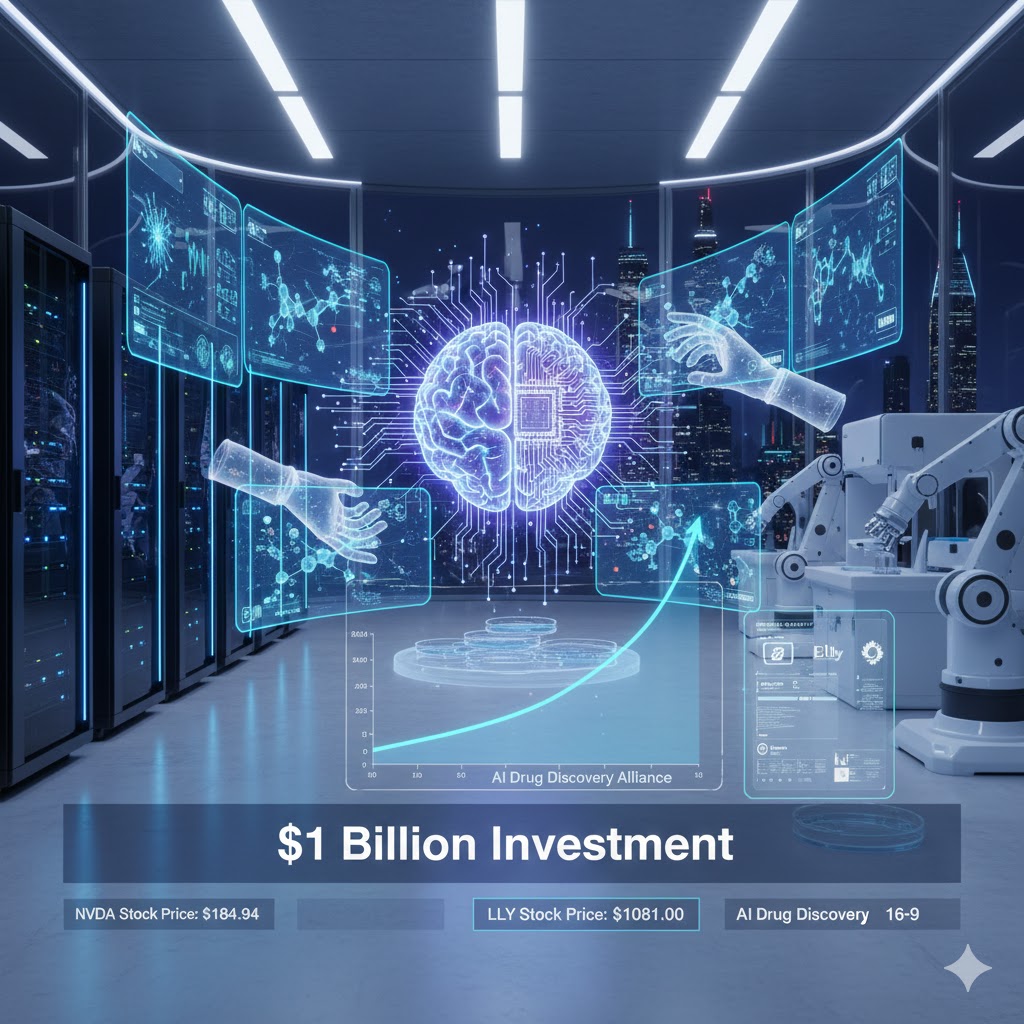
The global capital markets witnessed a watershed moment on January 12, 2026, as the undisputed sovereign of artificial intelligence, NVIDIA (NVDA), joined forces with the pharmaceutical titan Eli Lilly (LLY) to launch a first-of-its-kind joint innovation laboratory. This strategic alliance aims to solve the most intractable challenges in drug discovery by marrying NVIDIA’s unparalleled accelerated computing stack with Eli Lilly’s century-long expertise in medicinal chemistry and clinical development. With a committed investment of up to $1 billion over the next five years, the venture represents more than just a collaboration; it is the formalization of the “Digital Twin” era for the human body.
For those tracking NVDA stock and LLY stock, this announcement serves as a powerful fundamental catalyst. As of January 12, the NVDA stock price hovered around $184.94, while Eli Lilly stock closed at $1,081.00, marking a 1.64% gain on the day as the market digested the long-term implications of this “Silicon-Biology” convergence. This partnership is designed to move the industry away from the slow, trial-and-error method of “wet lab” testing toward a high-fidelity “In-Silico” model where billions of molecular combinations can be simulated in minutes.
NVIDIA: The Infrastructure Backbone of the Bio-AI Revolution
The momentum behind NVIDIA stock continues to be driven by its total dominance of the data center. In its most recent NVIDIA Financial Report for the third quarter of fiscal 2026, the company reported a record revenue of $57.0 billion, a staggering 62% increase year-over-year. Of this total, Data Center revenue accounted for $51.2 billion, underscoring that the AI boom is not just a trend but a structural shift in global computing.
NVIDIA’s specific value proposition in the pharmaceutical sector lies in its BioNeMo platform—a generative AI cloud service for drug discovery. By partnering with Eli Lilly, NVIDIA is effectively moving from a “tool provider” to a “co-architect” of the drug discovery process. CEO Jensen Huang’s vision of a “blueprint” for drug development suggests that NVIDIA’s GPUs and specialized AI models will become as essential to scientists as the microscope was to their predecessors.
The fiscal strength revealed in the NVDA stock price performance is supported by robust gross margins, which stood at 73.6% in the recent quarter. This profitability allows the company to return massive amounts of capital to shareholders, including $37.0 billion in buybacks and dividends during the first nine months of fiscal 2026 alone. As the company guides for $65 billion in revenue for the fourth quarter, the Eli Lilly partnership ensures that NVIDIA’s TAM (Total Addressable Market) expands into the trillion-dollar life sciences sector.
Eli Lilly: Trillion-Dollar Ambitions Fueled by AI Precision
For Eli Lilly stock, the narrative has evolved from a pure-play obesity story into a broader industrial technology play. The Indianapolis-based giant recently hit a $1 trillion market capitalization late in 2025, fueled by the explosive success of Mounjaro and Zepbound. In its Q3 Eli Lilly Financial Report, the company posted a 54% revenue increase to $17.6 billion, driven largely by its incretin portfolio.
However, the partnership with NVIDIA signals that Lilly is looking past its current blockbuster drugs to solve the next generation of medical challenges. The joint lab will utilize NVIDIA’s Blackwell GPU architecture to accelerate Lilly’s R&D pipeline, which already includes 16 new Phase 3 programs. The goal is to reduce the “Eroom’s Law” effect—the observation that drug discovery is becoming slower and more expensive over time—by using AI to predict the efficacy and toxicity of small molecules before they ever reach a human subject.
The LLY stock price has benefited from a trailing EPS that jumped to $7.02 in the third quarter, significantly beating consensus estimates. Analysts are now looking at the company’s path to $94 billion in annual revenue by 2027. The entry into the oral obesity market and the integration of AI-driven manufacturing are expected to be the key milestones of 2026. By investing in the NVIDIA alliance, Lilly is de-risking its future pipeline, ensuring that its next $100 billion drug is discovered with the speed of silicon rather than the traditional decade-long development cycle.
Strategic Synergy: The $1 Billion Investment in Human Capital and Compute
The $1 billion commitment between the two firms is divided into three critical pillars: Talent, Infrastructure, and Computing Resources. From a business development perspective, this is a defensive and offensive masterstroke.
- Talent Acquisition: By creating a “joint lab,” both companies can attract the world’s leading “biocomputational” scientists who wish to work at the intersection of LLMs and proteomics.
- Infrastructure Scaling: The lab will likely be anchored by an on-premise NVIDIA DGX SuperPOD dedicated solely to Eli Lilly’s proprietary chemical libraries, ensuring data privacy while maximizing throughput.
- Market Expansion: For NVIDIA, this is a lighthouse project that will force other big pharma players to adopt its H100/B200 stacks or risk obsolescence. For Lilly, it provides a “computational moat” that competitors like Novo Nordisk will find difficult to replicate.
The market has responded with optimism. While NVDA stock 大涨 (surged significantly) in previous quarters, the current consolidation phase is seen by many as a “healthy reset” before the next leg of AI adoption in vertical industries. The Eli Lilly Earnings trajectory suggests a 32.5% growth in EPS for the coming year, a figure that could be further revised upward as AI efficiencies begin to manifest in lower R&D-to-sales ratios.
Technical Analysis and Market Sentiment
As we move through January 2026, the NVDA stock price is consolidating near its 50-day moving average. Technical indicators suggest that the $180 support level is firm, while resistance remains near the all-time high of $212. For LLY stock, the $1,100 level represents a key psychological barrier. The stock’s PEG ratio of 0.77 suggests that despite its high nominal price, it remains undervalued relative to its expected earnings growth trajectory.
Investors monitoring NVIDIA stock should look for the Q4 results in February for confirmation of the Blackwell GPU ramp-up. Similarly, Eli Lilly stock participants are focused on the Feb 5th earnings call, where updated guidance for the oral obesity drug orforglipron is expected. The joint lab news has added a layer of “quality” to the growth profiles of both companies, moving them away from speculative AI hype toward tangible, industrial-scale applications.
In summary, the NVIDIA and Eli Lilly alliance is the most significant signal to date that the “AI winter” is nowhere in sight for the healthcare sector. By combining the world’s most advanced computing platform with its most successful drug developer, the two firms are not just discovering medicines—they are inventing a new way to innovate. As the NVDA stock and LLY stock prices reflect this new reality, the 2026 fiscal year is poised to be the year where “Silicon meets Biology” at a scale never before imagined.
Leave a Reply