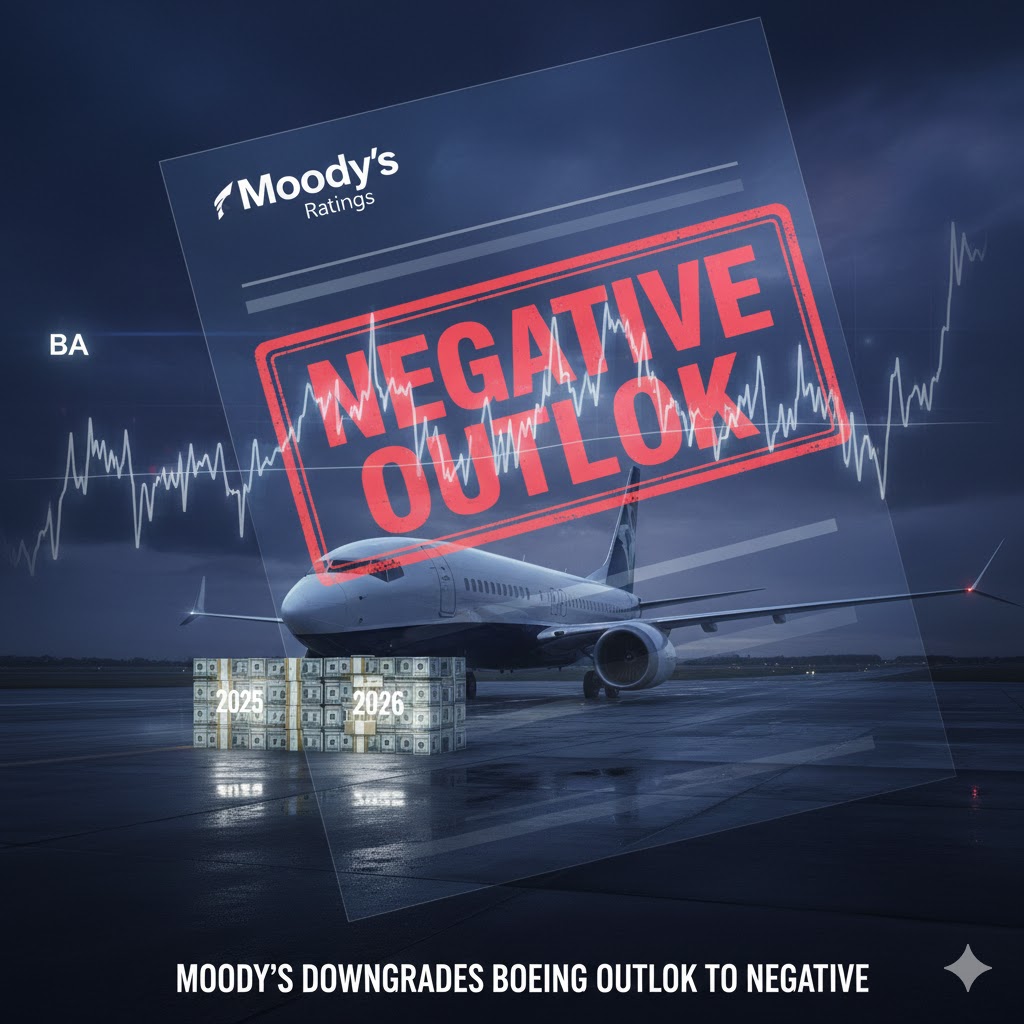
The global aerospace landscape has entered a period of intense financial scrutiny as institutional credit agencies reassess the recovery trajectory of its most storied players. In a move that has reverberated through the bond markets and equity trading floors alike, Moody’s Ratings has officially downgraded the credit outlook of The Boeing Company (NYSE:BA) to negative. This shift from a stable outlook marks a critical juncture for the Arlington-based aerospace giant, reflecting deep-seated concerns over the manufacturer’s ability to stabilize its commercial production rates and generate the free cash flow necessary to address a looming “wall of debt” maturing between 2025 and 2026. For investors and aviation analysts, the downgrade is not merely a technical adjustment of credit risk; it is a signal that the structural challenges at Boeing—ranging from regulatory production caps to persistent supply chain volatility—may endure significantly longer than previously modeled.
The decision by Moody’s to revise the outlook underscores a fundamental misalignment between Boeing’s operational realities and its mid-term financial obligations. Central to this downgrade is the “inadequate performance” of the Commercial Airplanes (BCA) segment. Despite robust global demand for new aircraft, fueled by a post-pandemic travel surge and the modernization needs of major carriers like United Airlines Holdings, Inc. (NASDAQ:UAL) and Ryanair Holdings plc (NASDAQ:RYAAY), Boeing has struggled to convert its massive $529 billion backlog into consistent delivery figures. The primary friction point remains the 737 MAX program, which has been subject to an unprecedented production cap imposed by the Federal Aviation Administration (FAA) following a series of high-profile quality control lapses in early 2024. Although the FAA recently permitted a modest increase in the production ceiling from 38 to 42 aircraft per month in late 2025, Moody’s remains skeptical that the company can sustain the “defects-free” manufacturing pace required to hit its internal target of 53 jets per month by the end of 2026.
The Cash Flow Paradox and the Debt Maturity Wall
The core of the “negative” outlook lies in a daunting liquidity math problem. Boeing (NYSE:BA) exited the third quarter of 2025 with a cash and marketable securities balance of approximately $23 billion, a figure that provides a temporary buffer but masks an underlying burn rate that has troubled credit analysts. For the first nine months of 2025, the company reported a free cash outflow of roughly $2.25 billion. While this is a marked improvement from the disastrous $10.2 billion outflow recorded during the same period in 2024, it remains insufficient to comfortably service the company’s upcoming debt obligations. Boeing faces $4.3 billion in debt maturities in 2025, followed by a massive $8.0 billion maturity in 2026.
Moody’s projection suggests that annual free cash flow will fall short of these figures, likely forcing the company to return to the capital markets to issue new debt. This “refinancing risk” is particularly acute in a higher-for-longer interest rate environment, which increases the company’s interest expense and complicates its path back to a “single-A” credit rating. To put the scale of this challenge into perspective, Boeing’s consolidated debt stood at approximately $53.4 billion as of October 2025. While the company has benefited from an increase in its market capitalization—which recently eclipsed $173 billion—institutional lenders like State Street Corporation (NYSE:STT) and BlackRock, Inc. (NYSE:BLK) are increasingly focusing on the company’s “Debt-to-EBITDA” ratios, which are expected to remain elevated until at least 2027.
Segment Performance: Commercial Losses vs. Defense Resilience
A deep dive into Boeing’s financial statements reveals a stark divergence between its business segments. In the third quarter of 2025, Boeing reported total revenues of $23.27 billion, a 30% increase year-over-year. However, the Commercial Airplanes segment recorded a loss from operations of $5.35 billion. Much of this loss was driven by a staggering $4.9 billion non-cash charge related to the delay of the 777X program. Originally intended to be a flagship widebody offering to compete with the A350 from Airbus SE (OTC:EADSY), the 777X’s first delivery has been pushed back to the first quarter of 2027. This delay not only defers critical “delivery-day” cash payments from customers like Emirates but also necessitates billions in additional research and development and working capital build-up.
In contrast, the Boeing Defense, Space & Security (BDS) segment has begun to show signs of an operational turnaround. After several years of heavy losses on fixed-price contracts—including the KC-46A Pegasus tanker and the T-7A Red Hawk trainer—BDS swung to a modest operating profit of $114 million in Q3 2025, compared to a loss of $2.38 billion in the prior-year period. Revenue for the defense segment rose 25% to $6.9 billion, beating consensus estimates. This improvement is attributed to stabilizing production lines and a growing backlog of $76 billion, with 20% of orders coming from international governments seeking to bolster their defense postures amidst geopolitical tensions. For companies like Lockheed Martin Corporation (NYSE:LMT) and Northrop Grumman Corporation (NYSE:NOC), Boeing’s defense recovery is a critical indicator of the health of the broader U.S. industrial base, though it remains too small to offset the massive cash burn on the commercial side.
Regulatory Oversight and Manufacturing Culture
The negative outlook from Moody’s is also an indictment of the “execution risk” inherent in Boeing’s safety and quality overhaul. FAA Administrator Mike Whitaker has maintained a persistent, on-site presence at Boeing’s Renton and Everett facilities, emphasizing that the regulator will not permit further production rate hikes until Boeing proves a “fundamental cultural shift” toward safety. This oversight has slowed the company’s ability to clear its “Moses Lake inventory”—the stockpile of already-built jets that were stored during the MAX groundings. While Boeing (NYSE:BA) CFO Jay Malave indicated in late 2025 that the company had finally exhausted its stock of deliverable stored aircraft, the transition to “higher production” as the sole driver of delivery growth is a risky phase.
The operational complexity is further compounded by the acquisition of Spirit AeroSystems Holdings, Inc. (NYSE:SPR). Expected to be finalized in early 2026, this deal will vertically reintegrate Boeing’s most critical supplier but will also require the consolidation of approximately $4 billion of Spirit’s external debt onto Boeing’s balance sheet. While this move is intended to improve quality control at the source (the fuselage manufacturing), the near-term financial strain and integration challenges are cited by Moody’s as a primary reason for the negative outlook. Investors in the industrial sector, such as those holding the Industrial Select Sector SPDR Fund (NYSE:XLI), are closely watching whether this integration will truly eliminate “traveled work”—the practice of finishing parts out of sequence—which has been the root cause of many of Boeing’s manufacturing defects.
Market Sentiment and the Path to 2027
Despite the credit downgrade, the equity market has shown a degree of “cautious optimism” regarding Boeing’s 2026 prospects. The stock has rallied approximately 23% throughout 2025, outperforming the S&P 500. This disconnect between credit sentiment and equity performance suggests that stock investors are pricing in a “best-case scenario” for the 2026 recovery. Analysts tracking the company at firms like JPMorgan Chase & Co. (NYSE:JPM) expect Boeing to report its first profitable year since 2018 in the 2026 fiscal year, with projected earnings per share (EPS) of $1.11.
However, the “negative” credit outlook serves as a sobering reminder that for the bondholders and ratings agencies, the margin for error is razor-thin. If 2026 free operating cash flow (FOCF) does not reach the $3 billion target—already a downward revision from previous estimates—the risk of a further downgrade into “junk” territory becomes a real possibility. Such a move would significantly increase Boeing’s cost of capital and potentially trigger forced selling from investment-grade bond funds managed by institutions like T. Rowe Price Group, Inc. (NASDAQ:TROW).
Conclusion: A Year of Precarious Stabilization
As 2026 begins, Boeing (NYSE:BA) stands at a crossroads where operational excellence is no longer optional—it is a requirement for financial survival. The negative outlook from Moody’s reflects a world where the “Boeing premium” has vanished, replaced by a rigorous demand for delivery consistency and debt reduction. The company’s success in 2026 will be judged not by its visionary projects or defense wins, but by the quiet, repetitive rhythm of the Renton assembly lines.
The upcoming Q4 2025 earnings call will be the next major litmus test. Investors will be looking for specific updates on the 737 MAX 10 certification, the stabilization of the 787 Dreamliner production at 10 units per month, and a clear plan for the $8 billion in 2026 debt maturities. For now, Boeing remains an industrial giant in a state of precarious stabilization—a “show-me” story that will require every bit of its 110-year engineering heritage to navigate.
Leave a Reply