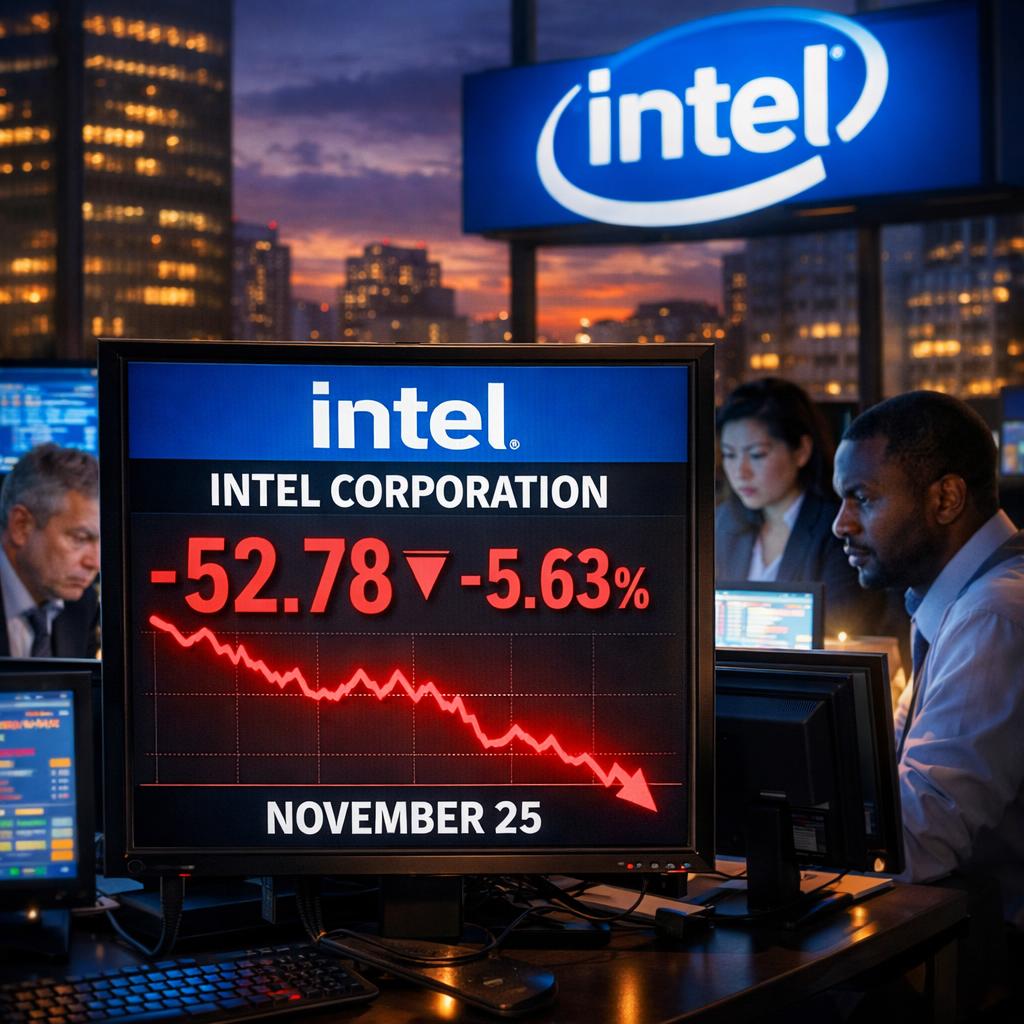
Intel Corporation (INTC) found itself under renewed pressure this holiday week, with shares sliding as much as 3.9% during intraday trading on December 24, 2025. This move dragged the stock to its lowest intraday level since late November, catching many investors off guard after what had otherwise been a year of tentative recovery. While the broader semiconductor sector remains buoyed by the insatiable demand for AI-integrated hardware, Intel’s path continues to be defined by high-stakes technical milestones and the friction of a massive structural pivot.
The immediate catalyst for the decline appears to be a mix of technical profit-taking and whispers regarding the evaluation of its 18A process node. Reports surfaced indicating that certain high-profile potential clients, including industry titan NVIDIA, may have paused specific production evaluations. For a company that has staked its entire future on reclaiming transistor density leadership by 2026, such reports—even if part of the standard, rigorous testing cycle—are enough to spook a market that has grown weary of Intel’s “wait-and-see” narrative.
Deciphering the Valuation: Expensive Growth or Cheap Assets?
Assessing Intel’s valuation in late 2025 requires a look beyond traditional metrics. On a trailing twelve-month (TTM) basis, the price-to-earnings (P/E) ratio looks astronomical—exceeding 1,000x by some estimates—primarily because the company’s bottom line has been decimated by multi-billion dollar capital expenditures and the divestment of units like Altera. However, using P/E for a company in the middle of a “once-in-a-generation” turnaround is often misleading.
When we pivot to the price-to-book (P/B) ratio, a different story emerges. Intel currently trades at approximately 1.48x book value, a stark contrast to the semiconductor industry average which often sits above 30x. This suggests that while the market is skeptical of Intel’s short-term earnings power, it is essentially pricing the company’s vast physical infrastructure—its global network of “fabs”—at a deep discount. For the patient value investor, you are buying the world’s second-largest foundry footprint for pennies on the dollar compared to its replacement cost.
The 18A Milestone and the “National Champion” Buff
The bull case for Intel rests almost entirely on the successful ramp-up of the Intel 18A (1.8nm) process. As of December 2025, Intel has officially moved into high-volume manufacturing (HVM) for this node. This is a watershed moment. 18A is the first commercial process to integrate RibbonFET gate-all-around transistors and PowerVia backside power delivery simultaneously—technological leaps that even TSMC is not expected to fully deploy in tandem until later in 2026.
Furthermore, Intel’s role as the “National Champion” of U.S. semiconductor policy cannot be ignored. With a $3 billion “Secure Enclave” contract from the Department of Defense and ongoing support via the CHIPS Act, Intel has a sovereign floor beneath its stock price that its competitors do not. The company has successfully narrowed its focus, spinning off non-core units to become a leaner, foundry-first organization under the leadership of CEO Lip-Bu Tan.
Strategic Outlook: Buy, Hold, or Sell?
Despite the recent intraday slide to $35.17, Intel’s technical setup suggests a “Hold” for the cautious and a “Speculative Buy” for those with a 24-month horizon. The stock has recovered roughly 80% from its 2024 lows, yet it remains far below its historical peaks.
- The Bull Case: If 18A yields stabilize above 65% in early 2026, Intel will likely secure massive orders from “frenemies” like Apple or NVIDIA who are desperate to diversify away from a single-source supply chain in Taiwan.
- The Bear Case: Intel’s capital intensity remains a massive drag on free cash flow. If the “AI PC” supercycle fails to trigger a massive refresh in the consumer market, Intel’s Client Computing Group may not be able to fund the Foundry’s expansion.
Recommendation: Buy on the Dip. The current dip toward the $35 support level represents a classic “climbing the wall of worry” opportunity. While the headlines focus on short-term evaluation pauses, the fundamental reality is that Intel has closed the decade-long “process gap” with its rivals. For investors who can stomach the volatility of a company reinventing itself in real-time, the current valuation offers a rare entry point into a vital piece of the global AI infrastructure at a fraction of the cost of its peers.
Leave a Reply