The electronics manufacturing services (EMS) sector has historically been characterized by razor-thin margins and a perceived lack of moat. However, the narrative surrounding Jabil Inc. (NYSE: JBL) underwent a seismic shift on December 17, 2025. With the release of its first-quarter fiscal year 2026 financial results, Jabil proved that it is no longer just a contract manufacturer; it is a critical architect of the global AI infrastructure. For investors tracking the Jabil stock price, the data presented in this report serves as a roadmap for a company transitioning from a volume-based business model to a value-driven engineering powerhouse.
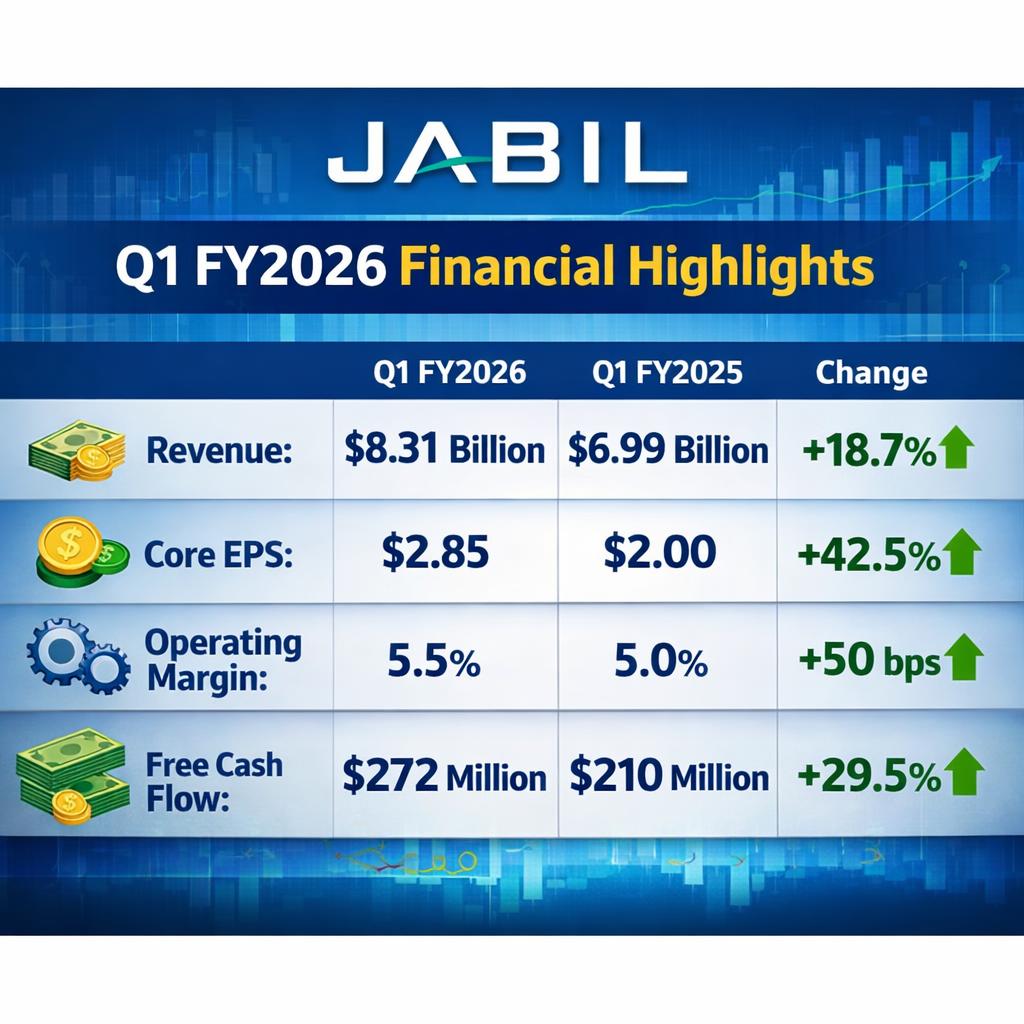
The Quantifiable Triumph: Breaking Down the Q1 Numbers
The sheer scale of Jabil’s beat-and-raise performance in Q1 2026 cannot be overstated. Revenue for the quarter reached an impressive $8.31 billion, representing an 18.7% year-over-year increase. This growth is particularly striking when compared to the broader industrial manufacturing sector, which has struggled with stagnating demand. The Jabil stock reaction, which saw a significant intraday surge following the announcement, was fueled by a bottom-line performance that exceeded even the most optimistic analyst projections. Core diluted earnings per share (non-GAAP) arrived at $2.85, a massive leap from the $2.00 reported in the same period last year.
To understand the health of Jabil Inc. stock, one must look beyond the top-line revenue. The company’s core operating margin expanded to 5.5%, a 50-basis-point improvement over the previous year. In the world of EMS, where a 10-basis-point move is considered significant, this expansion is a testament to Jabil’s shifting product mix. The company has been aggressively pruning lower-margin legacy contracts—specifically in traditional consumer mobility—in favor of high-complexity, high-margin sectors like AI-driven data centers, renewable energy infrastructure, and medical devices.
Strategic Segments: The Engines of Growth
The JBL Financial Report divides the company’s operations into two primary segments: Innovations and Solutions (I&S) and Electronics Manufacturing Services (EMS). While both segments grew, the internal dynamics tell a story of strategic repositioning.
The AI and Data Center Boom
Within the I&S segment, the “Intelligent Infrastructure” division has become the crown jewel. Jabil’s management highlighted that revenue from AI-related infrastructure reached approximately $3.2 billion in Q1 alone. As hyperscale cloud providers (Amazon, Google, Microsoft) race to build out their generative AI capabilities, they are moving away from off-the-shelf servers toward customized, liquid-cooled, high-density GPU clusters.
Jabil’s role here is pivotal. They are not just assembling components; they are designing the thermal management systems and power distribution units that allow these AI chips to run at peak efficiency. This shift into “design-led manufacturing” is the primary driver of the margin expansion seen in the Jabil Earnings report. By integrating more proprietary intellectual property and complex engineering services into their builds, Jabil creates a higher barrier to entry for competitors and a more profitable relationship with its clients.
Healthcare and Regulated Industries
Another pillar supporting the long-term value of Jabil Inc. stock is the Healthcare and Life Sciences division. This sector is largely insulated from the boom-and-bust cycles of the consumer tech market. In Q1, healthcare revenue grew by 7%, driven by the increasing electronification of medical devices and the trend toward “connected health.” Jabil’s ability to navigate the rigorous FDA and global regulatory requirements provides a “moat” that pure-play tech manufacturers lack. This segment provides the steady, predictable cash flow that allows Jabil to reinvest in more volatile, high-growth areas like AI.
Operational Excellence: The Secret Sauce of Margin Expansion
A deep dive into the JBL Financial Report reveals that the company’s success is as much about internal discipline as it is about external demand. Jabil’s “Global Business Services” (GBS) initiative has successfully streamlined its back-office operations, saving an estimated $150 million annually. Furthermore, the company’s inventory management has been exemplary. In a post-pandemic world where many manufacturers are sitting on mountains of obsolete parts, Jabil has kept its inventory “lean,” with a focus on high-velocity components.
The company’s net capital expenditures for the quarter were $185 million, much of which was directed toward high-automation manufacturing lines in India and Mexico. By reducing reliance on manual labor in high-cost regions, Jabil is shielding itself against wage inflation—a major risk factor for the JBL stock price in 2026. The move toward “Lights-Out Manufacturing” where robots handle the bulk of PCB (Printed Circuit Board) assembly is no longer a futuristic concept; it is Jabil’s current reality.
Geopolitical Strategy: Navigating the Global Chessboard
For any investor considering JBL stock, the company’s geographic footprint is a critical variable. Jabil has been a pioneer of the “China Plus One” strategy. While they maintain a significant and highly efficient presence in China to serve the domestic market there, they have rapidly expanded their capacity in India, Vietnam, and Malaysia.
The recent expansion of their facility in Pune, India, is particularly noteworthy. This site is becoming a global hub for power electronics and renewable energy hardware. As the world moves toward decentralized energy grids and home battery storage, Jabil is positioning itself as the primary manufacturer for the hardware that manages these systems. This diversification not only reduces geopolitical risk—a common concern for those looking at Jabil Inc. stock—but also taps into the high-growth emerging markets of South Asia.
Financial Health and Shareholder Returns
One of the most attractive aspects of the latest Jabil Earnings is the company’s commitment to returning capital to shareholders. During the Q1 call, management announced an extension of their share repurchase program, with $1.5 billion in remaining authorization. In the first quarter alone, they repurchased approximately 2.4 million shares.
This aggressive buyback strategy does two things: it signals management’s belief that the Jabil stock price is currently undervalued, and it provides a floor for the stock during periods of market volatility. With a debt-to-EBITDA ratio of roughly 1.8x, Jabil’s balance sheet remains “Investment Grade,” giving it the flexibility to pursue strategic acquisitions. The acquisition of certain assets from BYD Electronics earlier in the cycle has already begun to pay dividends, allowing Jabil to scale its capabilities in precision mechanics and high-end enclosures.
Market Outlook and Future Revenue Drivers
Looking ahead to the remainder of fiscal year 2026, the guidance provided in the JBL Financial Report is exceptionally bullish. Management raised their full-year revenue outlook to a range of $32.2 billion to $32.6 billion. This implies that the growth seen in Q1 is not a one-off “pull forward” of demand, but the beginning of a sustained upward trajectory.
The next frontier for Jabil lies in the “Edge AI” market. While the current focus is on massive data centers, the next three years will see a surge in AI-capable devices at the edge—think autonomous delivery drones, smart industrial robots, and AI-powered medical diagnostic tools. Jabil’s “integrated solutions” approach means they are uniquely positioned to help OEMs (Original Equipment Manufacturers) bring these complex products to market faster. This “speed-to-market” advantage is why Jabil continues to win contracts over lower-cost but less sophisticated competitors.
Analyzing the Risks: Why the JBL Stock Price Could Face Headwinds
Despite the stellar Jabil Earnings report, a prudent analysis must acknowledge potential pitfalls. The electronics industry is notoriously cyclical. While AI is currently in a “super-cycle,” any cooling in hyperscale spending would hit Jabil’s most profitable segment the hardest.
Furthermore, the transition in the automotive sector remains a wild card. Jabil has invested heavily in EV charging infrastructure and battery management systems. If the global shift to electric vehicles continues to slow due to infrastructure hurdles or consumer preference, Jabil may see a lower-than-expected return on those specific capital investments. However, the company’s diversified portfolio typically allows weakness in one area to be offset by strength in another.
Valuation and Investment Recommendation
As we analyze the current state of JBL stock, the valuation presents a compelling case. Trading at a forward P/E ratio of approximately 19x based on the updated $11.55 EPS guidance, Jabil is priced significantly lower than pure-play AI stocks (like Nvidia or Arista Networks) while still capturing much of the same growth tailwind.
When you factor in the share buybacks and the consistent margin expansion, the “Core P/E” begins to look even more attractive. Wall Street analysts have begun adjusting their targets upward, with many now seeing a path for the Jabil stock price to reach $260–$275 by the end of 2026.
Conclusion: A New Era for Jabil
The December 17 JBL Financial Report marks a turning point for the company. Jabil has successfully navigated the transition from a traditional manufacturer to a high-tech solutions provider. By aligning its business with the most powerful secular trends of the decade—AI, healthcare innovation, and renewable energy—it has decoupled its growth from the broader, more sluggish manufacturing index.
For investors, the message is clear: Jabil is a “best-in-class” operator with a management team that understands how to allocate capital efficiently. The combination of double-digit revenue growth, expanding margins, and a shareholder-friendly capital return policy makes Jabil Inc. stock a cornerstone holding for any tech-focused portfolio.
Recommendation: BUY. The recent pull-back or consolidation in the broader tech market provides an excellent entry point for long-term investors. As Jabil continues to execute on its “Jabil 2030” vision, the current Jabil stock price will likely be viewed as a bargain in hindsight.
Key Data Summary from Q1 2026
| Metric | Q1 FY2026 Actual | Q1 FY2025 Actual | Change (%) |
| Revenue | $8.31 Billion | $6.99 Billion | +18.7% |
| Core EPS | $2.85 | $2.00 | +42.5% |
| Operating Margin | 5.5% | 5.0% | +50 bps |
| Free Cash Flow | $272 Million | $210 Million | +29.5% |
The roadmap is set, the infrastructure is built, and the demand is real. Jabil is no longer just making “things”; it is making the “things” that make the modern world work. Whether it’s the liquid cooling in a data center or the circuitry in a robotic surgeon, Jabil’s fingerprints are everywhere.
Leave a Reply