Reports indicate that the AI boom is sparking a rush for memory chips. From December last year to January this year, the price of a specific type of DRAM surged by 75%. More and more retailers and intermediaries are adjusting prices daily.
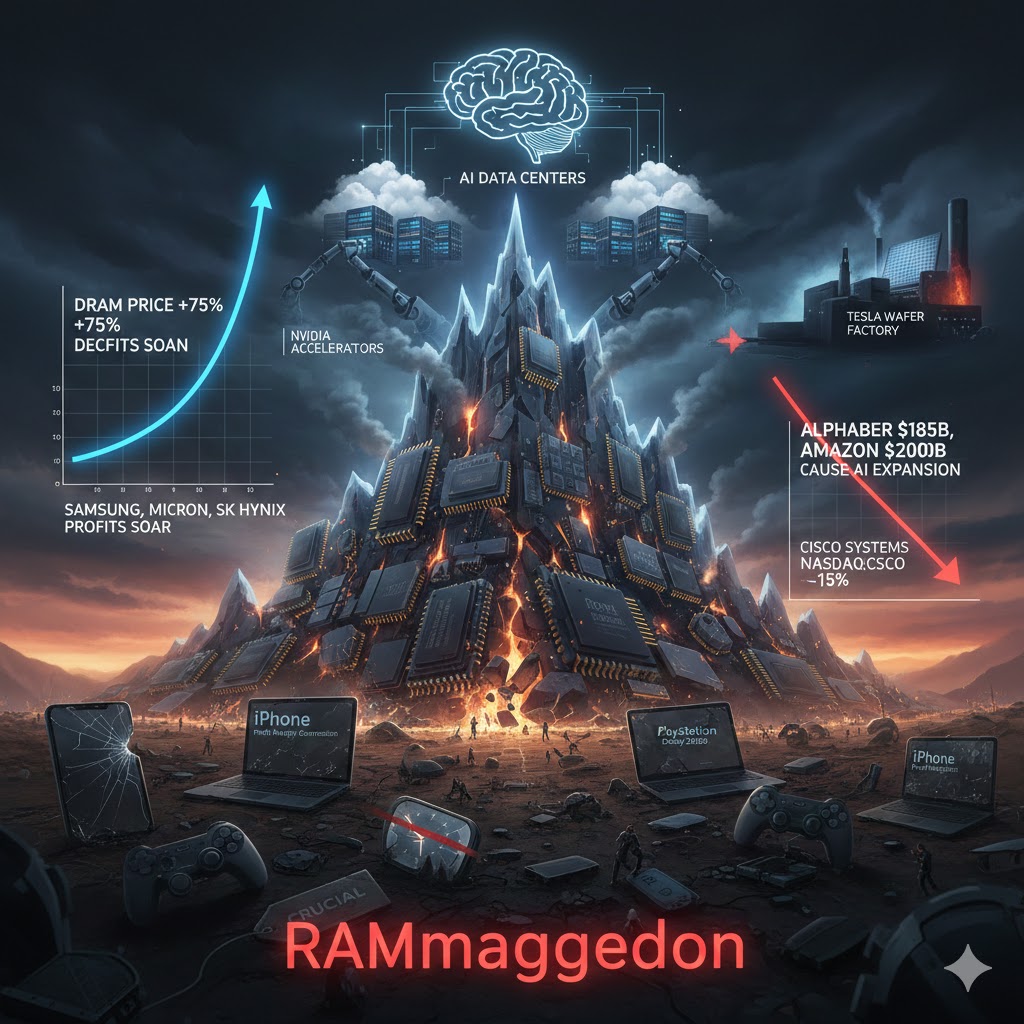
Price Soars, Memory Chip Shortage Escalates
Since the beginning of 2026, major companies like Tesla and Apple have signaled that the shortage of DRAM (dynamic random access memory) will limit production. Apple’s CEO Cook warned that this will compress iPhone profit margins; Micron Technology (NASDAQ:MU) called this bottleneck “unprecedented”; and Tesla’s CEO Musk pointed to the thorny nature of the problem, stating that Tesla would have to build its own memory manufacturing plants. Musk said at the end of January, “We have two options: hit the chip wall or build a wafer factory.”
The root cause of the situation is the expansion of AI data centers. Companies like Alphabet, OpenAI, and others are consuming large amounts of memory chip capacity as they purchase millions of Nvidia AI accelerators (each equipped with a large amount of memory) to run chatbots and other applications. This has forced consumer electronics manufacturers to compete for the dwindling supply of chips from suppliers like Samsung and Micron.
Bloomberg reported that the price of a certain type of DRAM rose by 75% from December to January, driving up prices throughout the holiday season. Increasingly, retailers and middlemen are adjusting prices daily, and “RAMmageddon” has become a term some use to describe the impending crisis.
“We are at the center of an unprecedented upheaval,” said Tim Archer, CEO of semiconductor equipment supplier Lam Research, at a conference in South Korea this month. “From now until the end of this decade, the demand in front of us will surpass anything from the past, and in fact, it will overwhelm all other sources of demand.”
Supply Running Out, Analysts Sound the Alarm
What’s concerning is that even before AI giants have fully launched their large-scale data center construction plans, prices are already skyrocketing, and supply is running low. Alphabet and Amazon have just announced plans for construction booms this year, with spending potentially reaching $185 billion and $200 billion, respectively—more than any other company’s single-year capital expenditure in history.
Mark Li, a semiconductor analyst at Bernstein, warned that memory chip prices are rising in a “parabolic” manner. While this will bring hefty profits to Samsung, Micron, and SK Hynix, other electronics industries will face heavy costs in the coming months.
This chaos is threatening the profitability of entire product lines and disrupting long-term planning. Reports indicate that Sony is considering delaying the launch of its next-generation PlayStation console until 2028 or even 2029, severely disrupting its strategy to maintain user engagement across hardware generations. Nintendo, which saw storage card demand spike due to the new Switch 2 console in 2025, is also considering raising prices for the device in 2026.
A laptop manufacturer’s executive mentioned that Samsung recently began reviewing memory supply contracts quarterly, instead of the usual annual review. Steiner Sundsbø, CEO of Norwegian IT company Atea ASA, told analysts in February: “Right now, we are at the center of a storm, responding hourly and daily.”
Cisco Systems (NASDAQ:CSCO) mentioned the memory shortage in its weak earnings outlook last week, causing its stock to drop by the largest single-day margin in four years. Qualcomm (NASDAQ:QCOM) and Arm Holdings (LSE:ARM) both warned that the impacts will become more pronounced in the future.
Last year, Micron decided to terminate its 30-year-old Crucial brand of consumer memory, which has severely impacted the high-end and DIY computer market. Falcon Northwest, a custom computer maker, reported that the exit of Crucial triggered a “buying spree”—causing manufacturers to stockpile and driving memory prices to new highs in January. Throughout 2025, the average price of each custom computer sold by Falcon Northwest rose by $1,500 to about $8,000.
The root cause of this shortage is the memory industry’s strategic shift toward AI. Meta, Microsoft, Amazon, and Alphabet are spending heavily to build data centers capable of training and hosting AI algorithms. Their expenditures rose from $217 billion in 2024 to about $360 billion last year, and it’s expected to reach $650 billion in 2026. This is among the most expensive investments in human history, as they aim to surpass competitors in the decisive AI field. The four major tech companies are spending lavishly on the components, resources, and talent required to build AI infrastructure.
Few industries, like the global memory market, have been so profoundly altered by this rush. In the three years since ChatGPT was launched, Samsung, SK Hynix, and Micron have redirected most of their capacity, R&D, and investment toward high-bandwidth memory (HBM) used for Nvidia and AMD AI accelerators. This has resulted in a reduction in capacity for regular DRAM, which is used in basic electronics like mobile phones.
Counterpoint analyst MS Hwang stated: “The DRAM shortage will continue to affect the electronics, telecom, and automotive industries throughout the year. We are already seeing panic purchasing signs in the automotive industry, while smartphone manufacturers are turning to more cost-effective chip alternatives to mitigate the impact.”
Short-term recovery of basic memory supply is unlikely. Samsung, SK Hynix, and Micron have all experienced multiple memory demand booms and busts. Although they are accelerating expansion, building more memory chip production facilities will take years.
The rising cost of memory means DRAM could soon account for 30% of the bill of materials for low-end smartphones—three times as much as it was at the beginning of 2025. Counterpoint Research indicates that the most affected will be lower-priced models with little pricing power.
“For the AI and automotive industries, memory is now the new gold, but clearly, this won’t be easy,” said Jayeshri Ural, CEO of Arista Networks, a partner of AMD. “It will benefit those companies that planned ahead and have the financial strength to invest.”
Leave a Reply