As the global technological landscape shifts from basic digitalization toward the high-stakes world of production-scale artificial intelligence, investors are increasingly looking for companies that offer tangible infrastructure value rather than mere speculative buzz. On January 6, 2026, Penguin Solutions Inc. (NASDAQ: PENG) released its PENG Financial Report for the first quarter of fiscal year 2026, providing a critical window into how a legacy memory and computing firm is successfully re-engineering itself into an enterprise AI leader.
At a current PENG stock price of approximately $19.08 (reflecting a period of post-earnings volatility as of January 9, 2026), the company finds itself at a valuation crossroads. Despite beating non-GAAP earnings expectations, the Penguin Solutions Earnings narrative remains complex, as the market weighs flat year-over-year revenue growth against a rapidly expanding strategic pipeline and a robust shift toward high-margin software and services.
Financial Statement Deciphered: Beyond the Bottom-Line Beat
The PENG Financial Report for Q1 2026 revealed total net sales of $343.1 million, representing a modest 1% year-over-year increase. While this might seem underwhelming at first glance, a deeper dive into the segment-level performance shows a significant realignment of the company’s revenue engine. The total revenue came in slightly below the consensus analyst estimate of $345.5 million, yet the company managed to deliver a significant surprise on the profitability front.
The Dichotomy of GAAP and Non-GAAP Results
One of the most critical aspects of the Penguin Solutions Earnings release is the stark contrast between GAAP and non-GAAP figures. Penguin Solutions reported a GAAP diluted earnings per share (EPS) of just $0.04, down from $0.10 in the year-ago quarter. This decline was primarily driven by high non-cash expenses, including stock-based compensation and the amortization of acquisition-related intangibles.
However, on a non-GAAP basis—which the management and many institutional investors view as a more accurate reflection of operational health—the company delivered $0.49 per share, handily beating the consensus estimate of $0.37. This “beat” is a direct result of tighter operational controls, specifically a reduction in operating expenses and better-than-expected margins in the Integrated Memory segment.
Margin Evolution and Inventory Discipline
Gross margins have remained a point of debate for PENG stock watchers. The GAAP gross margin came in at 28.0%, down 70 basis points year-over-year, while the non-GAAP gross margin was 30.0%. This contraction is largely due to the “business mix” shift—the company is currently exiting its higher-margin “Penguin Edge” legacy business and hyperscale hardware sales, which creates a temporary headwind but clears the path for future software-driven growth.
Perhaps the most impressive operational feat mentioned in the PENG Financial Report was the management of inventory. The company successfully reduced its Days Inventory Outstanding (DIO) from 96 days to 79 days. This reduction freed up significant cash, contributing to a net cash from operating activities of $31 million—a stark improvement from the negative cash flow seen in the final quarter of the previous fiscal year.
Segment Performance: The Engine Room of AI Transformation
To understand why the PENG stock price continues to attract institutional interest, one must analyze the three distinct business pillars that define Penguin Solutions today: Advanced Computing, Integrated Memory, and Optimized LED.
Advanced Computing: The Growth Catalyst
Advanced Computing is the crown jewel of the company’s AI strategy, representing roughly 44% of total revenue. This segment generated $151 million in the first quarter, a 9% increase over the preceding quarter. CEO Mark Adams highlighted that the market is shifting from “training” environments to “inference-driven” use cases, which aligns perfectly with Penguin’s expertise in solution design and system integration.
The revenue “lumpiness” in this segment—where large-scale deployments for enterprise clients can create quarterly volatility—remains a concern for some PENG stock analysts. However, the company’s guidance for 10% to 25% year-over-year growth in Advanced Computing suggests that the pipeline for production-scale AI is accelerating as we move further into 2026.
Integrated Memory: The Quiet Powerhouse
Often overlooked by the AI-hype crowd, the Integrated Memory segment contributed $136.5 million to the top line, showing strong resilience. As enterprise AI clusters grow, the demand for specialized, high-performance memory becomes non-negotiable. Penguin is currently investing in next-generation memory products, including Compute ExpressLink (CXL) and Optical Memory Appliances (OMA), with first OMA shipments targeted for late 2026. This segment is expected to grow between 10% and 20% this fiscal year, providing a stable cash-flow base to fund AI innovations.
Optimized LED: Maintaining Stability
Representing roughly 16% of revenue, the Optimized LED segment remains flat but stable. While it is not the primary growth driver for PENG stock, it provides a diversified revenue stream that prevents the company from being purely a “one-trick pony” in the semiconductor space.
Strategic Roadmap: Partnerships, Software, and the SK Telecom Factor
The Penguin Solutions Earnings call in January 2026 placed heavy emphasis on the company’s transition from a hardware-heavy mix to a more lucrative “Software and Services” model. This is the “secret sauce” that could eventually drive a massive re-rating of the PENG stock price.
The SK Telecom Investment
A transformative event for the company was the closing of the SK Telecom investment in mid-December 2025. This strategic partnership provides more than just capital; it opens doors to collaboration in energy, cooling, and networking—all critical components of the modern AI data center. As SK Telecom expands its global AI footprint, Penguin Solutions is positioned as their primary infrastructure partner, potentially opening up multibillion-dollar markets in the Asia-Pacific region.
The Dell Technologies Partnership
In a move to broaden its Total Addressable Market (TAM), Penguin recently expanded its Origin AI solutions to include Dell servers. By combining Dell’s massive storage and networking capabilities with Penguin’s proprietary management software, the company can now target mid-market enterprises that were previously out of reach. Management expects this partnership to “hit its stride” in late 2026, which could lead to a significant revenue inflection point.
Software Platform Enhancements
The upcoming release of Penguin’s enhanced AI software platform features a simplified user interface and multi-tenant capabilities. This is a crucial development for enterprise clients who want to allow shared access to AI platforms across different departments while ensuring strict data isolation. By moving further into the “management” layer of AI, Penguin is creating “sticky,” recurring revenue streams that command higher multiples than pure hardware sales.
Valuation Analysis: Is PENG a Deep-Value Play?
As we analyze the PENG stock price of $19.08, we see a P/E ratio that appears high on a trailing basis (roughly 78x) due to the aforementioned one-off charges and losses in 2025. However, the forward-looking metrics tell a much more compelling story.
Based on management’s reaffirmed guidance for fiscal 2026—projecting non-GAAP diluted EPS of $2.00 (±$0.25)—the stock is currently trading at a forward P/E of less than 10x. In a semiconductor and AI sector where peers often trade at 30x to 50x earnings, PENG stock looks remarkably cheap.
DCF and Analyst Price Targets
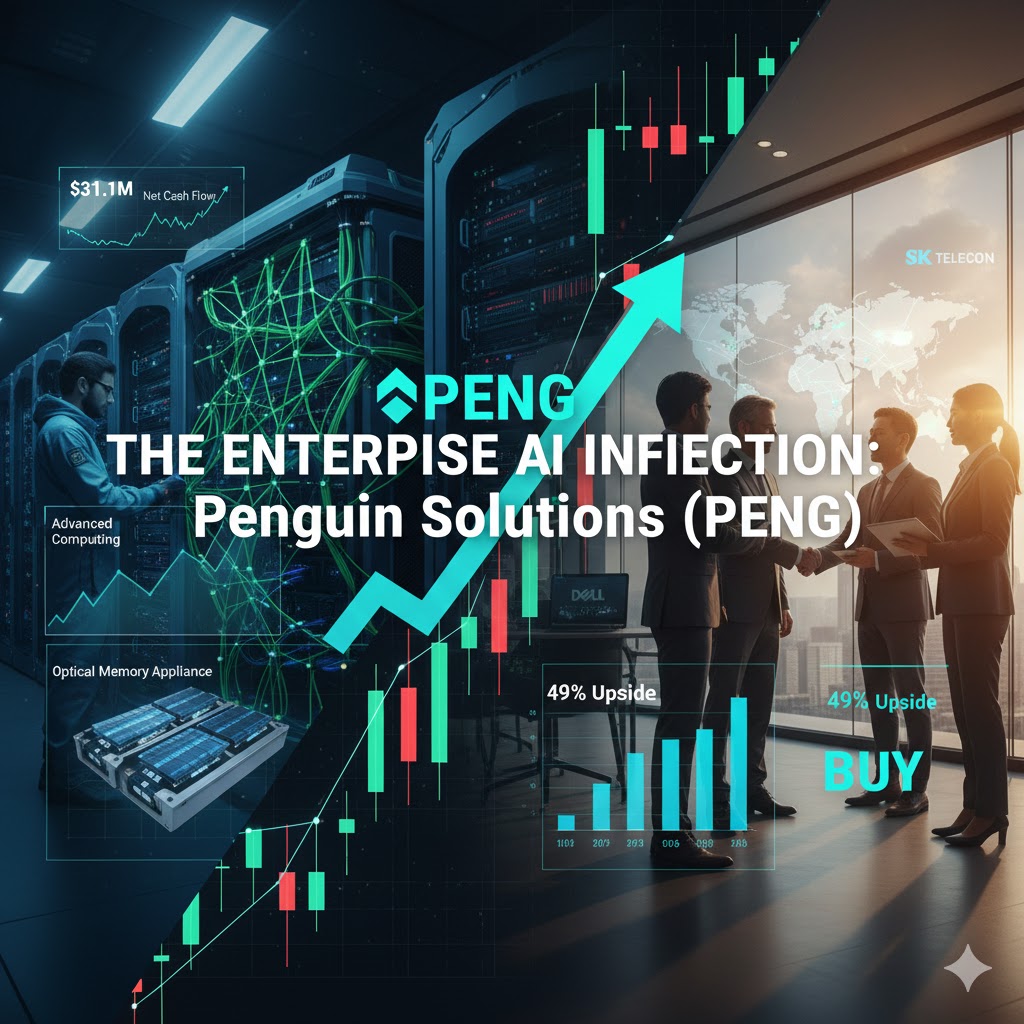
Discounted Cash Flow (DCF) models from several institutional analysts place the “fair value” of Penguin Solutions between $24.92 and $31.00. With a median analyst price target of $28.50, there is an implied upside of nearly 50% from current levels. The support seen from institutional giants like BlackRock and Vanguard—who added significant positions in late 2025—further bolsters the “deep value” thesis.
Market Outlook and Risks: Navigating the AI Lumps
Despite the bullish long-term narrative, the path for PENG stock is not without its hurdles. Investors must be aware of the following risks:
- Revenue Lumpiness: Large enterprise AI deals are notoriously difficult to time. A single delay in a major shipment can lead to a quarterly revenue miss, as seen in the slight Q1 shortfall.
- Business Mix Headwinds: The exit from legacy businesses like Penguin Edge will continue to create a “top-line drag” through most of 2026. While this is a “good” strategic move, it requires investor patience.
- Competitive Landscape: As AI infrastructure becomes more lucrative, Penguin will face increased competition from larger players like Hewlett Packard Enterprise (HPE) and Super Micro Computer.
Conclusion: Investment Verdict and Stock Price Outlook
The Penguin Solutions Q1 2026 Earnings report confirms a company that is successfully executing a difficult pivot. By shedding lower-margin legacy businesses and doubling down on enterprise AI infrastructure and high-performance memory, management is building a more resilient, higher-margin entity.
The current PENG stock price of $19.08 represents an attractive entry point for investors who can look past quarterly “lumpiness” and focus on the 2026-2027 growth trajectory. With a solid cash position of $461 million, a narrowing net debt leverage, and a forward P/E that sits at a deep discount to the industry, the “Deep Value AI Play” label is well-deserved.
Recommendation: BUY
We anticipate that as the Dell partnership scales and the SK Telecom collaborations bear fruit in late 2026, the market will re-rate the stock to a more industry-appropriate multiple. Our 12-month price target remains $28.00, reflecting a 47% upside. For long-term investors, the PENG stock represents a rare opportunity to buy into the AI revolution at a “pennies on the dollar” valuation.
Leave a Reply