Apple (NASDAQ:AAPL) shares are facing their toughest test since 2024, as soaring memory chip prices eat into the company’s profit margins. The iPhone maker is set to report earnings after the U.S. market close on Thursday, with investors looking for clear evidence of how cost pressures are affecting the business.
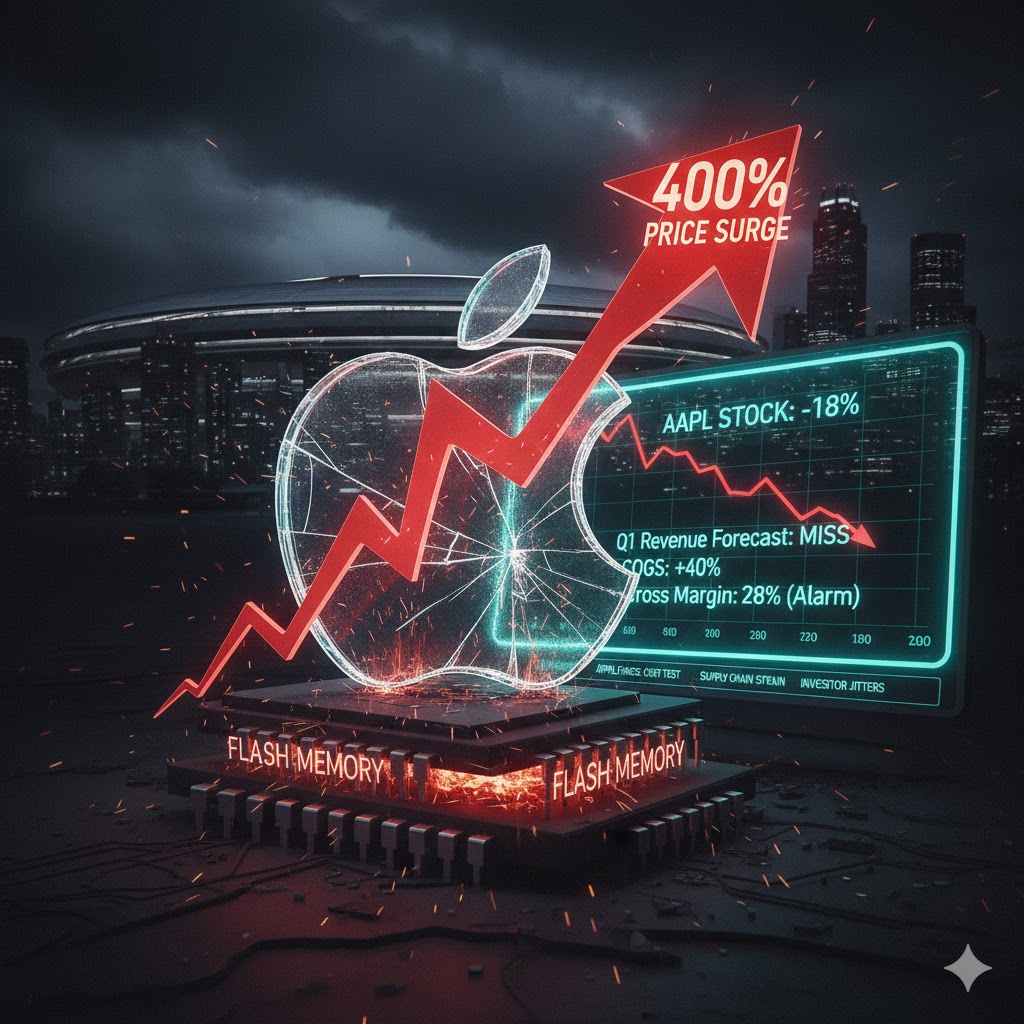
Since hitting a peak on December 2, Apple shares have fallen more than 10%, making it the worst-performing stock among the “Mag7” technology names and the largest drag on the S&P 500 over the same period. The stock has declined for eight consecutive weeks, marking its longest losing streak since 1993.
This selloff is at least partly driven by market concerns over surging memory chip costs. As a critical component in smartphones and tablets, sharply higher memory prices are expected to weigh on Apple’s margins and profitability. The issue has overshadowed positive news around the company’s artificial intelligence initiatives and is expected to become even more pronounced after supply contracts expire in the second half of 2026.
Since late September, spot price indices for dynamic random-access memory (DRAM) chips have surged nearly 400%, reflecting a demand boom fueled by AI data center construction. On Tuesday, Apple supplier Qorvo Inc. issued guidance that fell well short of expectations and noted on its earnings call that “memory pricing and supply constraints are affecting customers’ production plans.”
Cost Pressure Beyond Historical Levels
“We’ve seen Apple face memory pricing pressure before, but never at this unprecedented pace,” said Shaon Baqui, Senior Technology Research Analyst at Janus Henderson, which holds a significant stake in Apple (NASDAQ:AAPL). “The market is clearly uncertain and worried that we could see more bad news on the memory front.”
According to data from technology research firm IDC, memory accounts for 10% to 20% of smartphone manufacturing costs. IDC has described rising memory prices as a “crisis” for hardware companies, with prices expected to remain elevated for the foreseeable future.
Apple’s scale gives it considerable bargaining power with suppliers and some ability to pass higher costs on to consumers, particularly as demand for premium models remains strong. However, the steep rise in memory prices leaves it with limited options. “Apple can mitigate some of the pressure, but the levers it can pull are limited,” Baqui said. “Pulling the pricing lever could damage demand. Clearly defining the margin impact will be critical.”
Wall Street Takes a Wait-and-See Approach
For now, Wall Street is largely standing on the sidelines. According to data compiled by Bloomberg, consensus expectations for Apple’s 2026 net profit have barely changed over the past month, with revenue and margin forecasts also remaining stable. If those assumptions are revised downward due to memory costs, it would imply that the stock is even more expensive in real terms—despite already trading at a premium to major indices and its own historical levels.
The memory issue comes at a time of mixed investor sentiment toward the tech giant. Apple’s previous earnings report offered an optimistic outlook, but sales in China unexpectedly declined. Meanwhile, Wall Street’s view of Apple’s AI positioning has turned more positive after the company struck a multi-year agreement with Alphabet’s Google to support Apple’s AI technologies, including Siri. The deal is seen as validating Apple’s strategy of not investing as aggressively in AI as some of its peers.
“I like Apple’s approach to spending,” said David Wagner, portfolio manager at Aptus Capital Advisors, which holds Apple shares. “Everyone is focused on its positioning in AI, but this shows it’s not falling behind.”
Valuation Premium Meets Slowing Growth
Apple (NASDAQ:AAPL) currently trades at around 30 times forward earnings, above its 10-year average of 22 times and higher than the Nasdaq 100 Index (NASDAQ:NDX) and the broader “Mag7” group.
Revenue for Apple’s 2026 fiscal year (ending in September) is expected to grow 8.7%, the fastest pace since 2021, but growth is projected to slow in each of the following three fiscal years. According to Bloomberg Intelligence, the overall technology sector is expected to see revenue growth of about 19% in 2026, while the technology hardware and equipment sub-sector is forecast to grow 11%.
Even so, despite elevated valuation multiples and relatively modest growth, many investors continue to view Apple as a relative safe haven within the technology space. Its strong balance sheet, durable profitability, and robust cash flow make it a stable core holding in portfolios.
“Clearly the valuation multiple is high, but relative to the other ‘Mag7’ names, Apple looks like a very resilient company,” Baqui said. “It has a massive installed user base and recurring revenue from services, all of which support free cash flow. I don’t know if we’ll see a growth inflection anytime soon, but in volatile times, it still feels like a warm blanket.”
Leave a Reply