The automotive industry has long looked to Tesla, Inc. (NASDAQ:TSLA) as the vanguard of manufacturing disruption, with its “Gigacasting” process serving as the crown jewel of its production efficiency. However, as the fiscal realities of 2026 set in, a significant strategic pivot has emerged. Tesla has reportedly scaled back its ambitious plans to implement full, single-piece underbody gigacasting for its next-generation vehicles. This retreat from a much-touted manufacturing breakthrough signals a profound shift in the company’s internal priorities. Amidst a cooling global electric vehicle (EV) market and intensifying competition from lower-cost manufacturers, Tesla appears to be prioritizing immediate capital preservation over the long-term, high-risk pursuit of radical production innovations. This decision is not merely a technical adjustment; it is a defensive maneuver aimed at protecting the company’s eroding margins as it navigates a transitional period in its corporate lifecycle.
The fiscal architecture of Tesla (NASDAQ:TSLA) has faced unprecedented pressure over the past several quarters. In the most recent financial disclosures for early 2026, the company revealed that while total revenue remained resilient due to its energy storage segment, the automotive gross margin—a key metric for institutional investors—has struggled to return to its historic highs above 20%. The decision to abandon the “unboxed” single-piece casting for a more traditional three-piece underbody assembly is a direct response to the massive capital expenditure (CapEx) requirements associated with the gigacasting process. While the single-piece method promised to eliminate hundreds of parts and robots, the upfront investment in specialized “Giga Presses” from suppliers like IDRA Group, combined with the high scrap rates often associated with such large-scale aluminum die-casting, created a financial “valley of death” that the company could no longer ignore in the current high-interest-rate environment.
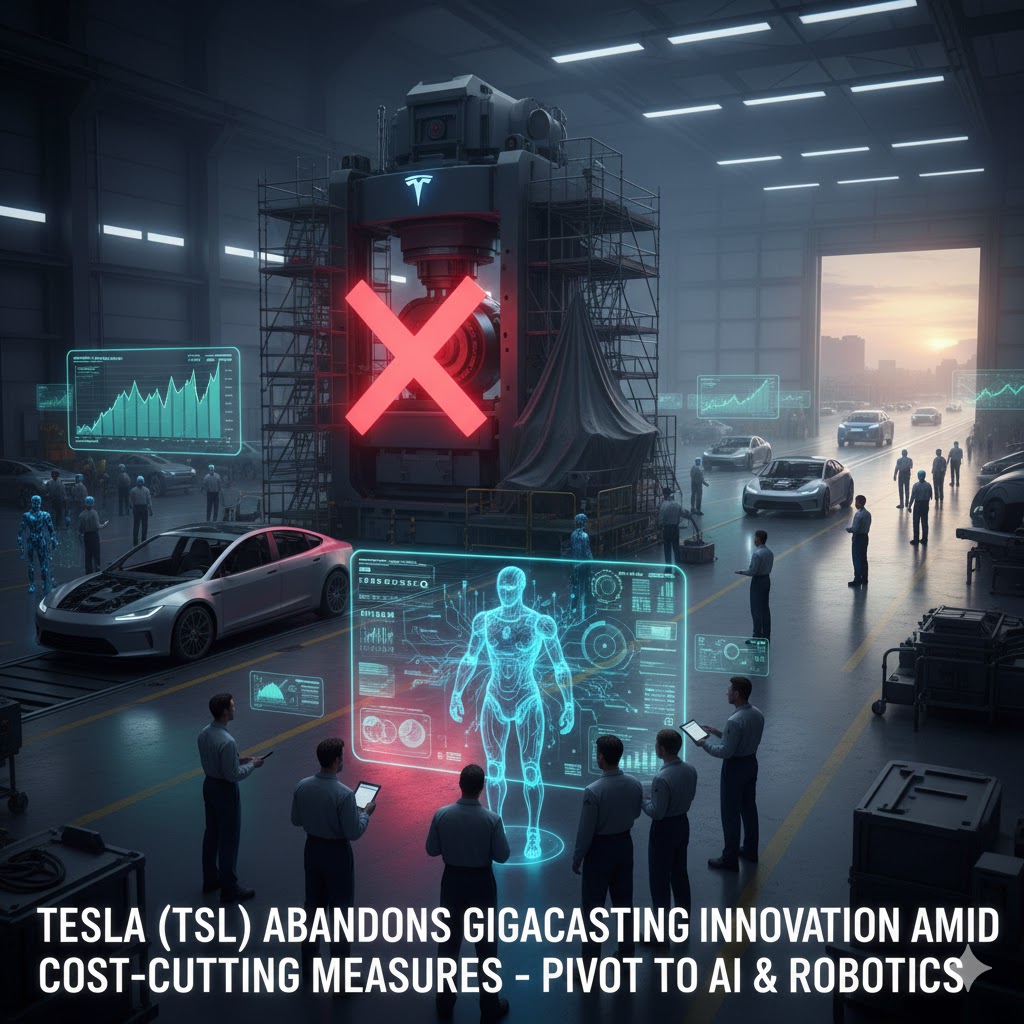
From a business development perspective, this strategic retreat is closely linked to Tesla’s broader “cost-cutting super-cycle.” Throughout 2025 and into 2026, the company has implemented several rounds of global layoffs, impacting nearly 10% of its workforce, and has significantly streamlined its product development roadmap. The “Model 2″—often referred to in the media as the $25,000 affordable Tesla—was initially slated to be the primary beneficiary of the single-piece gigacasting innovation. By simplifying the chassis to a single component, Tesla hoped to achieve the price parity with internal combustion engine vehicles that has remained elusive. However, internal reports suggest that the complexity of achieving a zero-defect rate on a single-piece underbody was threatening to delay the Model 2’s launch well beyond 2026. By reverting to a proven three-piece casting method, Tesla (NASDAQ:TSLA) is choosing “speed to market” over “manufacturing perfection,” a pragmatic shift that reflects the urgency of competing with nimble rivals like BYD Co. Ltd. (OTC:BYDDF).
The technical challenges of gigacasting have been a recurring theme in industry analysis. While the Model Y produced at Gigafactory Texas and Berlin already utilizes front and rear giga-castings, the integration of these two sections with a central battery-carrying floor into a single monolithic casting presented an exponential increase in engineering difficulty. For most manufacturers, including traditional giants like Toyota Motor Corporation (NYSE:TM) and Ford Motor Company (NYSE:F), the “sweet spot” of efficiency currently lies in modular casting rather than total structural unification. Tesla’s decision to follow this more conservative path suggests that even the industry’s most aggressive innovator has found the limit of what is currently economically viable in large-scale aluminum fabrication.
Market analysts have been quick to dissect the impact of this move on Tesla’s long-term valuation. For years, a significant portion of the premium attached to Tesla (NASDAQ:TSLA) shares was based on the belief that its manufacturing “moat” was widening. If Tesla is now using assembly methods more closely aligned with those of traditional OEMs (Original Equipment Manufacturers), the argument for its superior efficiency becomes harder to sustain. However, some institutional investors, including those at funds like BlackRock, Inc. (NYSE:BLK) and The Vanguard Group, may view this as a sign of maturity. A company that can admit when an innovation is not yet ready for prime time is a company that is protecting its balance sheet. In an environment where the cost of capital remains elevated, cash-flow stability is often prized over speculative engineering feats.
Furthermore, the reallocation of resources away from gigacasting innovation appears to be feeding into Tesla’s “AI-First” pivot. CEO Elon Musk has increasingly signaled that the future of Tesla (NASDAQ:TSLA) lies not in being a mere car company, but in being a leader in robotics and autonomous systems. The massive R&D budgets previously dedicated to manufacturing engineering are being redirected toward the Dojo supercomputer and the development of the “Optimus” humanoid robot. By mid-2026, Tesla expects to have thousands of Optimus units working within its own factories, performing the very assembly tasks that gigacasting was supposed to eliminate. In this light, the abandonment of single-piece casting isn’t just a cost-cutting measure; it is a strategic bet that silicon-based intelligence will be a more effective productivity driver than iron-based manufacturing.
The impact on Tesla’s supply chain is also significant. Suppliers that had been gearing up for a “gigacasting-only” future are now having to recalibrate. The demand for ultra-high-pressure die-casting machines remains strong, but the focus has shifted toward smaller, more manageable modules. This shift provides an opening for Tier 1 suppliers like Magna International Inc. (NYSE:MGA) and Nemak, who specialize in sophisticated aluminum components but lacked the scale to produce entire vehicle underbodies. For these companies, Tesla’s retreat is a signal that the traditional automotive supply chain still has a vital role to play in the EV era.
In terms of market competition, the timing of Tesla’s manufacturing pivot is critical. In China, manufacturers like Xiaomi Corporation (OTC:XIACY) and Geely Automobile Holdings Limited (OTC:GELYF) have been aggressively adopting their own versions of gigacasting. If these competitors can successfully implement the single-piece casting that Tesla (NASDAQ:TSLA) is now abandoning, they could potentially leapfrog Tesla in terms of production cost efficiency in the crucial sub-$30,000 segment. This creates a high-stakes race where Tesla is betting on software (FSD and AI) while its rivals are betting on hardware (manufacturing integration). The result of this divergent strategy will likely determine the market leaders of the 2030s.
The environmental impact of this decision is another layer of the analysis. Gigacasting was praised for its potential to reduce the carbon footprint of manufacturing by eliminating thousands of welds and reducing the physical size of the factory. By moving back toward a multi-piece assembly, Tesla (NASDAQ:TSLA) may see a slight increase in the energy intensity of its production lines. However, the company is offsetting this through its Energy segment, which saw record deployments of the Megapack 3 in the first half of 2026. For ESG-focused investors, the trade-off between manufacturing efficiency and the rapid scaling of renewable energy storage is a complex but necessary calculation.
Operational data from Tesla’s Gigafactory Texas suggests that the transition to the revised assembly method is already underway. The “unboxed” assembly line, which was a central feature of the 2023 Investor Day, is being modified to accommodate the three-piece casting approach. This allows the factory to maintain a high level of automation while reducing the “down-time” caused by the calibration of the massive 9,000-ton presses. As Tesla (NASDAQ:TSLA) prepares for the mass production of the Cybercab in late 2026, the reliability of the assembly line is paramount. A single failure in a single-piece casting can scrap an entire vehicle frame; in a three-piece system, only the defective module is lost, providing a much-needed boost to factory yields.
Looking at the broader macroeconomic picture, Tesla’s cost-cutting is reflective of a “secular stagnation” in the luxury EV segment. As early adopters are already served, the next wave of buyers is far more price-sensitive and less concerned with the underlying engineering “cool factor.” For these consumers, a Tesla (NASDAQ:TSLA) that is $2,000 cheaper because it uses a three-piece frame is more attractive than a more expensive one with a single-piece casting. Tesla is essentially commoditizing its own manufacturing process to meet the market where it is, rather than where the company’s engineers wanted it to be.
The strategic focus on FSD (Full Self-Driving) also plays into this. If Tesla (NASDAQ:TSLA) can achieve “unsupervised” autonomy in 2026, as Musk has predicted, the manufacturing cost of the car becomes secondary to the value of the software. A Robotaxi that generates $30,000 in annual high-margin revenue doesn’t need to be built using a revolutionary casting process to be profitable. This “Software-as-a-Service” (SaaS) model is the ultimate goal, and every dollar saved on the gigacasting R&D is a dollar that can be spent on training the neural networks that will power the autonomous fleet.
In conclusion, the report that Tesla (NASDAQ:TSLA) is abandoning its most radical gigacasting innovations represents a watershed moment for the company. It marks the end of the “manufacturing-at-all-costs” era and the beginning of a more mature, fiscally disciplined phase. While some may see this as a loss of the company’s innovative edge, a deeper analysis reveals a calculated shift toward the next frontier: AI and robotics. By prioritizing the health of its balance sheet and the speed of its product launches, Tesla is positioning itself to survive the “EV winter” and emerge as a diversified technology conglomerate. The Giga Press will remain a part of the Tesla story, but the dream of a single-piece car has been deferred in favor of the reality of a profitable, scalable business. Investors should monitor the upcoming Q2 and Q3 2026 earnings calls for further details on how these cost savings are being redeployed into the “Optimus” and “Cybercab” programs.
Leave a Reply