The global telecommunications equipment sector has faced a daunting period of capital expenditure retrenchment as major mobile operators across North America and India digest the massive investments made during the initial 5G rollout phase. However, Telefonaktiebolaget LM Ericsson (NASDAQ:ERIC), commonly referred to in financial circles as Eric, has signaled a potential turning point in its fiscal recovery. By reporting first-quarter financial results that substantially outpaced analyst estimates for adjusted Earnings Before Interest and Taxes (EBIT), the Swedish telecommunications giant has reignited investor confidence. This performance, characterized by aggressive cost-cutting measures and a strategic pivot toward high-margin software services, resulted in a pre-market stock surge exceeding 6%, providing a much-needed breath of optimism for a sector that has been largely sidelined by the broader technology rally.
The fundamental narrative of the first quarter revolves around the company’s ability to defend its margins in the face of declining organic sales. For the period ending March 31, Ericsson (NASDAQ:ERIC) reported that while group organic sales fell by approximately 14% year-over-year, the adjusted EBIT reached SEK 4.3 billion, comfortably exceeding the consensus forecast of roughly SEK 1.7 billion. This “beat” was not a product of top-line growth, but rather a masterclass in operational discipline and the benefits of a shifting product mix. The adjusted EBIT margin, a critical KPI for institutional investors monitoring the company’s turnaround, rose to 8.1%, up from 6.4% in the same quarter of the previous year. This expansion is particularly noteworthy given the contraction in the Networks segment, which has historically been the company’s primary profit engine.
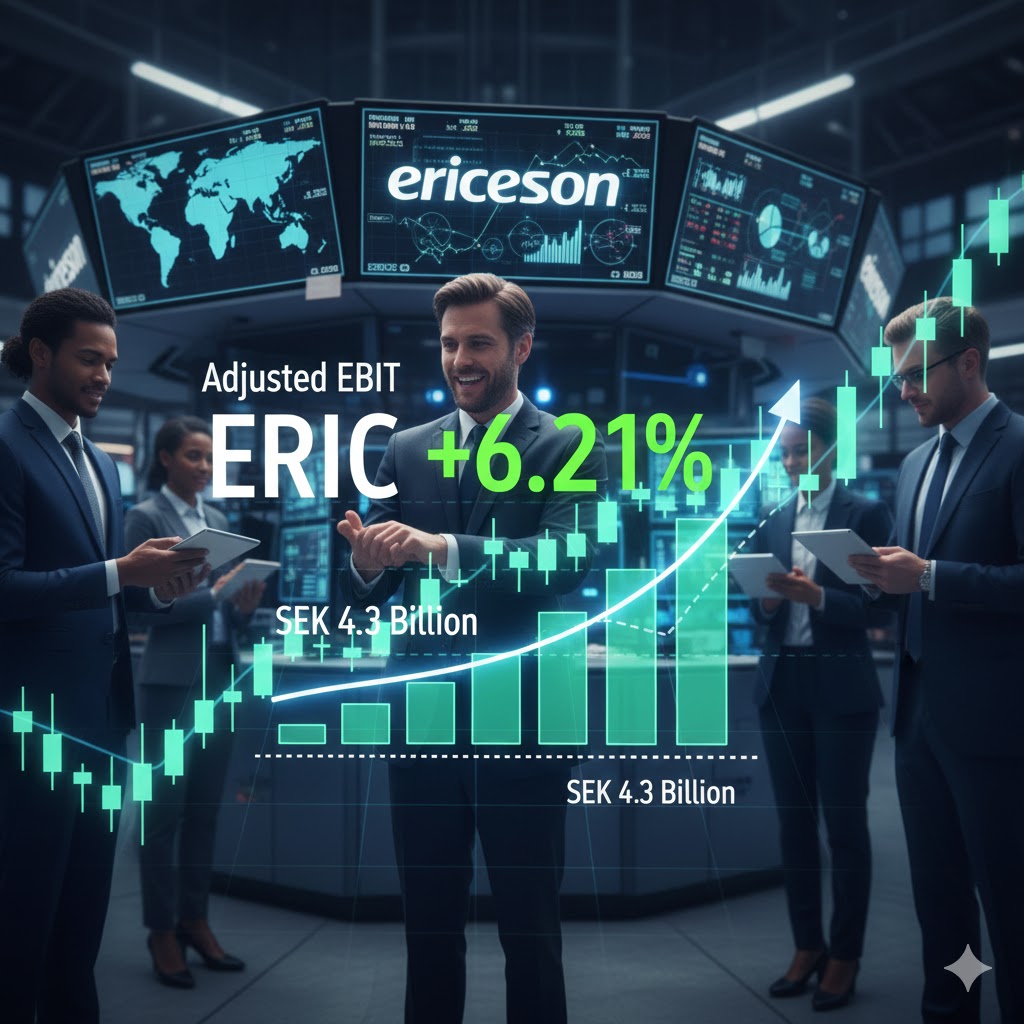
At the heart of this financial resilience is a strategic transformation led by CEO Börje Ekholm. The company has moved aggressively to streamline its operations, announcing thousands of layoffs globally, including a significant reduction of 1,200 staff in its home market of Sweden. These restructuring efforts are part of a broader initiative to shave billions off the annual cost base. In the first quarter alone, the company realized the benefits of these efficiencies, with operating expenses falling significantly. Furthermore, Ericsson (NASDAQ:ERIC) has benefited from increased Intellectual Property Rights (IPR) licensing revenues, which provided a high-margin cushion against the softness in hardware sales. For a company competing against rivals like Nokia Oyj (NYSE:NOK) and Samsung Electronics, maintaining a lead in patent monetization is essential to sustaining R&D investment during cyclical troughs.
The Networks segment, which encompasses the critical 5G radio access network (RAN) infrastructure, remains the focal point of the company’s long-term health. During the first quarter, sales in this division declined by 19% organically. This was largely attributed to the “normalization” of investment levels in India, where the initial rapid deployment of 5G infrastructure by operators like Reliance Jio and Bharti Airtel has transitioned into a more moderate phase. Additionally, North American operators such as AT&T Inc. (NYSE:T) and Verizon Communications Inc. (NYSE:VZ) have remained cautious, focusing on maximizing existing capacity rather than broad-based new builds. Despite these headwinds, Ericsson (NASDAQ:ERIC) managed to increase the gross margin in its Networks segment to 44%, supported by a competitive product portfolio and the successful execution of its “Cloud RAN” and “Open RAN” strategies.
One of the most significant milestones for the company’s business development in recent months was the landmark $14 billion agreement with AT&T Inc. (NYSE:T) to build a commercial-scale Open RAN network. This deal is not just a revenue driver; it is a validation of Ericsson’s technological roadmap. By leading the transition toward open, programmable networks, the company is positioning itself as an indispensable partner for operators seeking to monetize their 5G investments through network slicing and enterprise-grade APIs. This shift toward “Network as a Platform” is a central pillar of the company’s 2024-2025 growth strategy, aiming to move the industry away from commoditized connectivity and toward value-added services.
In the Cloud Software and Services segment, the results indicated a stabilizing trend. While the division has historically struggled with profitability, the first quarter showed a narrowing of losses and a clear path toward a positive EBITA. The company is increasingly focusing on automating network operations and providing AI-driven analytics tools to its customers. By integrating machine learning into its management suites, Ericsson (NASDAQ:ERIC) allows operators to optimize power consumption and predict network failures before they occur—a value proposition that aligns perfectly with the ESG (Environmental, Social, and Governance) mandates of large corporations. The expansion of these software offerings is critical for diversifying revenue away from the lumpy and capital-intensive hardware cycles.
Market participants are also keeping a close eye on the Enterprise segment, which includes the acquired Vonage business. The integration of Vonage is intended to provide a platform for developers to access network capabilities via APIs, creating a new ecosystem for 5G monetization. While the segment faced some initial integration hurdles and a challenging macroeconomic environment for cloud communication services, the strategic intent remains sound. The goal is to allow a developer at a company like Uber Technologies Inc. (NYSE:UBER) or Meta Platforms Inc. (NASDAQ:META) to programmatically request specific network performance—such as low latency for a VR session—directly through a simple API call. If Ericsson (NASDAQ:ERIC) can successfully scale this platform, it could unlock a multi-billion-dollar market that currently lies dormant.
The company’s balance sheet also showed signs of strengthening. Free cash flow before M&A was positive at SEK 3.7 billion, a significant improvement from the negative cash flow reported in the prior-year period. This improvement was driven by better management of working capital and the phasing out of some high-cost inventory. For a company that pays a consistent dividend, maintaining a robust net cash position is vital. As of the end of the first quarter, Ericsson (NASDAQ:ERIC) reported a net cash position of SEK 10.8 billion, providing it with the financial flexibility to continue investing in its next-generation “Zenith” radio platform and other R&D priorities.
Looking ahead to the remainder of the fiscal year, management has cautioned that the market remains “uncertain” but “stabilizing.” The second half of 2024 is expected to benefit from the ramping up of the AT&T contract and a potential recovery in some European markets. However, the competitive landscape remains fierce. The geopolitical tension surrounding Chinese vendors like Huawei has provided a tailwind for Ericsson (NASDAQ:ERIC) in Western markets, but it has also led to increased pressure on pricing and the need for continuous innovation to maintain a performance edge. The company’s ability to defend its market share in the face of a resurgent Nokia Oyj (NYSE:NOK) will be a key theme in the upcoming quarters.
From a valuation perspective, the pre-market surge reflects a “relief rally” as the worst-case scenarios for the 5G downturn appear to be avoided. Investors are beginning to reward the company for its ability to generate “quality” earnings—those derived from cost control and high-margin segments—rather than just “volume” earnings. With a price-to-earnings (P/E) ratio that remains attractive relative to its historical average and its peer group, Ericsson (NASDAQ:ERIC) is being viewed by some analysts as a classic deep-value play in the tech sector. However, the long-term success of the investment thesis depends on whether 5G monetization actually materializes for the mobile operators, thereby triggering the next wave of infrastructure spending.
Innovation in the radio space continues to move at a rapid pace. Ericsson (NASDAQ:ERIC) recently unveiled its latest “Massive MIMO” antennas, which are significantly lighter and more energy-efficient than previous generations. These product developments are crucial for operators who are struggling with rising electricity costs and the physical limitations of existing cell towers. By reducing the total cost of ownership (TCO) for its customers, the company reinforces its competitive moat. Furthermore, the company’s push into 5G Standalone (SA) technology is enabling new use cases in industrial automation, where companies like Siemens AG (OTC:SIEGY) are looking to deploy private 5G networks for smart manufacturing.
The market’s reaction to the earnings beat also underscores the sensitivity of telecom stocks to interest rate expectations. As capital-intensive businesses, both the equipment makers and their customers are sensitive to the cost of borrowing. A stabilization of global interest rates could provide a more favorable backdrop for the resumption of larger-scale network projects. While Ericsson (NASDAQ:ERIC) cannot control the macroeconomic environment, its focus on “controlling what it can control”—namely its cost structure and product innovation—is clearly paying dividends.
In conclusion, the first-quarter results from Ericsson (NASDAQ:ERIC) represent a significant milestone in its journey toward sustainable profitability. By exceeding adjusted EBIT expectations during a period of top-line contraction, the company has demonstrated that it possesses the operational flexibility to navigate a challenging market cycle. The pre-market surge of over 6% is a testament to the market’s appreciation of this discipline. As the company moves toward the second half of the year, the focus will shift from cost-cutting to the execution of major contracts and the scaling of its enterprise API platform. If the Swedish giant can maintain this momentum, it may well prove that the “5G winter” is finally giving way to a more temperate and profitable spring. The path forward is not without risks, particularly regarding global geopolitical stability and the pace of operator spending, but for now, Ericsson (NASDAQ:ERIC) has reclaimed its position as a resilient leader in the global telecommunications arena.
Leave a Reply