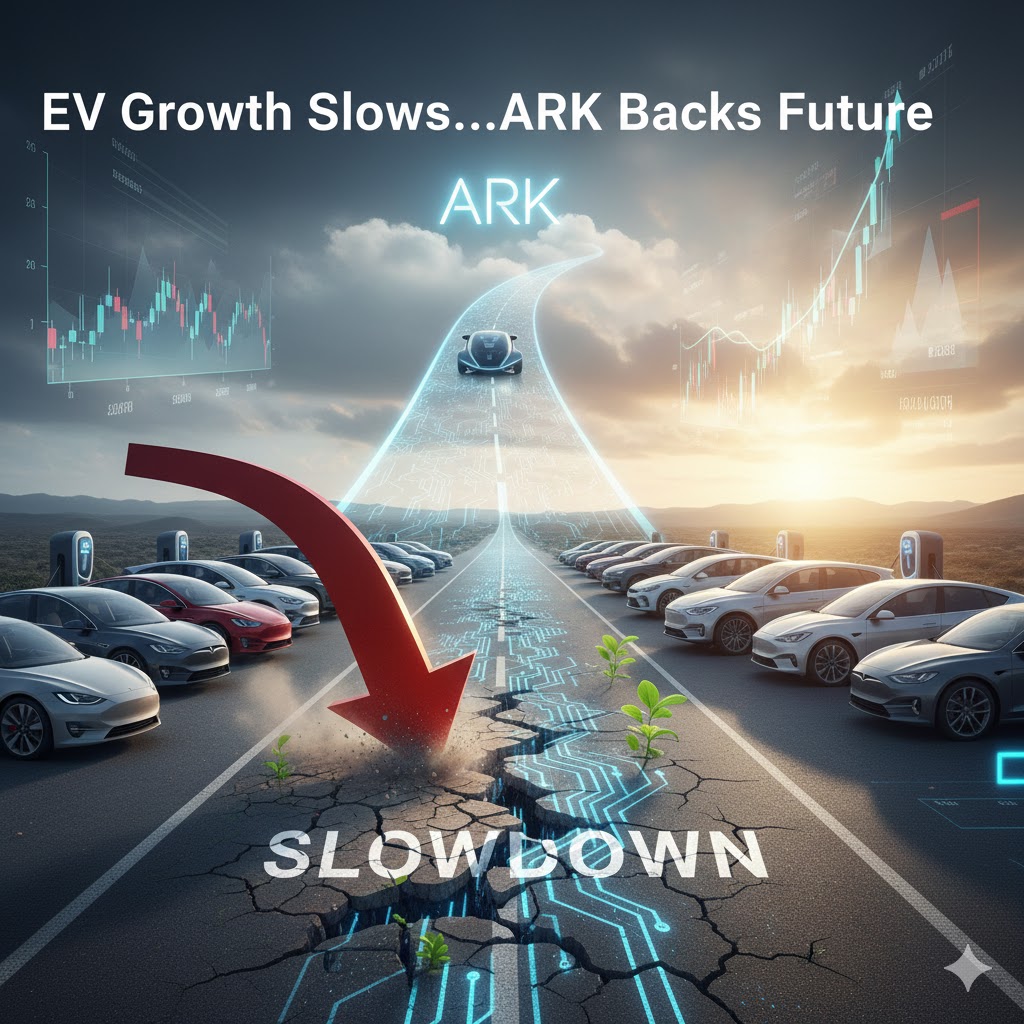
The narrative surrounding the electric vehicle (EV) industry has undergone a dramatic recalibration in late 2025 and early 2026. What was once heralded as an unstoppable juggernaut of exponential growth is now facing the realities of market saturation, infrastructure bottlenecks, and persistent consumer hesitancy. The headline, “Electric Vehicle Growth Slows Down Ark Backs Future Prospects,” encapsulates this evolving sentiment, highlighting a divergence between macroeconomic trends and the conviction of growth-focused investment firms like ARK Invest. While global EV sales growth has indeed moderated from the blistering triple-digit rates of previous years, Catherine Wood’s ARK Invest remains steadfast in its long-term bullish outlook, asserting that the current slowdown is a transient “air pocket” before the next wave of disruptive innovation and mass adoption.
This analysis delves into the critical factors contributing to the decelerated EV growth, examining the supply-side dynamics, consumer behavior shifts, and the evolving regulatory landscape. Simultaneously, it unpacks the core tenets of ARK Invest’s counter-cyclical thesis, focusing on the technological advancements, cost efficiencies, and infrastructure developments that ARK believes will reignite the EV revolution. We will explore specific examples of companies within ARK’s portfolio that are poised to capitalize on this anticipated future acceleration, analyzing their financial health, product development pipelines, and strategic market positioning without offering specific buy or sell recommendations.
The Macroeconomic Headwinds: A Reality Check for EV Growth
The euphoria that propelled EV stocks to dizzying heights between 2020 and 2023 has given way to a more sober assessment. Global EV sales, while still growing, saw their year-over-year expansion rate fall from a peak of 80% in 2022 to approximately 28% in 2025. This slowdown is not uniform across all markets or segments but reflects several interconnected macroeconomic and structural challenges.
Firstly, interest rates have played a pivotal role. The era of near-zero borrowing costs made financing expensive new EVs more palatable. As central banks globally maintained higher rates through 2025 to combat persistent inflation, the average monthly payment for a new EV surged by an estimated 15-20%, pricing out a significant portion of the mass market. This financial headwind has disproportionately affected younger buyers and those with tighter credit, who were previously key drivers of early adoption.
Secondly, consumer apprehension has become more pronounced. “Range anxiety” persists, particularly in regions with nascent charging infrastructure. While battery technology has improved, the perceived inconvenience of charging compared to traditional gasoline refueling remains a barrier for many. Furthermore, the “total cost of ownership” (TCO) advantage of EVs has narrowed. While electricity is generally cheaper than gasoline, the high upfront purchase price, coupled with insurance premiums that are often 10-15% higher for EVs, has eroded the economic incentive for some buyers. Used EV prices have also seen a notable depreciation, causing concern among potential first-time buyers.
Thirdly, the “early adopter” phase has matured. The initial wave of EV buyers was largely affluent, environmentally conscious, and willing to pay a premium for cutting-edge technology. The next wave of consumers is more price-sensitive and demands greater practicality, reliability, and ubiquity of charging solutions. Carmakers, having rapidly expanded production capacity, are now finding themselves with accumulating inventory, leading to price wars and eroding margins across the industry. This is particularly evident in China, the world’s largest EV market, where aggressive local brands have driven down prices to unprecedented levels, challenging established players.
ARK’s Counter-Cyclical Thesis: The Seeds of Future Disruption
Despite these immediate headwinds, ARK Invest’s conviction in the long-term prospects of the EV market remains unshaken. Their thesis hinges on several fundamental beliefs:
- Declining Battery Costs: ARK highlights that battery pack prices, the single most expensive component of an EV, have continued their exponential decline, albeit with temporary supply-chain-induced blips. They project battery costs to fall below $80 per kWh by 2027, a critical threshold where EVs will achieve “cost parity” with internal combustion engine (ICE) vehicles even without subsidies. This continuous cost compression, driven by advancements in lithium-iron-phosphate (LFP) and solid-state chemistries, is the core of their “S-curve adoption” model.
- Autonomous Driving as a Catalyst: ARK argues that the true disruption of the EV market will not come from electrification alone, but from the convergence of EVs with autonomous driving (AD) technology. Once vehicles can operate autonomously, the utility of a car transforms from a depreciating asset to a revenue-generating asset in a “Robotaxi” network. This shift will drastically reduce the cost of transportation, making owning a personal vehicle less necessary and accelerating the adoption of purpose-built autonomous EVs. Companies like Tesla (a major ARK holding) are at the forefront of this convergence with their Full Self-Driving (FSD) initiatives.
- Infrastructure Expansion: While charging infrastructure is currently a bottleneck, ARK believes that private sector investment, driven by profitability and government incentives, will rapidly accelerate its build-out. The adoption of universal charging standards (like the North American Charging Standard, NACS) is seen as a key enabler, simplifying the user experience and encouraging wider deployment. Companies specializing in charging solutions and energy management systems are therefore considered critical enablers within ARK’s investment universe.
- Software-Defined Vehicles: ARK posits that EVs are fundamentally “computers on wheels,” allowing for over-the-air (OTA) updates, new feature monetization, and continuous performance improvements. This software-centric approach creates recurring revenue streams and enhances customer loyalty, transforming the automotive industry from a purely transactional model to a subscription-based service model. This capability is expected to unlock further value as AI integration deepens.
Companies Aligned with ARK’s Vision: Beyond the Usual Suspects
While ARK Invest is famously bullish on Tesla, their portfolio reflects a broader conviction in the entire EV ecosystem.
- Tesla (NASDAQ: TSLA): Despite its recent volatility, Tesla remains a cornerstone of ARK’s EV strategy. Their financial analysis focuses not just on vehicle sales, but on the company’s lead in AI (FSD), battery technology, and energy storage. Tesla’s gross margins, while fluctuating, remain significantly higher than legacy automakers, primarily due to its direct-to-consumer sales model and vertical integration. ARK monitors Tesla’s progress on “gigafactory efficiency” and “4680 battery cell production” as key indicators of its long-term cost advantage.
- Baidu (NASDAQ: BIDU): As a Chinese tech giant, Baidu is a bet on the massive scale of China’s autonomous driving market. Its Apollo platform is one of the most advanced robotaxi services globally. Baidu’s financial statements show growing revenue from its AI cloud and autonomous driving unit, though it still represents a smaller portion of its overall search and advertising revenue. ARK’s interest lies in Baidu’s strategic planning to leverage its vast data moat and government support to dominate autonomous mobility in China.
- BYD (HKG: 1211): Often overlooked in the Western media, BYD has become the largest EV manufacturer by volume globally. ARK sees BYD as a highly vertically integrated powerhouse, producing not just EVs but also batteries, semiconductors, and even public transportation solutions. BYD’s aggressive market expansion into Europe, Southeast Asia, and Latin America, coupled with its cost leadership, makes it a formidable long-term player. ARK analysts closely track BYD’s battery innovations (like the Blade Battery) and its ability to maintain healthy margins amidst intense competition.
- Aptiv PLC (NYSE: APTV): This company provides critical software-defined vehicle architectures and advanced driver-assistance systems (ADAS) to numerous automakers. Aptiv represents a picks-and-shovels play on the broader EV and autonomous trend. Their new product development focuses on scalable, modular platforms that reduce complexity and cost for OEMs. ARK’s financial modeling for Aptiv emphasizes its strong order book and its strategic partnerships with both legacy and new EV players.
Market Implications and Investor Sentiment
The “Electric Vehicle Growth Slows Down” headline has undeniably shaken investor confidence, particularly for those who entered the market during the peak speculative phase. Many early-stage EV startups have seen their valuations collapse, and even established players have experienced significant pullbacks. This period of consolidation and rationalization is, in ARK’s view, a necessary “cleansing” of the market, separating the genuinely disruptive innovators from the overvalued hype.
For mainstream financial media and search engine optimization, the current narrative emphasizes caution and the challenges of profitability. However, for those with a longer time horizon, like ARK Invest, the current dip is seen as an opportunity. They contend that the fundamental technological trajectory of EVs—driven by declining costs and increasing capabilities—remains intact, and the temporary slowdown is masking the underlying strength of the innovation curve.
Risks to ARK’s Thesis
While compelling, ARK’s bullish stance is not without risks:
- Regulatory Uncertainty: Shifting government incentives for EV purchases could further impact demand.
- Raw Material Volatility: The prices of lithium, nickel, and cobalt remain subject to supply chain disruptions and geopolitical factors.
- Technological Competition: Legacy automakers are rapidly catching up, and new entrants (especially from China) are intensifying competition.
- Infrastructure Pace: The build-out of charging infrastructure might not keep pace with demand, even with increased investment.
- Consumer Preference Shift: A significant shift back to hybrid vehicles or a prolonged economic downturn could hurt EV adoption rates.
Conclusion: A Dip, Not a Deluge
The “Electric Vehicle Growth Slows Down Ark Backs Future Prospects” saga represents a classic divergence in market perception. Short-term headwinds, driven by macroeconomic factors and market maturation, are creating a period of significant volatility and reduced growth rates. However, ARK Invest’s thesis posits that these are merely temporary speed bumps on a long, inexorable journey towards a fully electric, autonomous transportation system.
For investors, the key is to differentiate between cyclical slowdowns and structural reversals. ARK’s detailed analysis of declining battery costs, the convergence with autonomous driving, and the relentless march of software-defined vehicles suggests that the fundamental drivers of EV adoption remain powerful. While the path to mass adoption may be bumpier than initially anticipated, the destination—a world dominated by electric and autonomous mobility—is, in ARK’s view, inevitable. The current market skepticism, therefore, presents an opportunity for those with a multi-year investment horizon to “back the future prospects” that these disruptive innovators represent. The slowdown is a signal for recalibration, not retreat.
Leave a Reply