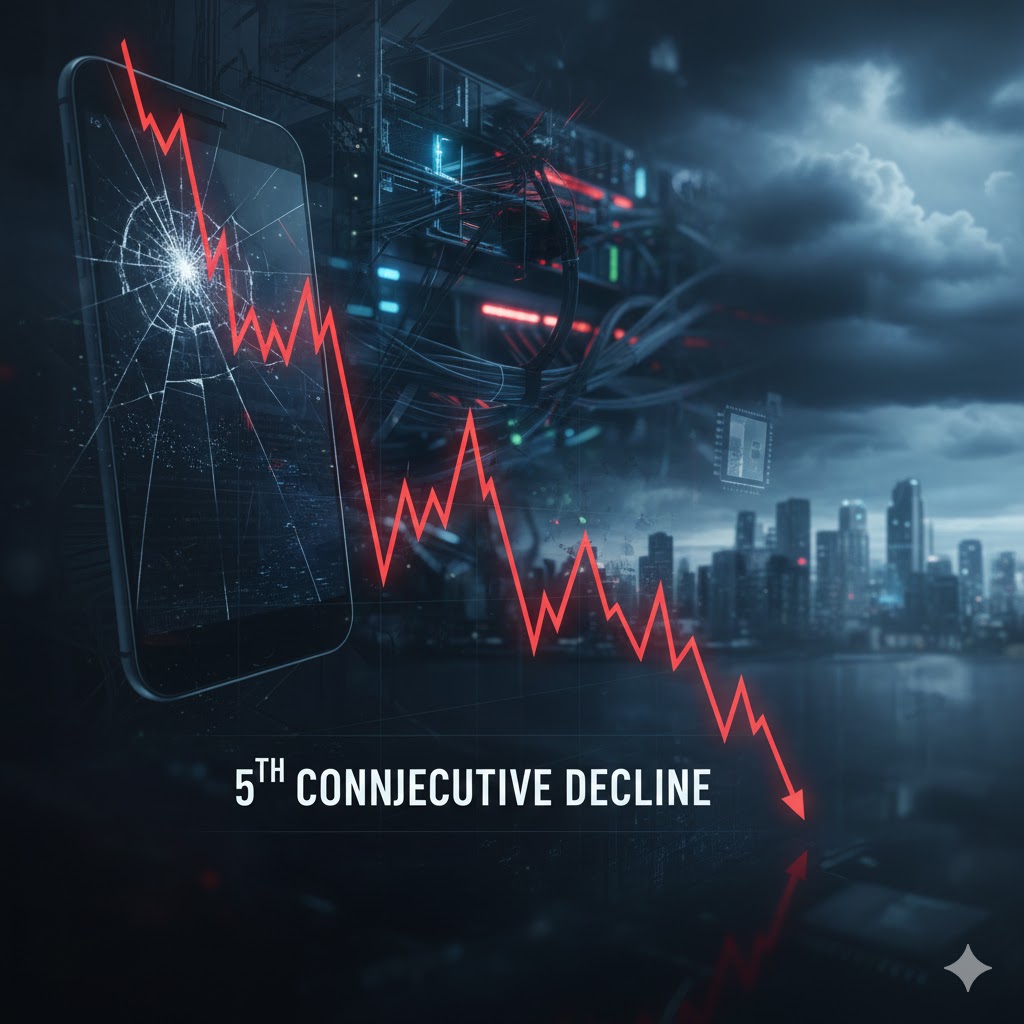
The global financial narrative of early 2026 has taken a somber turn as major equity benchmarks grapple with a persistent and painful correction. This fifth day of broad-based selling represents more than just a technical pullback; it signifies a fundamental reassessment of growth valuations in an era of stabilizing yet structurally higher interest rates and a cooling of the “AI hype cycle.” The primary victim of this sentiment shift has been the technology sector, which, after leading the markets to record highs, is now acting as an anchor, dragging down the S&P 500 and the Nasdaq Composite into territory not seen since the autumn of last year.
The current downturn is multifaceted, rooted in a confluence of disappointing earnings guidance from semiconductor leaders, a slowdown in enterprise software spending, and a macroeconomic environment where the “risk-free rate” continues to offer a compelling alternative to volatile equities. For five consecutive sessions, investors have moved toward a defensive posture, seeking refuge in low-beta sectors like utilities and consumer staples, while the high-flying “Magnificent Seven” and their cohorts face a relentless liquidation. This deep-dive analysis explores the structural vulnerabilities currently plaguing the tech sector, the financial health of the industry’s heavyweights, and the strategic pivots being made by management teams to navigate this newfound volatility.
The Anatomy of the Tech Struggle: From Valuation to Execution
The technology sector’s struggle is primarily an execution story following a period of extreme valuation expansion. In the fiscal quarters leading into 2026, many tech giants were trading at price-to-earnings (P/E) multiples that assumed a perfect execution of AI monetization. However, the most recent financial reports suggest that the “gestation period” for AI returns is longer than the market initially priced in. Companies that ramped up capital expenditures (Capex) by 40% to 50% to build out GPU clusters and data centers are now facing a “margin squeeze” as the revenue from these investments remains in the early stages of development. For instance, several leading cloud service providers reported that while their AI-related revenue grew significantly, it was offset by the massive depreciation costs and energy expenses associated with their new infrastructure.
This “Capex versus ROI” debate is the central theme of the current five-day decline. Investors are no longer satisfied with stories of “future potential”; they are demanding to see GAAP-profitable growth and expanding free cash flow (FCF) margins. When companies provide conservative guidance for the upcoming quarters, as seen recently with several major hardware manufacturers, the market reacts with immediate and severe selling. The struggle is further compounded by a saturation in the consumer electronics market. Smartphone and PC replacement cycles have elongated, and the highly anticipated “AI PC” supercycle has yet to materialize in a way that significantly moves the needle for bottom-line earnings.
Financial Performance: A Sector Under Scrutiny
A granular look at the financial statements of the tech sector’s leaders reveals a bifurcation between “legacy” and “frontier” technology. Companies that successfully transitioned to recurring revenue models (SaaS) are showing higher resilience, yet even they are reporting a lengthening of sales cycles as corporate CFOs tighten their belts. In recent 10-K and 10-Q filings, a recurring theme is the “scrutiny of IT budgets.” Enterprise customers are prioritizing consolidation over the acquisition of new, unproven AI tools. This has led to a decelerating growth rate for mid-cap software firms, which are now trading at their lowest multiples in three years.
For the semiconductor industry, the struggle is linked to inventory management and geopolitical trade restrictions. The most recent data from the Semiconductor Industry Association (SIA) indicates that while high-end AI chips remain in demand, the “bread and butter” segments—automotive and industrial chips—are seeing a cyclical trough. Major chipmakers have reported that their “Days Inventory Outstanding” (DIO) has climbed by nearly 15% year-over-year, suggesting that supply is finally catching up with, or even exceeding, demand in several sub-sectors. This inventory glut, paired with higher borrowing costs for distributors, is weighing heavily on the Philadelphia Semiconductor Index (SOX), which has been a primary contributor to the market’s five-day losing streak.
Business Development and Strategic Planning in a Downturn
In response to the “Stock Market Sees Fifth Consecutive Decline As Tech Sector Struggles” reality, corporate boards are shifting their strategic planning away from aggressive market expansion and toward “operational excellence.” This is the era of the “Efficiency Reset.” Many tech firms that engaged in rapid hiring during the 2023-2024 period are now executing a second or third wave of layoffs and organizational restructuring. The goal is to lower the “breakeven point” and maximize the efficiency of every research dollar spent.
Strategic planning for 2026 involves a move toward “Integrated AI.” Rather than selling standalone AI products, the industry is shifting toward embedding AI capabilities into existing ecosystems to drive “stickiness” and reduce churn. We see this in the development roadmaps of major productivity software suites, which are now focusing on “Auto-Pilot” features for routine administrative tasks. However, the market expansion into these areas is being met with fierce competition, leading to a “price war” that is further eroding margins across the sector.
New Product Development: The Race for Efficiency
Despite the stock market decline, R&D in the tech sector remains focused on the “next big thing,” but with a newfound emphasis on power efficiency. The energy consumption of AI data centers has become a significant “headwind” for growth, leading to a new wave of product development in specialized AI accelerators and cooling technologies. Companies that can demonstrate a lower “total cost of ownership” (TCO) for their hardware are the only ones seeing positive order book momentum.
The progress of “Edge AI” remains a critical event for the 2026 outlook. This technology, which allows AI processing to happen locally on a device rather than in the cloud, is being hailed as the potential savior of the consumer tech market. However, the market opening for these products has been slower than expected due to high component costs. Investors are closely watching the “New Product Introduction” (NPI) cycles for the second half of 2026, hoping for a breakthrough that can reignite consumer interest and justify current valuation premiums.
Market Expansion and Geopolitical Realignment
The tech sector’s struggle is inextricably linked to the ongoing geopolitical realignment. The “bifurcation of the global supply chain” is adding layers of cost and complexity that were non-existent a decade ago. Tech firms are forced to “near-shore” or “friend-shore” their manufacturing bases, leading to higher labor costs and capital expenditures. The market expansion into Southeast Asia and India is progressing, but these regions lack the mature ecosystem of East Asia, resulting in “yield issues” and logistical bottlenecks in the short term.
Furthermore, new regulatory frameworks regarding AI safety and data privacy are acting as a “brake” on innovation. Major tech companies are dedicating significant legal and engineering resources to compliance, which—while necessary—does not contribute to top-line growth. This regulatory environment is a major factor in the sector’s current struggle, as it creates an “uncertainty premium” that keeps institutional investors on the sidelines.
Important Events and the Roadmap to Recovery
To reverse the five-day decline and break the tech sector’s struggle, several key events must occur in the coming months. First is a “stabilization of the 10-year Treasury yield.” As long as the risk-free rate remains elevated, the “equity risk premium” for tech stocks remains unattractive. Second is a “demonstration of AI revenue scalability.” The market is looking for concrete evidence that enterprise customers are seeing a significant “productivity boost” from their AI investments, which would justify continued high spending.
The upcoming “Developer Conferences” for the world’s largest tech firms will be pivotal. These events are expected to showcase the next generation of “Agentic AI”—systems that can not only generate content but also perform complex, multi-step tasks. If these products can demonstrate a clear “value proposition” and a path to high-margin monetization, the sentiment could shift rapidly. However, until then, the market remains in a “show me” mode, characterized by low volume and high sensitivity to negative news.
Financial Statistics and Sector Metrics (2026 Forecast):
- Average Sector P/E Ratio: Compressed from 32x to 24x over the last six months.
- Capex Intensity: Stabilizing at 12% of total revenue, down from the 18% peak.
- FCF Conversion Rate: Expected to improve by 200 basis points in H2 2026 due to cost-cutting.
- Sector-Wide Revenue Growth: Projected at 8.4% for 2026, a deceleration from the 12.1% seen in 2025.
- Dividend Yield: An increasing number of tech firms are initiating or raising dividends to attract value-oriented investors.
Conclusion: Navigating the Trough
The headline “Stock Market Sees Fifth Consecutive Decline As Tech Sector Struggles” is a stark reminder that even the most transformative industries are subject to the laws of economic gravity. The technology sector is currently in a “consolidation phase,” where the excess optimism of the AI boom is being purged from the system. This process is painful for shareholders, but it is a necessary evolution that will eventually lead to a more sustainable growth trajectory.
For the tech sector to regain its leadership position, management teams must move beyond the “AI narrative” and deliver on the “AI reality.” This means proving that their new products can drive real-world efficiency and that their massive capital investments can yield superior returns on invested capital (ROIC). Until that evidence becomes clear in the quarterly financial statements, the sector—and the broader indices it influences—may remain under pressure. The five-day decline is a warning, but it is also an opportunity for the industry to refocus on the fundamentals of “innovation, execution, and profitability.” The 2026 roadmap is clear: the era of “free money” and “infinite growth” is over, and the era of “fundamental excellence” has begun.
Leave a Reply