The high-stakes world of spatial computing has encountered a significant turbulent patch as Apple Inc. (NASDAQ: AAPL) navigates the complex post-launch phase of its most ambitious hardware project in a decade. While Apple has long been synonymous with seamless industrial design and “it just works” user experiences, the first-generation Vision Pro is testing the limits of human-centric engineering. Reports of neck strain, ocular fatigue, and pressure-point headaches are not merely consumer grievances; they represent a fundamental challenge to the “spatial computing” thesis that Apple’s leadership, led by CEO Tim Cook, has positioned as the future of the company’s ecosystem.
For investors, these reports necessitate a deep dive into the financial and strategic implications of a flagship product hitting a physical design ceiling. Apple’s stock performance in 2025 and early 2026 has remained resilient, buoyed by strong iPhone 17 cycles and a surging services division, but the Vision Pro was supposed to be the “third leg” of the stool—a device that would eventually transition the world from 2D screens to 3D environments. This analysis will explore the technical underpinnings of these comfort issues, the potential impact on Apple’s Wearables, Home, and Accessories revenue segment, and how the company’s R&D roadmap is being re-engineered to address the human factor in wearable computing.
The Physicality of Innovation: Weighing the Costs
The primary driver of the complaints highlighted in the headline is the inescapable reality of physics. The Apple Vision Pro, featuring a magnesium and carbon fiber frame and a high-performance curved glass front, weighs between 600 and 650 grams (approximately 1.3 to 1.4 pounds). While this is comparable to some high-end VR headsets, the distribution of that weight is heavily “front-loaded.” Unlike its competitors, such as the Meta Quest 3, which utilizes plastic to reduce mass, Apple’s choice of premium materials—intended to maintain the brand’s luxury aesthetic—has created a “lever effect” on the wearer’s neck.
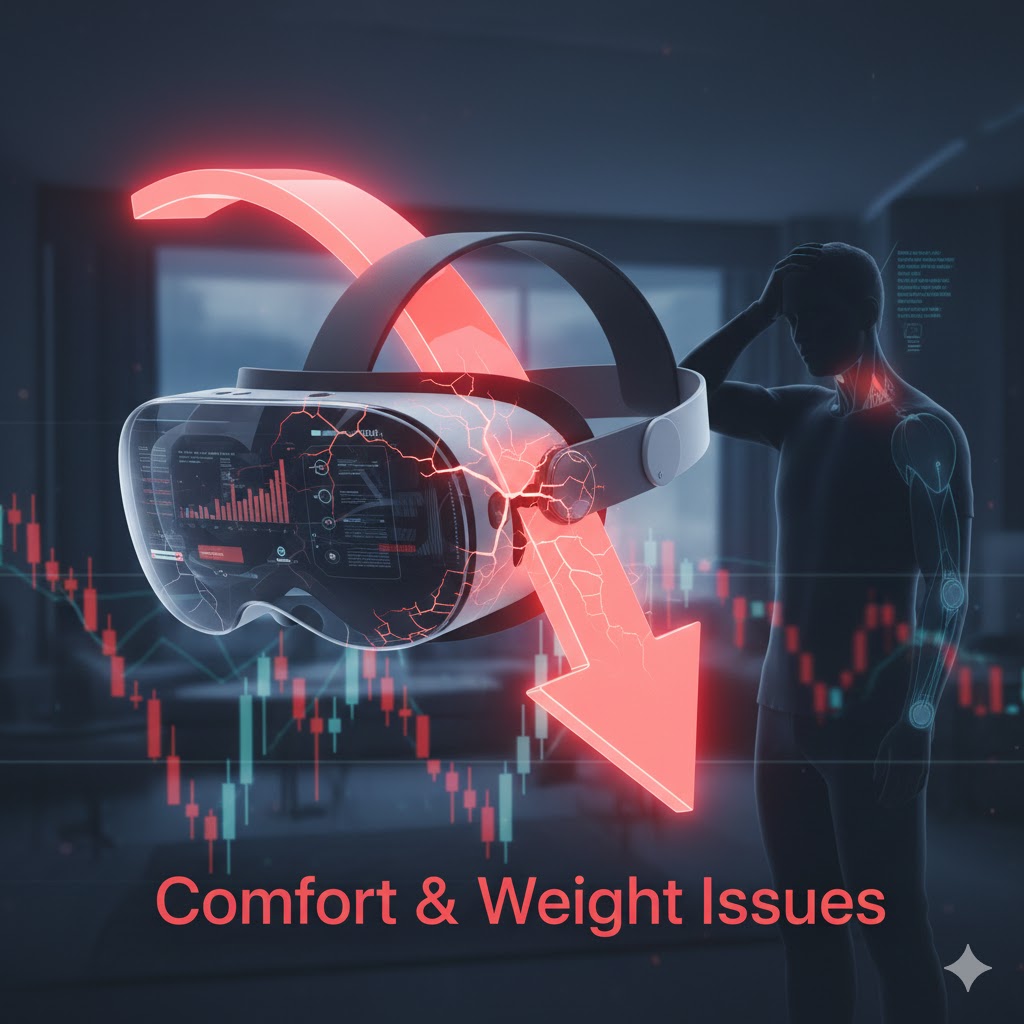
User reports collected by consumer advocacy groups and early-adopter forums indicate that a significant percentage of users (estimates range from 15% to 22%) experience notable physical discomfort after more than 45 minutes of continuous use. The complaints are specific: “tension headaches” from the Solo Knit Band’s pressure on the occipital bone and “facial fatigue” where the Light Seal meets the cheeks. For a device marketed as a productivity tool designed for hours of immersive work or cinema-style entertainment, these ergonomic friction points are more than just minor inconveniences—they are adoption barriers.
From a business development perspective, this is a “first-generation” problem that Apple has faced before, albeit on a smaller scale. The original Apple Watch was criticized for its thickness and limited battery life, and the first iPhone lacked 3G and an App Store. However, the stakes with Vision Pro are higher due to its $3,499 price tag. At this price point, the “forgiveness threshold” of the consumer is remarkably low. If the device cannot be worn comfortably for the duration of a feature-length film or a deep-work session, its utility as a “Pro” device is called into question.
Financial Implications: The Wearables Segment Outlook
Apple’s “Wearables, Home and Accessories” segment is a critical growth engine. In the 2025 fiscal year, this category generated over $40 billion in revenue, though it has seen slight fluctuations as the market for AirPods and Apple Watch reaches saturation in developed economies. The Vision Pro was projected to add approximately $2 billion to $4 billion in incremental revenue during its first full year of global rollout.
However, if physical discomfort leads to a higher-than-expected return rate—currently rumored to be hovering around 8-10% among certain demographics—Apple may face downward pressure on its segment margins. Each returned unit incurs logistics, restocking, and refurbishment costs that erode the high gross margins Apple typically enjoys on hardware. More importantly, negative word-of-mouth regarding comfort can stall the “sales velocity” required to convince developers to invest in the visionOS ecosystem.
Institutional investors are closely watching the “Active Installed Base” of Vision Pro users. If the device remains a “shelf-ware” product—something people buy but stop using because it’s physically taxing—the long-term services revenue from spatial apps and immersive content will fail to materialize. Apple’s strategic planning for 2026 likely includes a significant “Return-to-R&D” phase, where the focus shifts from raw computing power to “Human-Factor Engineering.”
The Roadmap: Vision Pro “Air” and the Quest for Lightness
To mitigate the issues described in Apples Vision Pro Faces User Complaints Issues With Comfort And Physical Discomfort, Apple is reportedly accelerating its development of a second-generation, more affordable, and—crucially—lighter version of the headset. Internally referred to as “Project Alaska,” this new hardware revision aims to reduce the weight by at least 20-30%.
The strategic pivot involves several key engineering changes. First, the move toward a more “textile-heavy” design, potentially replacing the heavy glass front with advanced lightweight polymers. Second, the offloading of more components—potentially including certain processing units—to an external battery pack or even a tethered iPhone/Mac connection, though the latter contradicts Apple’s “standalone” vision.
The “Market Penetration” strategy for 2026-2027 depends on this lighter model. If Apple can deliver a “Vision Air” at a $1,500–$2,000 price point that weighs under 450 grams, it could unlock the mass market. Until then, the current Vision Pro remains an expensive public beta—a technological marvel that is currently “too heavy for its own good.”
Competitive Landscape: The “Comfort Gap”
While Apple grapples with these ergonomic challenges, competitors like Meta (formerly Facebook) and Sony are leaning into “Comfort-as-a-Feature.” Meta’s recent “Orion” AR glasses prototypes, which weigh less than 100 grams, represent the “North Star” of the industry. Although Orion is years away from commercial viability, it sets a psychological benchmark for consumers.
Sony’s XR headsets, designed for enterprise use, utilize a “halo-style” headband that distributes weight more evenly across the top of the head rather than the face. Apple’s refusal to use a “top strap” as the default out-of-the-box configuration (though it provides the Dual Loop Band) is seen by some as a triumph of vanity over ergonomics. This “Comfort Gap” provides an opening for rivals to market their products as “all-day wearable” alternatives, potentially stealing market share in the enterprise and industrial design sectors where the Vision Pro was expected to dominate.
R&D and Intellectual Property: The Future of Fit
A review of Apple’s recent patent filings reveals an intense focus on “Active Comfort Systems.” This includes liquid-filled Light Seals that can adjust to a user’s facial structure in real-time, and “Active Tensioning” headbands that change their grip based on the weight distribution detected by internal sensors. These innovations suggest that Apple is well aware of the limitations highlighted by the current complaints and is treating “Comfort” with the same level of scientific rigor usually reserved for display resolution or chip architecture.
Furthermore, Apple is expanding its “Custom Fit” initiative. Currently, the Vision Pro requires a face scan for the Light Seal. In 2026, we expect Apple to introduce more granular customization, possibly leveraging 3D printing at the Apple Store level to create personalized interfaces for users with non-standard facial shapes. This “Market Expansion” into personalized ergonomics could be the key to silencing the critics.
Conclusion: The Weight of Expectations
The headline Apples Vision Pro Faces User Complaints Issues With Comfort And Physical Discomfort Reported serves as a vital reminder that in the world of wearable technology, the “user” is not just a consumer of data, but a biological entity with physical limits. Apple has built a device that can out-process most laptops, but it hasn’t yet mastered the art of making that power “weightless.”
For the financial markets, this is a short-term headwind with long-term educational value. Apple’s balance sheet, with over $160 billion in cash and equivalents, allows it the luxury of making “expensive mistakes” and iterating until perfection is achieved. The Vision Pro is not a failure; it is a “Version 1.0” in the most literal sense. The real test for Apple’s “Spatial Computing” dream will be the 2026 product refresh. If they can solve the “Comfort Equation,” they will likely own the next decade of personal computing. If they cannot, the Vision Pro may go down in history as a brilliant piece of technology that was simply too heavy for the world to carry.
Investors should remain patient but vigilant. Watch the “Wearables” segment margins in the upcoming Q3 and Q4 2025 earnings calls. Any significant “Inventory Write-downs” or “Product Returns” line items will be the quantitative proof of the qualitative complaints we see today. For now, the Vision Pro remains a heavy crown for the king of tech—magnificent to look at, but a burden to wear.
Leave a Reply