In the high-stakes arena of the global energy transition, one critical mineral has long been the “silent partner” of the lithium-ion battery: graphite. While lithium and cobalt often hog the headlines, graphite makes up nearly half of a battery’s mass by weight. As the United States scrambles to dismantle China’s stranglehold on this essential material—a country that currently processes over 90% of the world’s graphite—a sleeper candidate in the Empire State is quietly positioning itself as the cornerstone of American mineral independence.
Titan Mining Corporation (NYSE American: TII | TSX: TI), historically recognized as a robust zinc producer, has undergone a radical strategic transformation throughout 2025. The company recently unveiled a blockbuster Preliminary Economic Assessment (PEA) for its Kilbourne Graphite Project in St. Lawrence County, New York. The projections are not just impressive; they are disruptive to the global supply chain. Titan aims to achieve full commercial production by 2028, with a projected output of 40,000 metric tons of graphite concentrate per year. To put that into perspective, this single facility is slated to satisfy approximately 50% of the current total U.S. demand for natural graphite.
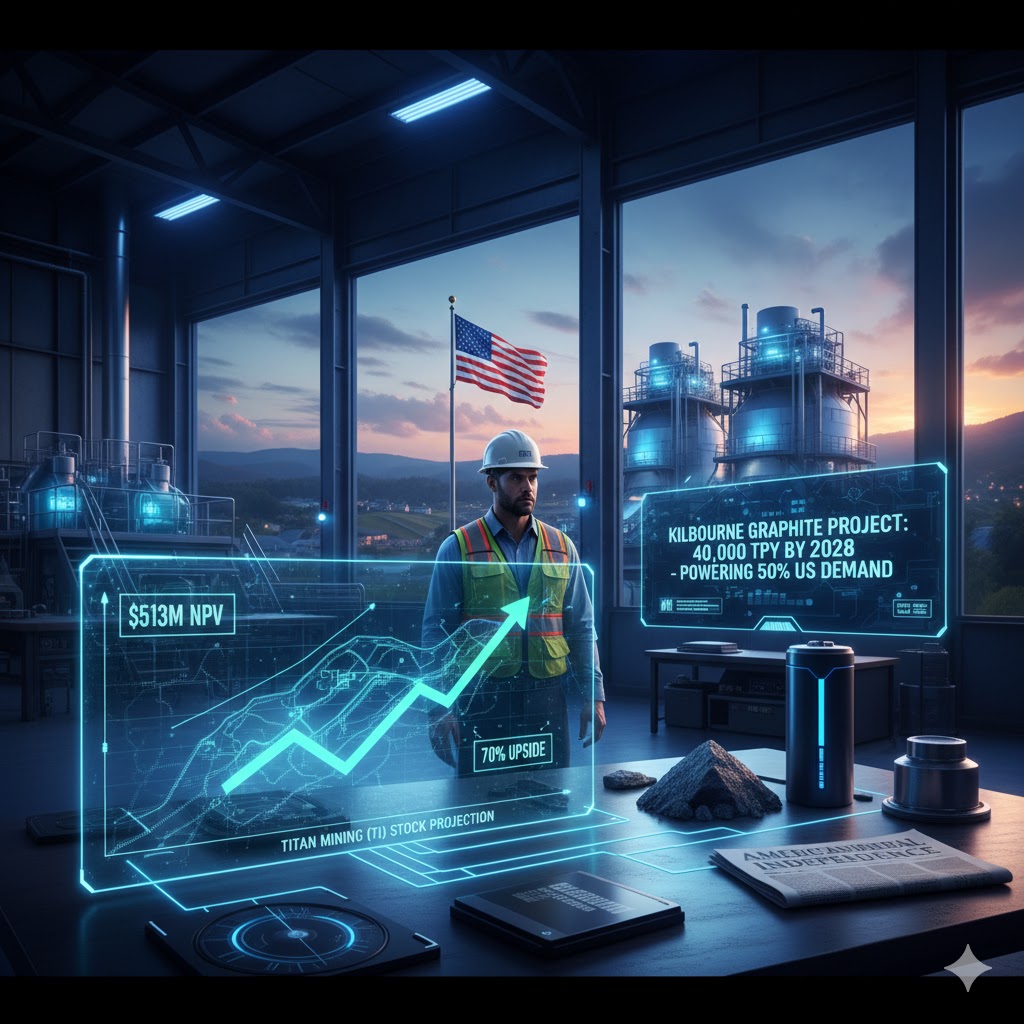
But is the market pricing this correctly? At its current valuation, Titan Mining appears to be one of the most significant mispricings in the small-cap mining sector. As of late December 2025, Titan’s stock trades around $2.43 to $2.52 (USD) on the NYSE American, with a market capitalization of approximately $230 million. When you stack this against the project’s internal economics, a clear case for “Underpriced” emerges. The Kilbourne Project boasts a staggering post-tax Net Present Value (NPV) of $513 million at a 7% discount rate, with an Internal Rate of Return (IRR) of 37%. Essentially, the value of this single graphite project alone is more than double the company’s entire current market capitalization, effectively giving investors the company’s existing zinc operations for free.
The strategic moat surrounding Titan is fortified by the U.S. federal government’s desperation for domestic supply. In a landmark move for the “Make More in America” initiative, the Export-Import Bank of the United States (EXIM) has already issued a $120 million non-binding Letter of Interest (LOI) to cover the majority of the project’s construction costs. Furthermore, in December 2025, Titan closed on a first-of-its-kind $5.5 million EXIM facility at a fixed interest rate of 4.77% to accelerate feasibility work. This level of sovereign backing materially de-risks the project for private investors and provides a non-dilutive pathway to production that few junior miners can match.
One of Titan’s greatest competitive advantages is its location. By leveraging the existing infrastructure of the Empire State Mine (ESM)—including 120,000 acres of mineral rights, existing power grids, roads, and a seasoned local workforce—Titan’s initial construction capital is a lean $156 million. This is a fraction of what a “greenfield” mine would require in a remote wilderness. In fact, Titan has already commenced start-up operations at a 1,200-tonne-per-year demonstration plant as of December 11, 2025. This facility will enable customer qualification runs throughout early 2026, significantly shortening the time-to-market compared to its peers.
From a product strategy standpoint, Titan is not just selling raw concentrate. The company is vertically integrating to produce Purified Micronized Graphite (PMG) and Coated Spherical Purified Graphite (CSPG)—the high-value “anode-ready” material that EV manufacturers crave to meet Inflation Reduction Act (IRA) subsidy requirements. With average Life-of-Mine EBITDA margins projected at a resilient 58-69%, the project is designed to generate an average annual EBITDA of $125 million. This cash flow profile is highly attractive in a commodity market that is forecast to see a 25% CAGR in natural graphite demand through 2030.
The bearish argument typically points to Titan’s debt levels or the execution risk of a 2028 commercial target. However, Titan is not a typical “pre-revenue” explorer. The company’s zinc operations generated over $105 million in trailing twelve-month revenue, providing the internal cash flow necessary to fund growth without the constant need for dilutive equity raises. Furthermore, a recent $15 million investment from a top-tier institutional investor in mid-December 2025 serves as a clear endorsement of the company’s dual-commodity strategy.
For investors, Titan Mining represents a rare “Two-for-One” deal: a profitable, cash-flowing zinc producer with a “free” call option on what is arguably the highest-return graphite project in the United States. While the 52-week range of $0.37 to $4.76 shows typical mining sector volatility, the current consolidation in the $2.50 range appears to be the final staging ground before the market fully digests the massive NPV gap. In an era where “Strategic Autonomy” is the primary mandate for the U.S. Department of Energy, Titan Mining is the ultimate play. For those willing to look past the short-term noise of the mining sector, Titan is a clear “Strong Buy” with a price target that could easily double once the Feasibility Study is delivered in late 2026.
Leave a Reply