Stellantis — the Franco-Italian automaker behind Jeep, Ram, Peugeot and Fiat — has argued that the European Commission’s recent move to scale back an effective 2035 internal-combustion ban does not fully address the industry’s real problems: affordability for mainstream consumers and the supply-chain readiness needed for mass BEV adoption. The company’s stance reflects hard economics — producing only battery electric vehicles by mandate risks leaving large segments of consumers without affordable new cars unless transitional technologies and flexible timelines are allowed. This policy shift lowers a major regulatory overhang for Stellantis and the European auto sector.
Quick snapshot — where the stock sits today
- Recent share price: approximately $11.9 per American-listed share (STLA.N). Market capitalisation: roughly $34–36 billion.
- Recent operating backdrop: Stellantis reported €37.2 billion net revenues in Q3 2025, up 13% year-on-year, and shipments rose ~13%, signaling commercial resilience even as margins and earnings have been pressured. The company recorded losses in recent periods, producing a negative trailing P/E while forward P/E estimates are materially lower (reflecting expected profitability recovery).
Those headline numbers show scale: Stellantis is a global revenue engine (well over €100 billion annual pace) but currently trading at depressed earnings multiples because the market is factoring in heavy transition costs and execution uncertainty.
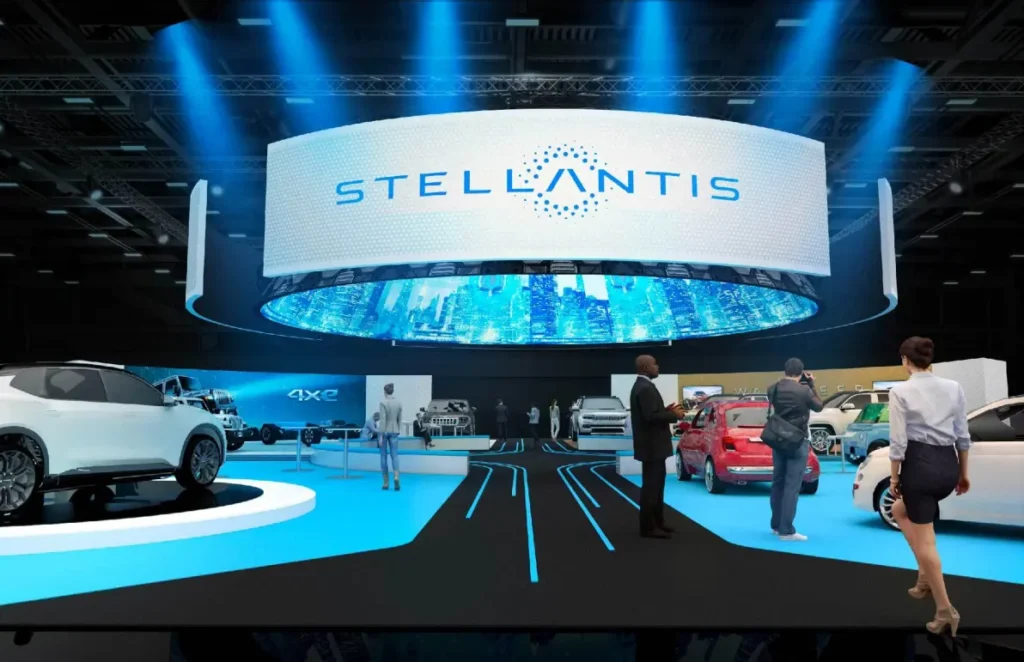
Why the EU policy shift matters to valuation
A harder line in Brussels (e.g., a strict 2035 ban) would have forced accelerated fleet electrification across Europe, pushing up capital spending, inventory write-downs, and margin compression — particularly for mainstream, lower-price segments where BEV economics are toughest. The revised proposal — which eases the timeline and allows transitional technologies more room — effectively buys time for Stellantis to:
- Deploy its dual-chemistry battery roadmap and staggered BEV launches rather than biting off full BEV conversion at once.
- Maintain sales of efficient ICE and plug-in hybrid models where economics remain positive for consumers, especially in price-sensitive markets.
- Smooth capital expenditure and supply-chain investments, reducing short-term pressure on margins.
Policy breathing room reduces execution risk and thus should, all else equal, support a higher valuation multiple than the market currently assigns.
Fundamentals and valuation — the math you need
Stellantis runs on very large top-line scale. Recent TTM revenue is roughly €170–172 billion (about $180B), yet recent net losses mean trailing P/E is negative; investors must therefore look to forward earnings and free-cash-flow (FCF) potential. Key points:
- Revenue scale provides a durable operating base and pricing power in key segments (trucks, SUVs, fleet).
- Earnings trajectory is the main valuation pivot: the market is pricing significant near-term margin risk. A modest recovery in operating profit margins toward mid-single digits would meaningfully re-rate the stock.
Illustrative scenario math (rounded and simplified):
- Base assumptions (consensus-style recovery): Revenue ≈ €170B; operating margin recovery to ~4% → operating income ≈ €6.8B. Apply 8x EV/EBIT multiple (conservative cycle) → enterprise value ≈ €54B. Subtract net debt (assume modest leverage) → implied equity value consistent with current market cap (i.e., valuation close to fair).
- Bull case (technology and margin execution): Operating margin → 7% → EBIT ≈ €11.9B. At 8–10x multiple, EV ≈ €95–120B → equity value materially higher (50–100% upside).
- Bear case (hardline regulation or slow EV ramp): Continued margin pressure, losses, and heavy capex → negative EPS for extended period → valuation compresses further.
The takeaway: small improvements in margin and clearer execution toward planned BEV launches can swing the valuation materially higher because the revenue base is already enormous.
Strategic positives
- Portfolio breadth and global footprint. Stellantis spans profitable North American truck brands (Ram, Jeep’s strong U.S. footprint) and volume European brands — a diversification advantage as markets electrify at different paces.
- Realistic electrification roadmap. Management emphasizes a practical, dual-track approach (battery chemistries and mix of BEV + efficient ICE/PHEV options) intended to preserve affordability and margin. This lowers the risk of inventory obsolescence.
- Procurement and supplier commitments. Recent announcements show active supplier spending and investment to shore up production capability in Italy and elsewhere — a signal of operational rebuilding. Reuters
Key risks that could keep shares depressed
- Execution risk on BEV rollouts and new models. Delivering 75+ BEV models by 2030 is ambitious; slippage or quality issues would hit margins and reputation.
- Cyclicality and short-term profitability. Recent losses and volatile margins highlight that top-line strength does not automatically convert to earnings until the product portfolio stabilizes and capex normalizes.
- Competitive pressure and Chinese EVs. If lower-cost Chinese imports accelerate in Europe, Stellantis must defend volume and pricing in core segments, pressuring margins.
- Policy flip-flops. While the recent EU easing helps, future regulatory tightening (or carbon pricing shifts) could reintroduce uncertainty.
Practical investment playbook
- Buy selectively for long-term investors who: (a) believe Stellantis can execute its cost and BEV plans; and (b) want exposure to a diversified auto manufacturer trading at valuation discounts to peers relative to revenue scale. Accumulate in tranches, using pullbacks to add.
- Hedge / Reduce exposure if you need short-term safety — e.g., if you cannot tolerate further negative earnings surprises or policy oscillations.
- Catalysts to monitor: quarterly margin trends, cadence of BEV launches and uptake, supplier and capex updates, and further EU regulatory clarifications.
Bottom line
The EU’s pragmatic retreat from a rigid 2035 ICE ban is a net positive for Stellantis: it reduces forced early electrification cost and preserves the company’s ability to offer affordable models for mass consumers while pursuing BEV growth. Given Stellantis’s enormous revenue base but near-term earnings uncertainty, the market has priced significant execution and regulatory risk — a discount that offers upside for investors confident in management’s execution and the multi-pathway electrification plan. For patient, risk-tolerant investors, selective buying now is justified; for short-term traders or valuation-sensitive investors, wait for clearer margin recovery or catalytic BEV delivery evidence.
Leave a Reply