
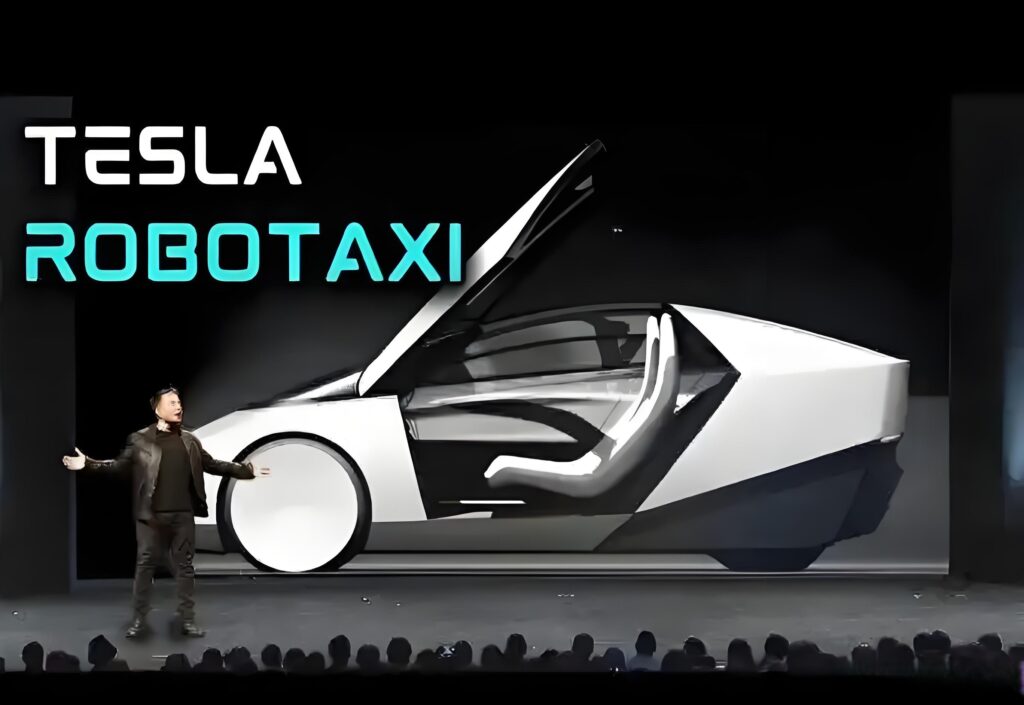


Tesla’s share price has rocketed as headlines shift from pure EV growth to an audacious autonomous-mobility future. Morgan Stanley now projects Tesla will ramp its Robotaxi fleet from “a handful today” to roughly 1,000 vehicles in 2026, with Cybercab production slated for April 2026 — a thesis that helped send the stock sharply higher after news of driverless tests in Austin. Those developments are material and potentially game-changing for Tesla’s TAM and unit economics — but they also sit against one of the highest P/E ratios the market has seen for a company of Tesla’s size. Investors must therefore ask: is the stock pricing a future that will actually arrive on time and at scale, or is it a valuation premium built on optimistic milestones?
Below I assemble the evidence, walk through concrete numbers, and show scenario math so you can judge if Tesla is overvalued or underpriced today.
The new facts that move the needle (what just happened)
- Morgan Stanley published a note forecasting a meaningful Robotaxi fleet expansion in 2026 — roughly 1,000 robotaxis next year — and projecting up to 1 million robotaxis by 2035 if Tesla executes at scale. This is explicitly tied to regulatory and technical milestones that Morgan Stanley expects to be crossed.
- Tesla has begun no-safety-driver testing for its autonomous fleet in Austin, a step Morgan Stanley and others call a critical validation toward commercial robotaxi deployment. Independent reporters described the Austin tests as a near-final validation step before scaling.
- Tesla’s roadmap includes the Cybercab (a vehicle purpose-built for robotaxi service) with production widely reported to target April 2026, which Morgan Stanley lists as a key catalyst.
These developments materially increase the plausibility of Tesla generating a new revenue stream (robotaxi ride revenue + potential fleet services) that could be sequenced into the company’s valuation. But plausibility is not equivalence to certainty.
Where the stock trades today (price, market cap, and earnings context)
- Most recent close: $489.88 per share (record/high close mid-December 2025).
- Market capitalization (approx): $1.63 trillion, placing Tesla among the handful of U.S. mega-caps.
- Trailing EPS (reported TTM): $1.50 (as shown in common market dashboards).
Because arithmetic must be explicit: to compute the trailing price-earnings multiple we divide the share price by trailing EPS digit-by-digit.
- Price = 489.88
- EPS (TTM) = 1.50
- Division: 489.88 ÷ 1.50 = 326.586666… → trailing P/E ≈ 327x (rounded).
A trailing P/E of ~327x is staggeringly high for any company outside early-stage, hyper-growth biotech or similar. For context, most mature tech names trade at mid-teens to low-30s P/E; even high-growth software firms rarely sustain hundreds-times earnings without substantial and visible revenue expansion.
Why Morgan Stanley’s Robotaxi thesis matters (and what it implies)
If Tesla truly scales to 1,000 robotaxis in 2026 and then to many thousands per year thereafter, the revenue and margin dynamics change:
- Robotaxi marginal cost per mile could be dramatically lower than ride-hailing with drivers; Morgan Stanley and others claim a possible structural cost advantage for Tesla robotaxis over incumbents.
- A monetized robotaxi service could create recurring ride revenue, potentially high gross margins once fleet and software amortization scale, and open new TAMs (urban mobility, logistics, robo-deliveries).
But moving from tests to mass commercialization requires: flawless safety metrics, favorable and consistent regulatory decisions across cities/states/countries, mature fleet operations, insurance models, and actual unit economics that beat current ride-hailing players after capex and operating costs.
Scenario math — three simple, transparent cases (12–36 month view)
We use a basic EPS/multiple framework because robotaxi revenue will feed the EPS line if and when it arrives. Starting point: TTM EPS = $1.50 and price = $489.88 (so trailing P/E ≈ 327x). We project EPS and then apply plausible multiples:
1) Bear case — Robotaxi execution stalls; EV margin pressure persists
- EPS stays flat (TTM EPS → $1.50).
- Market applies a conservative multiple (PE → 20x) for a slower-growth automaker.
- Implied price = 1.50 * 20 = $30.00 → downside ~-94% from $489.88.
2) Base case — Gradual improvement; limited robotaxi revenue; EV sales recover
- EPS grows to $6.00 (this would be +300% over current TTM — requiring material profit recovery and some new revenue). (Calculation: 1.50 + (1.50 * 3.0) = 6.00.)
- Market applies a multiple of 30x (premium for growth).
- Implied price = 6.00 * 30 = $180.00 → downside ~-63% from current.
3) Bull case — Robotaxi commercializes and scales, plus strong vehicle margin recovery
- EPS expands to $30.00 (this would reflect substantial new revenue from robotaxi and margin expansion; not impossible if robotaxi becomes material but a very optimistic assumption).
- Market applies a multiple of 40x (premium for scarce outcome).
- Implied price = 30.00 * 40 = $1,200.00 → upside ~+145%.
Notes on the math: each scenario is intentionally broad to show how sensitive valuation is to EPS and multiple assumptions. The bear and base cases show that even moderate EPS improvements leave the stock far below current price unless multiples remain extraordinarily high. The bull case requires transformative revenue and margins to justify today’s price or higher.
Key risks (why a neutral stance)
- Valuation stretch: trailing P/E near 327x bakes in nearly flawless execution and extremely rapid monetization of robotaxi services. Any delay or regulatory setback can compress multiples violently.
- Execution & regulatory risk: Austin tests are a major milestone but scaling unmanned operations across major metros requires sustained safety performance and regulators’ blessing. These are non-trivial.
- Capex and fleet economics: robotaxi fleets require upfront capital and ongoing operations; Tesla will either fund this itself (balance-sheet risk) or rely on partners — both bring complexity and margin dilution risk. Morgan Stanley’s optimistic per-mile cost assumptions may not hold uniformly across markets.
- Macro and EV demand cyclicality: EV sales and ASPs can swing with incentives, consumer demand, and competition — which undermines near-term EPS growth if hardware margins compress.
Why some investors remain bullish (and what would validate the thesis)
Bull investors point to (a) Tesla’s software advantage and fleet data, (b) vertical integration and low hardware cost trajectory, and (c) CEO Musk’s demonstrated ability to execute on ambitious hardware/software projects. The validation events that would materially de-risk the bull case are:
- Consistent safety metrics from unmanned Austin tests and regulatory approvals in at least one major U.S. city.
- On-time Cybercab production (April 2026) followed by meaningful commercial dispatches and per-vehicle utilization numbers supporting the unit economics.
- Concrete revenue or booking metrics from Robotaxi operations (ride revenue or fleet contracts) that show real contribution to the top line.
If those three boxes are ticked and early economics look favorable, the market could justify a much higher multiple — but until then, the current price largely reflects hope and optionality.
Practical investor playbook
- Risk-tolerant, long horizon: Small core weight is defensible if you believe in Tesla’s long-run optionality. Prefer dollar-cost averaging and increase allocation only after clear robotaxi revenue signs.
- Valuation-sensitive or near-term horizon: Trim or sell into strength. The downside from realistic base/bear EPS outcomes is large unless Tesla demonstrates near-term, tangible revenue shifts.
- Event tracking: Watch for (1) regulatory approvals and safety metrics from Austin; (2) Cybercab production progress in April 2026; (3) any reported ride revenue, utilization or contractual partners for fleet services.
Bottom line
Morgan Stanley’s projection of ~1,000 robotaxis in 2026 and driverless testing in Austin make Tesla’s autonomous future credible in a way it has not been before. Those are real, positive developments — and they explain why the market is awarding Tesla a breathtaking valuation today. But the current price assumes near-perfect execution and early monetization at scale. That’s not impossible, but it’s far from certain.
For most investors this means: do not buy full conviction at today’s levels. Treat Tesla as a high-conviction speculative holding that deserves active monitoring and event-driven sizing. If robotaxi milestones convert into concrete revenue and margins over the next 12–24 months, revisiting a bullish posture will be warranted — until then, a Hold / Neutral stance with risk-aware sizing is the prudent course.