The landscape of intelligent mobility in 2026 has reached a definitive tipping point, as the focus of the global automotive sector shifts from raw electrification to the sophistication of autonomous driving ecosystems. At the center of this transition is NIO Inc. (NYSE:NIO), which has officially commenced the rollout of its “full-scope urban functionality” for its Navigation on Pilot Plus (NOP+) system across its second-generation (NT2) platform vehicles. This strategic deployment marks more than just a software update; it signifies the culmination of a multi-year, multi-billion-dollar investment in the “Aquila Super Sensing” suite and the “Adam Super Computing” architecture. For institutional investors monitoring the Chinese New Energy Vehicle (NEV) market, the full-scope release serves as a critical de-risking event, moving NIO’s high-margin software-as-a-service (SaaS) aspirations from a pilot phase into a scalable revenue driver.
The NT2 platform, which underpins flagship models like the ES8, ET7, and the high-volume ES6, was engineered from its inception to handle the immense data throughput required for urban autonomy. By early 2026, NIO’s fleet has surpassed 1 million cumulative deliveries, providing a massive real-world data lake for the company’s internal AI training. The urban NOP+ functionality allows vehicles to navigate complex city environments—including unprotected left turns, roundabout management, and intricate pedestrian interactions—without driver intervention. This capability places NIO (NYSE:NIO) in direct competition with the “Full Self-Driving” (FSD) system from Tesla, Inc. (NASDAQ:TSLA) and the “XNGP” suite from XPeng Inc. (NYSE:XPEV), creating a trifecta of high-tech challengers vying for supremacy in the world’s most advanced EV market.
Financial Trajectory: Revenue Growth and Margin Expansion
The financial implications of this rollout are beginning to manifest in NIO’s fiscal performance. In its most recent quarterly report for the period ending December 2025, NIO (NYSE:NIO) recorded total revenues of RMB 21.79 billion (approximately $3.06 billion), representing a year-over-year increase of 16.7%. More importantly, the company’s vehicle gross margin has surged to 14.7%, its highest level in three years. This margin expansion is attributed to a combination of falling battery input costs and a growing contribution from high-margin digital services. As NOP+ transitions into a subscription-based model for urban use, analysts at JPMorgan Chase & Co. (NYSE:JPM) project that software revenue could account for as much as 10% of NIO’s total gross profit by the end of the 2026 fiscal year.
NIO’s balance sheet has also seen a notable stabilization. After a period of aggressive capital expenditure on its Power Swap network and R&D, the company ended 2025 with approximately RMB 36.7 billion in cash and cash equivalents. This liquidity position was bolstered by a strategic investment from CYVN Holdings, an investment vehicle majority-owned by the Abu Dhabi government, which has provided NIO with the “dry powder” necessary to fund its 2026 global expansion. With net losses narrowing by over 30% year-over-year to RMB 3.48 billion in Q3 2025, the company is on a visible path toward non-GAAP profitability in 2026—a milestone that CEO William Li has identified as the primary institutional goal for the current year.
The Power Swap Advantage and Infrastructure Scaling
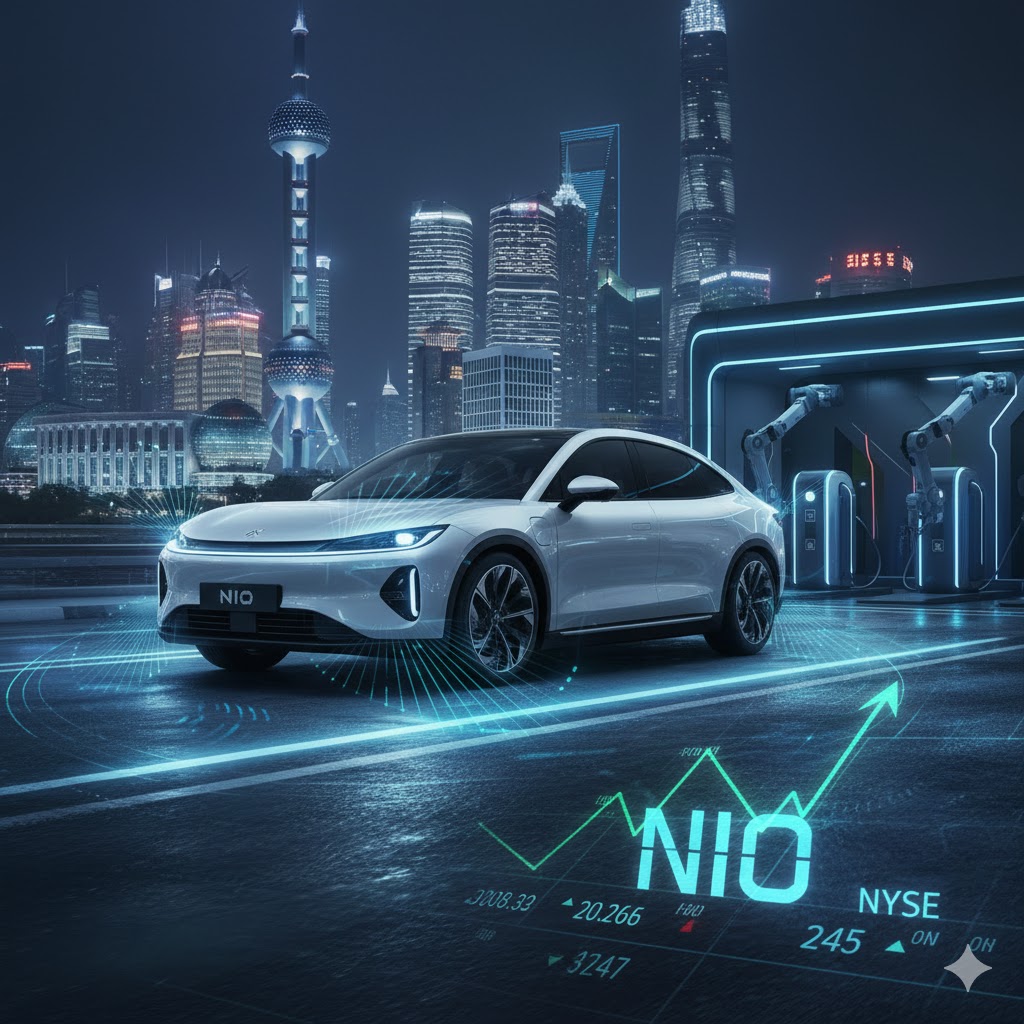
While autonomous driving represents the “brain” of NIO’s strategy, its “body” is defined by the unique battery-swapping infrastructure. As of January 2026, NIO (NYSE:NIO) operates over 3,400 Power Swap Stations globally, with more than 3,200 located in mainland China. The company has announced plans to add at least 1,000 additional stations in 2026, focusing on its “Battery Swap County Access” initiative to bring premium energy services to lower-tier cities. This infrastructure acts as a powerful defensive moat; it not only eliminates charging time concerns but also enables “Battery as a Service” (BaaS), which lowers the initial purchase price of the vehicle for consumers while creating a recurring revenue stream for the company.
The interoperability of this network has also expanded through strategic partnerships. In late 2025, NIO (NYSE:NIO) finalized agreements with major industry players, including Changan Automobile and Geely Automobile Holdings Limited (OTC:GELYF), to open up its swap network and collaborate on standardized battery pack designs. This move toward standardization is a significant event for the broader industry, as it potentially positions NIO’s swap technology as the de facto standard in the Chinese market, much like the North American Charging Standard (NACS) pioneered by Tesla (NASDAQ:TSLA). For investors, this creates a “platform effect” where NIO earns service fees from competitors’ customers, diversifying its income beyond simple vehicle sales.
Product Roadmap: Onvo, Firefly, and the NT3 Evolution
To broaden its market reach, NIO (NYSE:NIO) is executing a multi-brand strategy that will see significant activity in 2026. The main “NIO” brand remains focused on the premium segment, with the upcoming launch of three new models—likely including the ES9 flagship SUV and the refreshed ET9 sedan. Meanwhile, the “Onvo” sub-brand (marketed as Ledao in China) is targeting the mass-market family segment, competing directly with the Model Y. Initial data for the Onvo L60, launched in late 2025, suggests robust demand, with margins tracking between 15% and 20%—a healthy figure for a entry-level premium brand.
Furthermore, 2026 marks the international debut of the “Firefly” brand, NIO’s small-car specialized division designed specifically for the European and Southeast Asian markets. The first Firefly model, a small high-end EV, is scheduled to launch in Singapore and Europe in the first half of 2026. This brand is critical for NIO’s global strategy as it seeks to navigate the “EV chasm” in Europe while avoiding some of the higher tariffs applied to larger, more expensive Chinese exports. The company’s expansion into countries like Greece, Cyprus, and Portugal in 2026, through partnerships with local distributors like the Motodynamics Group, highlights a shift toward a more capital-efficient “distributor model” for its global operations.
Strategic Risks: Competition and Regulatory Scrutiny
Despite the technological milestones, NIO (NYSE:NIO) operates in an environment of intense competitive pressure and geopolitical complexity. In the domestic Chinese market, the entry of tech giants like Xiaomi Corporation (OTC:XIACY) into the automotive space has significantly compressed the timeframe for “innovation cycles.” Xiaomi’s rapid ramp-up to 100,000 units in its first year of production serves as a stark reminder that software-defined vehicles are becoming a commodity. To maintain its premium positioning, NIO must continue to differentiate itself through its “user enterprise” philosophy and superior service ecosystem.
Moreover, the regulatory environment for autonomous driving remains in a state of flux. While China has been proactive in granting permits for urban ADAS (Advanced Driver Assistance Systems) testing, the potential for liability in the event of hardware or software failure remains a long-tail risk. NIO (NYSE:NIO) has addressed this by working closely with domestic semiconductor manufacturers, such as Lontium Semiconductor Corporation, to ensure the reliability of its sensor-to-chip data pathways. Additionally, the company’s internal development of the “Shenji NX9031” autonomous driving chip—which is being licensed to robotics companies—demonstrates a commitment to vertical integration that mirrors the strategies of NVIDIA Corporation (NASDAQ:NVDA) and Tesla (NASDAQ:TSLA).
Conclusion: The 2026 Inflection Point
In conclusion, the rollout of full-scope urban NOP+ on the NT2 platform represents the definitive transition of NIO (NYSE:NIO) from a “startup” into a “mature industrial powerhouse.” The company has successfully navigated the liquidity crisis of 2023-2024 and emerged with a more diversified brand portfolio, a world-class infrastructure network, and a technological lead in urban autonomy. For institutional stakeholders, the key metrics to watch in 2026 will be the pace of “Firefly” deliveries in international markets and the company’s ability to maintain vehicle margins above 15% in a persistently competitive pricing environment.
NIO (NYSE:NIO) has proven that its “all-in” investment on technology and service is not just a marketing slogan but a viable financial strategy. As the 1,000,000th NIO vehicle rolls off the production line in Hefei, the company stands as a primary beneficiary of the global “intelligence-first” automotive revolution. Whether it can convert this technological leadership into sustainable, multi-billion-dollar net profits will be the defining narrative of the next 24 months. For now, the rollout of urban NOP+ provides a compelling piece of evidence that the future of mobility is being written in the software labs of Shanghai and the battery swap stations across the Yangtze River Delta.