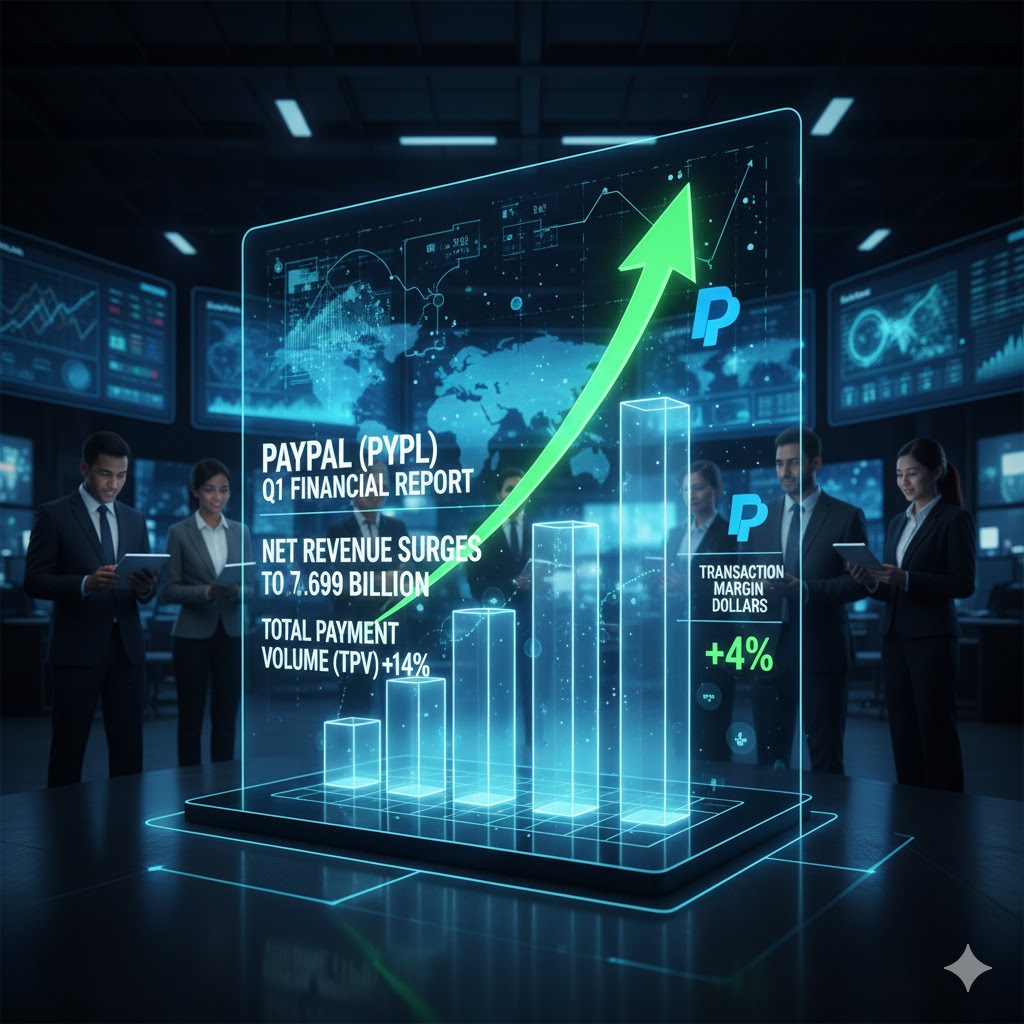
The global digital payments landscape is undergoing a rigorous period of recalibration as legacy providers attempt to synchronize their mature infrastructure with the accelerating demands of artificial intelligence and high-velocity commerce. PayPal Holdings, Inc. (NASDAQ:PYPL) has decisively signaled its entry into a new era of operational discipline and technological revitalization with the release of its first-quarter financial results for 2024. Amidst a backdrop of intense competition from both entrenched financial institutions and nimble fintech disruptors, the company reported a net revenue surge to $7.699 billion, a performance that not only surpassed conservative market estimates but also underscored the initial success of CEO Alex Chriss’s “transformation year” strategy.
This fiscal milestone is not merely a reflection of increased transaction volume; it represents a fundamental shift in how the Silicon Valley stalwart manages its unit economics. The 9% year-over-year revenue increase—reaching 10% on a currency-neutral basis—was bolstered by a significant expansion in total payment volume (TPV), which climbed 14% to $403.9 billion. More importantly for institutional investors, the company demonstrated a renewed ability to defend its margins. The transaction margin dollars grew by 4% to $3.5 billion, a critical metric that had been a point of contention in previous quarters. By focusing on “profitable growth” rather than raw volume, PayPal (NASDAQ:PYPL) is attempting to silence critics who argued that its unbranded processing business, Braintree, was diluting the company’s overall value proposition.
The Anatomy of the Q1 Beat
The financial architecture of the first quarter reveals a company that is successfully leveraging its global scale while aggressively trimming internal inefficiencies. PayPal (NASDAQ:PYPL) reported a GAAP operating income of $1.2 billion, a 17% increase compared to the prior-year period. The GAAP operating margin expanded by 98 basis points to 15.2%, while the non-GAAP operating margin, which excludes certain non-cash items and restructuring charges, expanded by 84 basis points to 18.2%. This margin expansion is particularly impressive given the broader macroeconomic headwinds of persistent inflation and fluctuating interest rates, which typically pressure consumer discretionary spending—the lifeblood of the PayPal ecosystem.
Geographically, the revenue mix showed a healthy diversification. Revenues from the United States totaled $4.5 billion, representing 58% of the net total and an 8% increase. However, the true engine of growth was found in international markets, where revenues reached $3.2 billion, a 12% surge. This international strength was largely driven by robust cross-border trade and the increasing adoption of digital wallets in Continental Europe and Asia. For global retailers like Amazon.com, Inc. (NASDAQ:AMZN) and eBay Inc. (NASDAQ:EBAY), who rely on PayPal’s seamless cross-border capabilities, the stability of these payment flows is a vital component of the global e-commerce supply chain.
Strategic Pivot: From Volume to Value
Under the leadership of Alex Chriss, who assumed the CEO role in late 2023, PayPal (NASDAQ:PYPL) has moved away from the “growth at all costs” mentality that defined the pandemic era. The current business development strategy is centered on six key innovations designed to “revolutionize” commerce through AI-driven personalization. Central to this is the rollout of “Fastlane by PayPal,” a guest checkout experience that reportedly recognizes 70% of consumers and accelerates the checkout process by nearly 40%. In a world where companies like Shopify Inc. (NYSE:SHOP) and Stripe are competing for merchant loyalty, the ability to reduce friction in the “last mile” of a transaction is a decisive competitive advantage.
Another pillar of the new strategy is the “Smart Receipts” initiative. By utilizing artificial intelligence to analyze billions of dollars in transaction data, PayPal (NASDAQ:PYPL) can now provide consumers with personalized recommendations and cashback offers directly within their digital receipts. This transforms a static confirmation of purchase into a dynamic marketing tool for merchants, encouraging repeat business and increasing the lifetime value of each customer. This move directly challenges the traditional advertising models of Alphabet Inc. (NASDAQ:GOOGL) and Meta Platforms Inc. (NASDAQ:META) by placing the offer at the most relevant moment—the point of purchase.
The integration of AI also extends to the company’s internal operations. By automating manual processes and optimizing risk management algorithms, PayPal is driving down its cost-to-serve. The company’s non-GAAP earnings per share (EPS) surged 27% year-over-year to $1.08, reflecting both the operational improvements and a robust share buyback program. In the first quarter alone, PayPal returned $1.5 billion to stockholders by repurchasing approximately 25 million shares, a clear signal of management’s belief that the stock remains undervalued relative to its long-term earnings potential.
The Venmo and Branded Checkout Dynamics
While the unbranded processing segment (Braintree) saw the strongest TPV growth at 26%, the market remains laser-focused on the performance of PayPal’s “branded” checkout and the monetization of Venmo. Branded checkout remains the company’s highest-margin business, and stabilizing its market share is a top priority. In the first quarter, PayPal (NASDAQ:PYPL) revamped its consumer app with a new interface and enhanced rewards programs, which led to a 7% increase in weekly app logins. This increased engagement is crucial for maintaining the brand’s relevance in an increasingly fragmented digital wallet market.
Venmo, which has long been a favorite among younger demographics for peer-to-peer (P2P) payments, is finally being harnessed as a significant revenue driver. The launch of Venmo business profiles and the expansion of the Venmo debit card are central to this effort. According to the Q1 report, customers who adopt the PayPal or Venmo debit card are significantly more engaged, generating a two-fold lift in transaction activity compared to those who only use the digital checkout. As of early 2026, approximately 4% of active PayPal consumer accounts in the U.S. have a debit card, leaving a massive runway for growth. By bridging the gap between digital P2P payments and physical brick-and-mortar commerce, PayPal (NASDAQ:PYPL) is effectively competing with traditional card issuers like Visa Inc. (NYSE:V) and Mastercard Incorporated (NYSE:MA).
Market Share and Competitive Moat
Despite the emergence of “Buy Now, Pay Later” (BNPL) competitors like Affirm Holdings, Inc. (NASDAQ:AFRM) and the aggressive push into payments by Apple Inc. (NASDAQ:AAPL) via Apple Pay, PayPal (NASDAQ:PYPL) maintains a formidable market share. Current industry statistics indicate that PayPal holds approximately 45.52% of the payment processing technology market. Its nearest competitor, Stripe, holds roughly 17%, followed by Shopify Pay. This dominant position is supported by a global network of 427 million active accounts and a presence on millions of merchant websites.
The “moat” around PayPal’s business is built on trust and data. With over 6.5 billion payment transactions in a single quarter, the company possesses an unparalleled dataset on consumer behavior. By feeding this data into its AI models, PayPal can provide superior fraud protection and more relevant offers than smaller competitors. Furthermore, for large enterprises like Walmart Inc. (NYSE:WMT) or Target Corporation (NYSE:TGT), the reliability and security of the PayPal platform remain a primary reason for its inclusion at checkout. The Q1 results suggest that while the company may have lost some ground in the “convenience” battle to one-tap mobile solutions, its “value-added” services are successfully re-entrenching its position within the merchant stack.
Balance Sheet Strength and Capital Allocation
A detailed analysis of the Q1 financial report would be incomplete without a look at the company’s “fortress” balance sheet. As of March 31, 2024, PayPal (NASDAQ:PYPL) held cash, cash equivalents, and investments totaling $17.7 billion, against a total debt of $11.0 billion. This strong liquidity position allows the company to navigate periods of market volatility while continuing to invest in R&D and strategic M&A. The net cash provided by operating activities in the first quarter was $1.9 billion, a 64% increase from the previous year.
The company’s adjusted free cash flow, which excludes the timing impact of its European BNPL receivables, remains a significant source of strength. This cash flow supports the company’s aggressive capital return strategy. For the full year 2024, the company expects to return billions to shareholders, a move that is highly favored by institutional investors such as BlackRock, Inc. (NYSE:BLK) and The Vanguard Group. In an environment where interest rates are “higher-for-longer,” the ability to self-fund growth and return capital without relying on expensive debt markets is a major differentiator.
Looking Ahead: The 2026 Horizon
As we move further into 2026, the success of the $7.699 billion revenue quarter will be judged by the company’s ability to sustain its momentum. Management has provided a cautious but optimistic outlook, projecting Q2 revenue growth of approximately 6.5% to 7%. The focus for the remainder of the year will be on the execution of the “Next-Gen” checkout and the scaling of the Advanced Offers platform. The company is also expected to deepen its integration with digital assets, following the successful launch of its PYUSD stablecoin, which aims to reduce the cost and increase the speed of cross-border settlements.
The competitive pressures from “sovereign AI” and domestic payment rails in emerging markets—such as UPI in India or Pix in Brazil—will continue to challenge PayPal’s international growth. However, the company’s pivot toward becoming an AI-first platform suggests it is ready for the fight. By moving from a “button on a website” to a comprehensive “commerce operating system” for small and medium-sized businesses (SMBs), PayPal (NASDAQ:PYPL) is seeking to capture a larger share of the $6 trillion global digital commerce market.
In conclusion, the first-quarter financial report of PayPal Holdings, Inc. is a clear signal that the company has successfully turned the corner. The surge in net revenue to $7.699 billion is a quantitative victory, but the qualitative shift in strategy—focusing on transaction margins, AI-driven personalization, and operational efficiency—is what will ultimately define its long-term valuation. While the road to full transformation is long and the competitive landscape remains treacherous, the “new” PayPal has demonstrated that it possesses the scale, the data, and the discipline to remain a dominant force in the global digital economy. For the investor, the Q1 results offer a compelling case that the company’s best days may still lie ahead, provided it can continue to execute with the same “surgical” precision demonstrated in the first three months of the year.