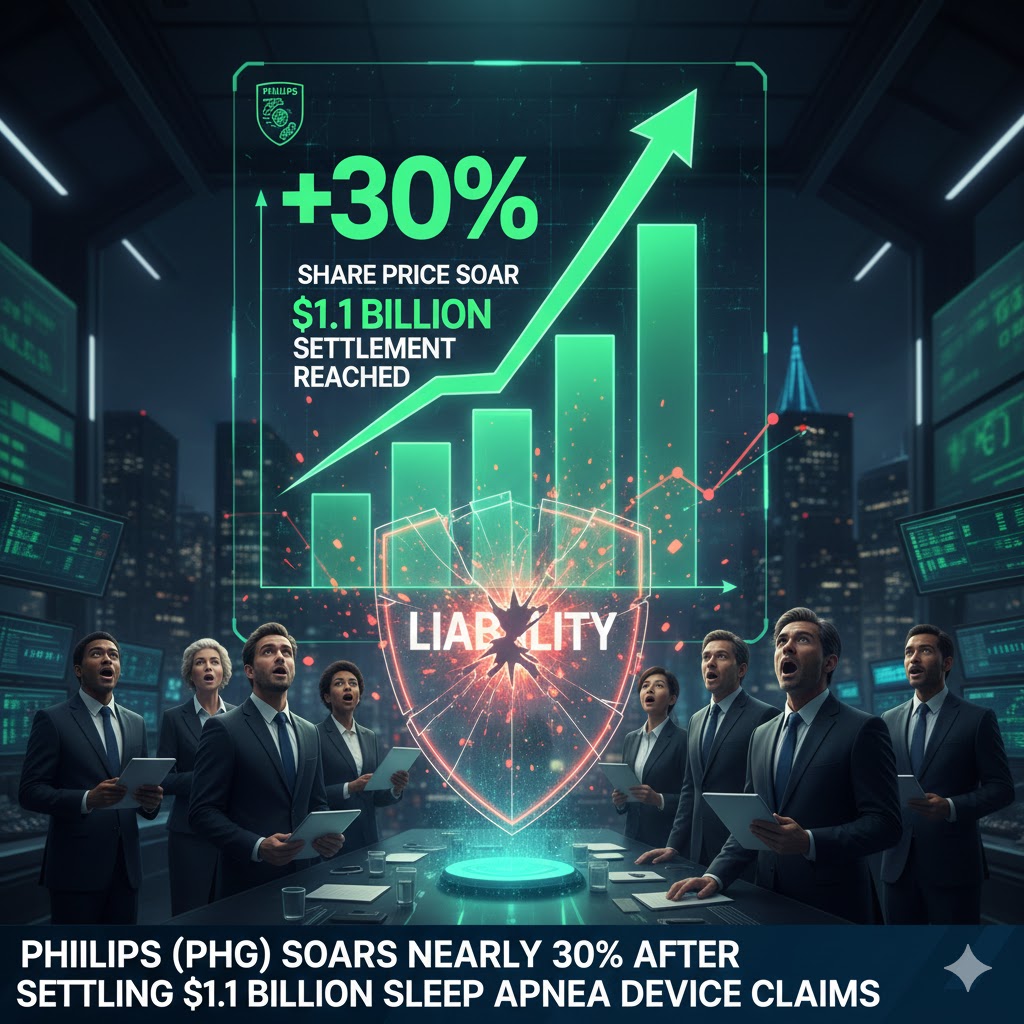
The global healthcare technology sector witnessed a historic volatility event in the second quarter of 2024 as Koninklijke Philips N.V. (NYSE:PHG), commonly known as Philips, finally addressed the massive legal overhang that had decimated its market capitalization for nearly three years. The Amsterdam-headquartered giant saw its American Depositary Receipts (ADRs) surge by nearly 30% in a single trading session—the largest one-day gain in the company’s modern history—following the announcement of a $1.1 billion settlement to resolve personal injury and medical monitoring claims in the United States related to its massive recall of sleep apnea and ventilator devices. This resolution represents a watershed moment for the company, signaling an end to the “existential threat” phase of its litigation crisis and allowing the market to begin valuing the firm based on its underlying operational performance rather than its potential bankruptcy risk.
The settlement, which was significantly lower than the $2 billion to $4 billion that many pessimistic analysts at firms like JPMorgan Chase & Co. (NYSE:JPM) and Barclays PLC (NYSE:BCS) had initially feared, covers approximately 58,000 claimants. These individuals alleged that the noise-abatement foam used in the DreamStation and other CPAP (continuous positive airway pressure) machines could degrade, becoming toxic or carcinogenic when inhaled. By capping the personal injury liability at $1.1 billion, Philips (NYSE:PHG) has provided the investment community with the “certainty” it has craved since the recall began in June 2021. For institutional investors, the primary takeaway was not the cost itself, but the fact that the cost was manageable within the company’s existing credit facilities and cash-flow projections, effectively removing the specter of a catastrophic, multi-decade legal drain.
From a balance sheet perspective, the first-quarter 2024 financial results released alongside the settlement news showcased a company that is leaner and more focused. Philips reported that its comparable sales grew by 2.4% during the quarter, despite the ongoing suspension of new sleep therapy device sales in the United States under a consent decree with the Department of Justice (DOJ). The company’s adjusted EBRTA (Earnings Before Interest, Taxes, and Amortization) margin improved to 9.4%, driven by strong cost-saving measures and price hikes that offset the inflationary pressures currently hitting the broader MedTech industry. The ability of CEO Roy Jakobs to deliver these operational improvements while simultaneously negotiating a complex global settlement suggests a high degree of managerial resilience that has resonated with the markets.
The competitive landscape in the sleep and respiratory care market has been fundamentally reshaped during Philips’ three-year period of paralysis. Its primary rival, ResMed Inc. (NYSE:RMD), has aggressively captured market share, leveraging Philips’ absence to cement its position as the leading provider of CPAP hardware and digital health solutions for sleep apnea. However, the surge in Philips (NYSE:PHG) stock suggests that investors believe the company can eventually reclaim its footing. While ResMed (NYSE:RMD) currently enjoys a dominant valuation multiple, Philips is trading as a “recovery play,” where the restoration of trust with physicians and patients is the next critical milestone. The company’s new product development pipeline, particularly in its Image-Guided Therapy and Ultrasound divisions, remains a core strength that provides a buffer while the Sleep & Respiratory Care (SRC) unit undergoes its long-term rehabilitation.
The $1.1 billion settlement specifically addresses the personal injury and medical monitoring class actions in the U.S. District Court for the Eastern District of Pennsylvania. Crucially, the company did not admit any fault or liability as part of the agreement. This is a common legal strategy utilized by large corporations, such as Bayer AG (OTC:BAYRY) in its Roundup litigation or Johnson & Johnson (NYSE:JNJ) in its talc-related settlements, to prevent the settlement from being used as evidence of wrongdoing in other jurisdictions. Philips (NYSE:PHG) still faces a separate investigation by the U.S. Department of Justice and a potential “economic loss” class action, but the personal injury component was by far the most volatile variable in its valuation model. With this hurdle cleared, the company’s free cash flow, which it expects to be in the range of €0.9 billion to €1.1 billion for the full year 2024, can now be reallocated toward R&D and debt reduction rather than just legal reserves.
Market analysts have noted that the “Philips surge” had a secondary effect on the broader healthcare sector. As the fear of a “litigation contagion” receded, other MedTech firms facing regulatory or legal challenges, such as Baxter International Inc. (NYSE:BAX) and Medtronic plc (NYSE:MDT), saw a modest “relief rally.” This highlights the interconnectedness of the global medical device market, where a major failure at one firm often leads to increased regulatory scrutiny for all. The U.S. Food and Drug Administration (FDA) has intensified its oversight of medical device manufacturing standards following the Philips recall, a shift that is forcing companies like Stryker Corporation (NYSE:SYK) and Boston Scientific Corporation (NYSE:BSX) to increase their internal quality-assurance spending.
In terms of business development and planning, Philips (NYSE:PHG) is now pivoting toward a “2025+ Growth Strategy.” This involves a heavy investment in informatics and artificial intelligence to assist radiologists and cardiologists. The company’s Image-Guided Therapy business, which provides the hardware and software for minimally invasive surgeries, has become its most reliable growth engine. In Q1 2024, this segment saw high single-digit growth in orders, particularly in North America and Western Europe. By shifting the corporate narrative away from “CPAP litigation” and toward “AI-enhanced diagnostic imaging,” Philips is attempting to reposition itself as a technology-first healthcare company, similar to how General Electric Company (NYSE:GE) recently spun off its healthcare unit as GE HealthCare Technologies Inc. (NASDAQ:GEHC) to focus on high-margin digital solutions.
The 30% rally was also fueled by a short squeeze. For months, Philips (NYSE:PHG) had been a favorite target for hedge funds looking to bet against the European industrial sector. When the settlement amount was revealed to be a fraction of the “worst-case scenario,” these short sellers were forced to cover their positions, adding significant upward pressure to the stock price. This technical factor, combined with the fundamental relief of the legal resolution, created a “perfect storm” for the bulls. However, long-term sustainability will depend on the company’s ability to satisfy the requirements of the DOJ consent decree. This decree essentially prohibits Philips from selling new sleep devices in the U.S. until it meets rigorous new manufacturing and testing standards. Until this restriction is lifted—a process that could take several more years—Philips will remain at a disadvantage compared to ResMed and smaller players like Inspire Medical Systems, Inc. (NYSE:INSP).
The geographical revenue mix for Philips remains diverse, which has helped the company survive the U.S. recall. While the U.S. accounts for roughly 40% of its sales, strong performance in China and India has provided a necessary cushion. In China, the government’s focus on “localization” of high-end medical equipment has led Philips to establish more domestic manufacturing and R&D centers. This strategy allows the company to participate in large-scale government procurement programs for MRI machines and CT scanners, competing head-to-head with Siemens Healthineers AG (OTC:SMMNY). The recovery of the Chinese healthcare market post-pandemic has been slower than expected, but Philips (NYSE:PHG) has managed to maintain stable margins in the region through a focus on premium clinical solutions rather than low-end commodity hardware.
From a product development standpoint, the company is betting heavily on its “HealthSuite” cloud platform. By connecting all of its diagnostic and monitoring devices into a single data ecosystem, Philips aims to provide hospitals with a holistic view of patient health. This “platform play” is similar to the strategies employed by tech giants like Amazon.com, Inc. (NASDAQ:AMZN) and Microsoft Corporation (NASDAQ:MSFT), both of whom are also making major inroads into healthcare cloud services. For Philips, the advantage lies in its deep clinical knowledge—its engineers understand the nuances of a heart rhythm or a lung scan in a way that generic cloud providers do not. This clinical depth is what makes Philips (NYSE:PHG) a vital partner for major hospital systems like the Mayo Clinic or Cleveland Clinic.
The $1.1 billion payment is expected to be made in 2025, and Philips has already set aside sufficient provisions to cover the majority of this amount. This proactive provisioning meant that the settlement did not require a new, massive charge against earnings, which further surprised the market in a positive way. Management has reiterated its 2024 guidance, which includes 3% to 5% comparable sales growth and an adjusted EBITA margin of 11% to 11.5%. These targets are ambitious given the current state of the SRC unit, but the company’s “Diagnosis & Treatment” and “Connected Care” segments are performing at a level that makes these numbers achievable. For investors, the focus has now shifted from “liquidity risk” to “execution risk.” Can Philips successfully navigate the consent decree and win back the hearts and minds of the medical community?
The role of ESG (Environmental, Social, and Governance) factors in Philips’ recovery cannot be overlooked. The recall was a massive failure of the “Social” component of ESG, as it directly impacted patient safety. To rectify this, Philips (NYSE:PHG) has overhauled its quality management system and appointed a new Chief Patient Safety Officer who reports directly to the CEO. The company has also committed to “circular economy” goals, aiming to have 25% of its revenue come from circular products and services by 2025. For institutional investors with strict ESG mandates, such as BlackRock, Inc. (NYSE:BLK), these structural changes are just as important as the financial settlement in determining whether the company is once again an “investable” asset.
As we look toward the 2026 horizon, Philips (NYSE:PHG) serves as a case study in corporate crisis management. The 30% surge in its stock price is a reminder of how quickly the market can re-rate a company once a “binary risk” is removed. While the path back to its pre-2021 highs will be long and arduous, the company has successfully transitioned from a defensive posture to an offensive one. The focus is now on innovation in the operating room, efficiency in the radiology suite, and digital connectivity in the home. The sleep apnea crisis will remain a dark chapter in the company’s 133-year history, but the settlement of April 2024 has effectively turned the page.
For the broader market, the Philips (NYSE:PHG) situation highlights the importance of “legal due diligence” in an era of mass tort litigation. In a world where 3M Company (NYSE:MMM) and Pfizer Inc. (NYSE:PFE) are also dealing with multi-billion-dollar legal battles over products like earplugs and Zantac, the Philips settlement provides a blueprint for how a company can find a middle ground between endless litigation and a total surrender. By taking the hit early and providing the market with a capped liability figure, Philips has regained control of its destiny. The surge in share price is a collective sigh of relief from an investment community that was tired of guessing and ready for the facts.
In conclusion, the nearly 30% soar of Philips after settling its $1.1 billion sleep apnea claims is a powerful testament to the value of certainty in the financial markets. It marks the return of a European industrial champion to the playing field, ready to compete in the high-stakes world of digital healthcare. While challenges remain—most notably the DOJ consent decree and the competitive lead held by ResMed—Philips (NYSE:PHG) is no longer a company fighting for its life; it is a company fighting for its future. The data supports a recovery narrative driven by strong performance in imaging and informatics, a manageable debt profile, and a strategic pivot toward AI. For the tech-savvy healthcare investor, the “new” Philips offers a compelling, albeit still high-risk, opportunity to participate in the ongoing digitalization of the global medical system.