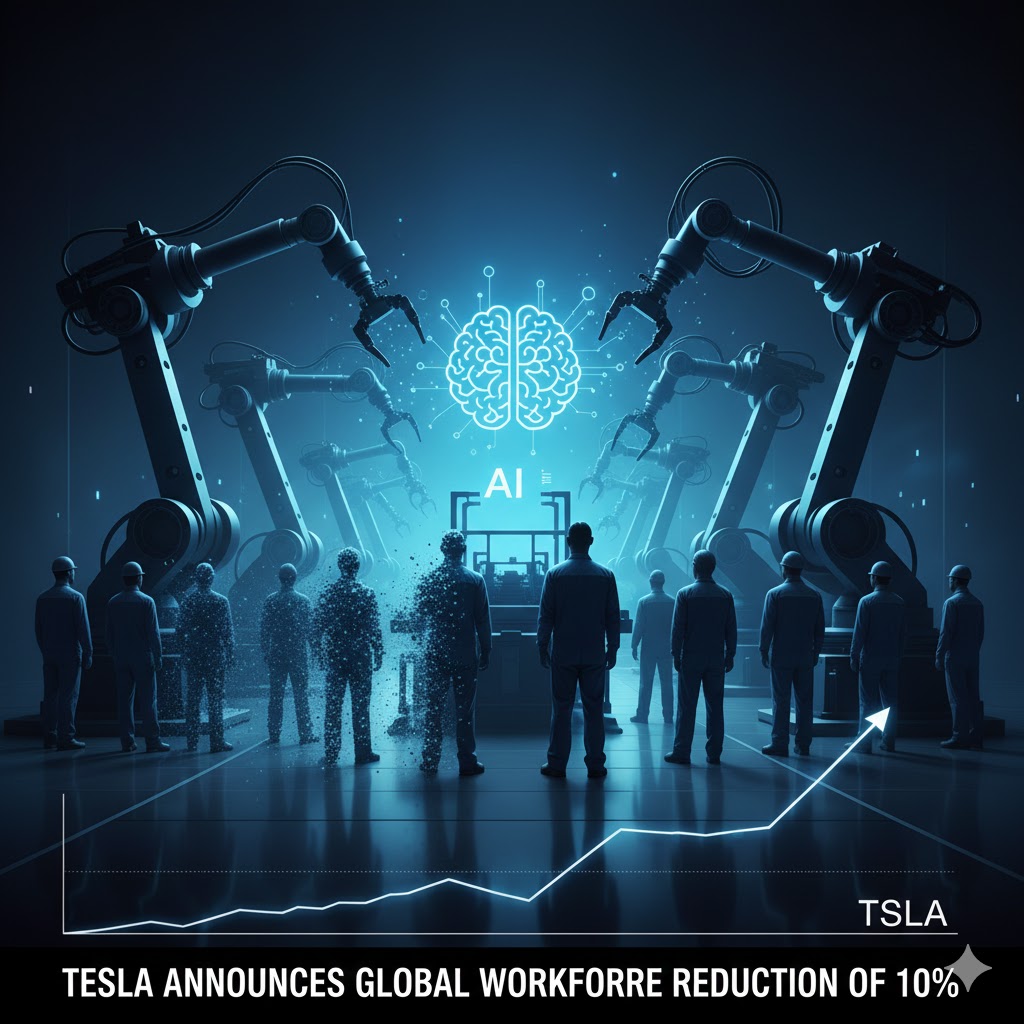
The global automotive sector, long viewed as a barometer for industrial health and technological progress, reached a significant inflection point in the second quarter of 2024. Tesla, Inc. (NASDAQ:TSLA), the undisputed pioneer of the electric vehicle (EV) revolution, sent shockwaves through the financial markets by announcing a global workforce reduction of approximately 10%. This strategic “downscaling,” affecting over 14,000 employees from its total headcount of roughly 140,473, is far more than a simple cost-cutting measure; it represents a fundamental pivot in the company’s long-term operational philosophy as it maneuvers through a cooling EV market, intensifying global competition, and its own internal transformation into an artificial intelligence and robotics powerhouse.
The immediate catalyst for this reorganization was a dismal first-quarter delivery report that fell nearly 9% below the previous year’s levels. Tesla (NASDAQ:TSLA) reported delivering 386,810 vehicles in Q1 2024, a sharp miss compared to market expectations of approximately 443,000 units. For a company whose valuation has traditionally been predicated on hyper-growth and production “s-curves,” the first year-over-year decline in deliveries since 2020 forced a swift reassessment of the corporate structure. CEO Elon Musk, in a leaked internal memo, characterized the layoffs as a necessary step to eliminate “duplication of roles and job functions” that had accumulated during the company’s rapid global expansion across North America, Europe, and Asia.
From a financial perspective, the move is a defensive play to shore up operating margins that have been under sustained pressure. Tesla’s gross automotive margin, excluding regulatory credits, dropped to approximately 14.6% in the first half of 2024—a significant retreat from the 25%-plus peaks seen in 2022. This margin erosion is the direct result of a relentless global price war, particularly in China, where Tesla (NASDAQ:TSLA) faces a formidable challenger in BYD Co. Ltd. (OTC:BYDDF). By reducing its global workforce, Tesla aims to lower its SG&A (Selling, General, and Administrative) expenses and improve its “operating leverage,” allowing the company to remain profitable even as average selling prices (ASPs) trend downward. For institutional investors like The Vanguard Group and BlackRock, Inc. (NYSE:BLK), this focus on “lean” operations is a prerequisite for maintaining a trillion-dollar valuation in a high-interest-rate environment.
The regional distribution of these cuts highlights Tesla’s shifting priorities. North America, the company’s most mature market and home to its headquarters in Austin, Texas, bore a significant portion of the burden, accounting for an estimated 60% of the total reductions. This suggests a consolidation of management and support functions as Giga Texas reaches operational maturity. In contrast, the Asia-Pacific region, led by the high-efficiency Giga Shanghai, saw a more modest reduction of roughly 15%, primarily concentrated in non-production departments. This underscores the critical importance of China as both a production hub and a growth frontier, where Tesla (NASDAQ:TSLA) must maintain a nimble local team to counter domestic rivals like Xiaomi Corporation (OTC:XIACY) and NIO Inc. (NYSE:NIO).
Critically, the layoffs were accompanied by the departure of key high-level executives, including Drew Bagliano, the Senior Vice President of Powertrain and Energy Engineering, and Rohan Patel, the Senior Global Director of Public Policy. These departures are particularly notable because Bagliano had been a cornerstone of Tesla’s technical leadership for nearly two decades. His exit, following the workforce reduction, suggests a broader “brain drain” or, more likely, a radical restructuring of the engineering department as the company shifts its R&D focus from traditional battery-and-motor engineering toward the “full-stack” AI required for the Cybercab and the Optimus humanoid robot.
As the company enters 2026, the success of this workforce reduction is being measured by its impact on R&D efficiency. Tesla (NASDAQ:TSLA) has reinvested much of the savings from the layoffs into its Dojo supercomputer project and the acquisition of massive GPU clusters from NVIDIA Corporation (NASDAQ:NVDA). The company’s goal is to achieve a 50% reduction in production costs for its next-generation “unboxed” platform by late 2026. This technical roadmap, if successful, would allow Tesla to launch a truly affordable “Model 2” while maintaining the software-like margins that distinguish it from legacy OEMs such as Ford Motor Company (NYSE:F) or General Motors Company (NYSE:GM).
The energy division has also emerged as a vital pillar of the company’s post-layoff stability. In the fourth quarter of 2025, Tesla Energy deployed a record 14.2 gigawatt-hours of storage, providing a high-margin revenue stream that is increasingly independent of the automotive cycle. For fund managers who track sustainable infrastructure, such as those at NextEra Energy, Inc. (NYSE:NEE), Tesla’s ability to scale its Megapack business while streamlining its automotive workforce is evidence of a more balanced and resilient business model. The 10% reduction, while painful for the affected employees, has effectively “cleared the decks” for this multi-modal expansion.
Regulatory hurdles continue to be a significant variable. While the workforce reduction was aimed at internal efficiency, Tesla (NASDAQ:TSLA) remains under the microscope of the National Highway Traffic Safety Administration (NHTSA) regarding the safety of its FSD software. Furthermore, the company has had to navigate complex labor relations in Europe, particularly at Giga Berlin, where environmental protests and union pressures have slowed capacity expansion. The decision to reduce the global workforce was a signal to these external stakeholders that Tesla is prioritizing capital discipline over raw headcount, a shift that has been generally well-received by the debt markets and credit rating agencies like S&P Global Inc. (NYSE:SPGI).
Market sentiment in early 2026 reflects a “wait-and-see” optimism. The stock price, which saw a 3% dip immediately following the layoff announcement in 2024, has since stabilized as the company proved its ability to maintain production volumes with a leaner team. The 10% workforce reduction is now viewed as the beginning of Tesla’s “Age of AI,” where human labor is increasingly augmented—and in some cases replaced—by the very automation technologies the company is selling to the world. For investors in the NASDAQ-100 index, Tesla remains a high-beta bet on whether this radical reorganization can indeed produce a “lean, innovative, and hungry” giant capable of dominating the next decade of autonomous transport.
Ultimately, the 10% workforce reduction was a strategic necessity for Tesla, Inc. (NASDAQ:TSLA) to reset its baseline in an era of “higher-for-longer” interest rates and global EV saturation. By trimming the fat and focusing its capital on the highest-conviction projects—Dojo, FSD, and Optimus—Tesla is attempting to transcend the “auto manufacturer” label once and for all. As the first Cybercabs begin their supervised pilots in 2026, the market will finally see if a leaner Tesla can deliver the exponential returns that its CEO has long promised. The 2024 layoffs were not an end, but a brutal, disciplined beginning.