As of January 10, 2026, the global luxury consumer goods sector is witnessing a peculiar divergence between mass-market stagnation and high-end resilience. At the heart of this narrative lies Chocoladefabriken Lindt & Sprüngli AG (SWX: LISN), a company that has long been considered the “Gold Standard” of the confectionery world. With its shares trading at CHF 116,200.00 on the SIX Swiss Exchange, the stock has become a focal point for institutional debate: Is the current valuation a justified reflection of its unrivaled brand moat, or is it a “sugar-coated” bubble facing the structural headwinds of record-high raw material costs?
This report provides a comprehensive deep-dive into Lindt’s 2026 operational landscape, scrutinizing its financial stability, the efficacy of its “premiumization” strategy, and its ambitious expansion into digital and emerging markets. While the share price has seen a 52-week fluctuation between CHF 97,000.00 and CHF 134,800.00, the fundamental question remains whether the company’s current P/E ratio of 41.3x is sustainable in a post-inflationary economy.
Financial Statement Analysis: Growth in the Shadow of Cocoa Volatility
Lindt’s financial performance over the 2025 fiscal year provides a blueprint of corporate resilience. The company reported record sales of approximately CHF 5.70 billion (TTM), representing an organic growth rate of roughly 9.2%. This growth was notably driven by price adjustments rather than volume increases—a strategic necessity forced by the unprecedented volatility in the cocoa market.
Profitability and Margin Integrity
Despite the “Cocoa Crisis” of 2024-2025, where raw material prices surged by over 300% before stabilizing, Lindt managed to maintain an EBIT margin of 15.6%. This stability is a direct result of the company’s “Premium Price Architecture,” which allows it to pass on costs to a loyal consumer base that views Lindt products as an affordable luxury rather than a discretionary commodity.
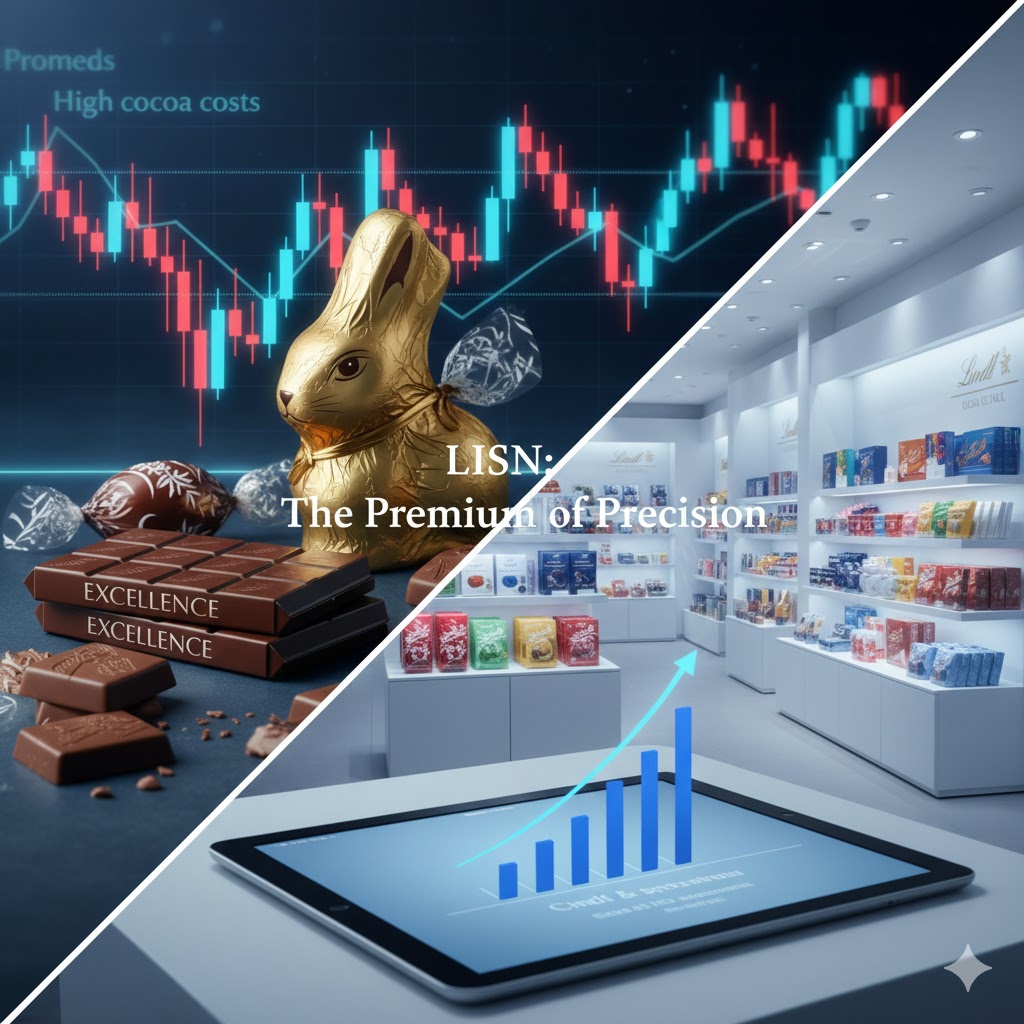
The company’s Net Income (TTM) stands at CHF 643.20 million, with an Earnings Per Share (EPS) of CHF 2,770.95. From a liquidity standpoint, Lindt maintains a fortress-like balance sheet. Its free cash flow generation reached a milestone of CHF 465 million in the previous fiscal year, allowing for a steady dividend payout of CHF 1,500.00 per share. However, the current Price-to-Earnings (P/E) ratio of 41.3x places it at a massive premium compared to the industry average of 16.0x, suggesting that investors are paying a steep price for the security of Swiss heritage.
Business Development: The “Dubai Chocolate” Phenomenon and Brand Agility
Innovation at Lindt has taken a modern, viral turn in late 2025 and early 2026. The company successfully capitalized on the “Dubai Chocolate” trend—pistachio and knafeh-filled bars—which dominated social media platforms. By rapidly iterating and launching its own high-end version of the viral bar, Lindt proved that a century-old firm can still move with the speed of TikTok.
The Direct-to-Consumer (DTC) Pivot
A key pillar of the company’s 2026 roadmap is the aggressive expansion of its Global Retail and E-commerce division. Lindt’s own shops and online boutiques now account for over 15% of total sales, growing at twice the rate of the traditional wholesale channel. This shift is critical for valuation because DTC sales carry significantly higher margins and provide the company with invaluable first-party data on consumer preferences.
In North America, Lindt has successfully integrated its Ghirardelli and Russell Stover brands into a unified logistics network. The “Russell Stover Transformation” project, aimed at modernizing the brand’s packaging and sugar-free offerings, has finally begun to yield positive volume growth in the U.S. market, which remains Lindt’s largest individual revenue contributor.
Product Development and Pipeline: Engineering the Next “Gold Bunny”
Lindt’s R&D focus for 2026 is centered on “Permissible Indulgence.” Recognizing the global trend toward health and wellness, the company has launched the Lindt EXCELLENCE 99% Cocoa global campaign and expanded its Vegan/Oat Milk portfolio.
The “Functional Confectionery” Experiment
Beyond traditional chocolate, Lindt is quietly testing “functional sweets” in select European markets. These products include cocoa-flavanol-enriched bars aimed at cardiovascular health, positioning the brand at the intersection of gourmet food and nutraceuticals. While still in the pilot phase, this move addresses a long-term risk: the potential decline in sugar consumption due to the widespread adoption of GLP-1 (weight-loss) medications. Early data from the pilot suggests that premium dark chocolate remains the “cheat meal” of choice even for health-conscious consumers.
Market Expansion: Scaling the “Third Pole” in China and the Middle East
While the European and North American markets are considered “mature,” Lindt’s valuation is heavily influenced by its potential in the “East.” The company’s performance in Greater China has inflected higher in early 2026, with revenue growth exceeding 12%. This is driven by the strategy of “Gifting and Occasions,” where Lindt Lindor truffles are positioned as the premium choice for Chinese New Year and Mid-Autumn Festival gifts.
Middle Eastern Resilience
The Middle East has emerged as a high-growth hub. The company’s recent entry into Saudi Arabia’s luxury retail sector has outperformed expectations, with flagship stores in Riyadh and Jeddah reporting record sales densities. The regional affinity for high-sugar, high-quality confectionery makes the GCC (Gulf Cooperation Council) one of the few areas where Lindt can achieve both volume and price growth simultaneously.
Strategic Risks and Macro-Events: Tariffs and Trade Wars
As of early 2026, Lindt is navigating a complex geopolitical landscape. The re-escalation of trade tensions and the implementation of new U.S. tariffs have prompted the company to increase its stock levels in Canada and the United States. CEO Adalbert Lechner recently noted that the company is “largely insulated” from tariff harm due to its local manufacturing presence in Stratham, New Hampshire, but logistical costs remain a persistent pressure point.
The company’s reliance on the West African cocoa supply chain also remains a systemic risk. While Lindt’s proprietary Farming Program covers 100% of its cocoa bean supply, ensuring traceability and ethical standards, it does not shield the firm from the global “spot price” of cocoa butter and solids, which are still trading at 2x their historical averages.
Synthesis: Assessing the Valuation Gap
The debate over LISN’s valuation is ultimately a debate over the “Safety Premium.” At a market capitalization of CHF 26.81 billion, Lindt is trading at a significant premium to peers like Mondelez or Nestlé.
- The Bull Case: Lindt is one of the few global brands that can raise prices by 10% without losing customers. Its expanding DTC network and successful “Dubai Chocolate” pivot suggest a brand that is gaining, not losing, cultural relevance. For long-term investors, the CHF 116,200 price point reflects the “un-disruptable” nature of a 180-year-old Swiss icon.
- The Bear Case: A P/E of 41x leaves zero room for error. If cocoa prices experience another spike, or if the GLP-1 impact on “indulgent categories” proves more severe than anticipated, the stock could undergo a painful de-rating. Current technical indicators like the RSI of 32.45 suggest the stock is nearing “oversold” territory, but the 52-week high of CHF 134,800 feels a long way off in the current high-interest-rate environment.
Ultimately, Lindt & Sprüngli remains a “compounder” stock. It is a business that does not seek to reinvent the wheel, but to perfect it. In 2026, its valuation is a reflection of its ability to maintain a sense of luxury in a world that is increasingly price-sensitive.