The pharmaceutical landscape of early 2026 is witnessing a powerful resurgence of European big-cap healthcare, led by the strategic and operational evolution of GSK plc (NYSE:GSK). Following a series of transformative years marked by the successful demerger of its consumer health business and a sharpened focus on infectious diseases and specialty medicines, the company has delivered a first-quarter performance that not only surpassed conservative analyst estimates but also provided a clear signal of long-term structural growth. By beating expectations in revenue and core earnings, and subsequently raising its full-year profit guidance, GSK has effectively neutralized many of the lingering concerns regarding its post-Zantac litigation profile and the eventual patent cliffs of its legacy respiratory portfolio.
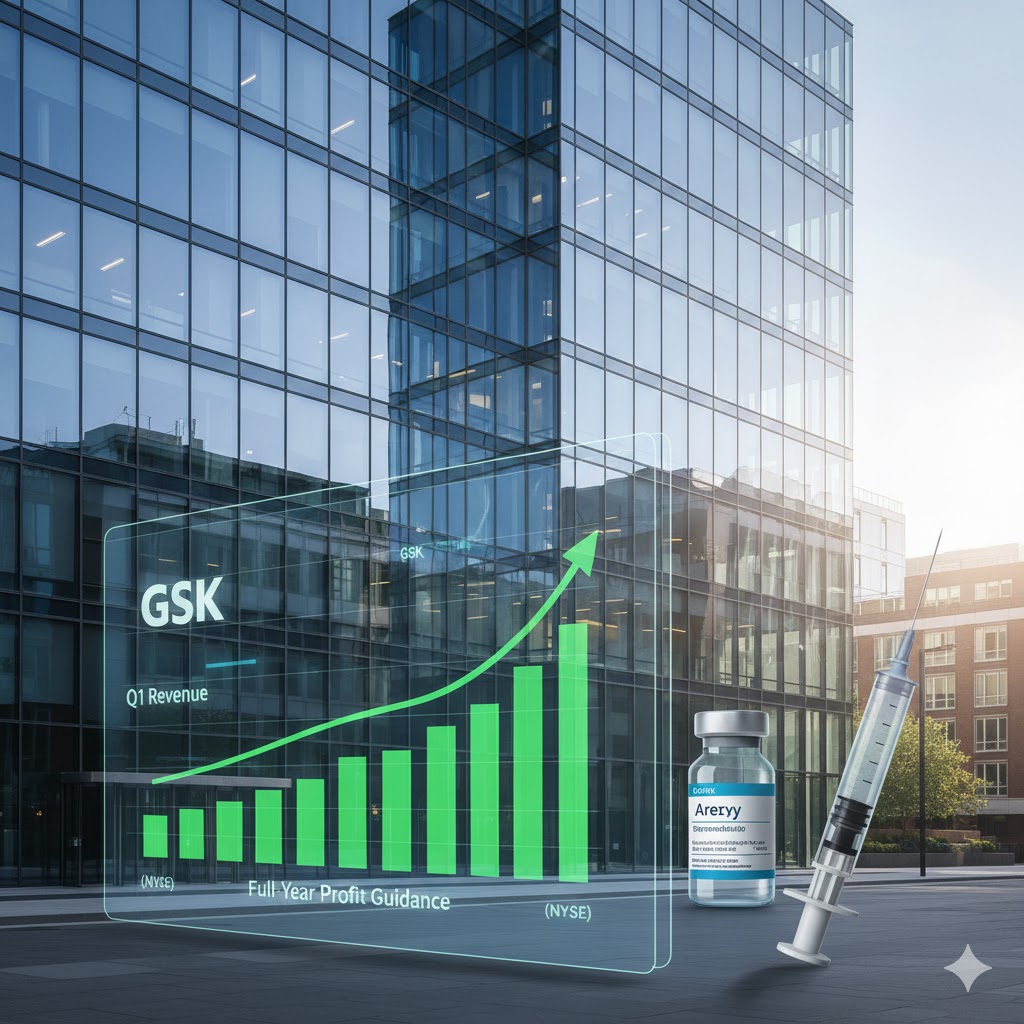
The financial results for the first quarter of 2025, which set the stage for the current 2026 momentum, revealed a company hitting its stride across nearly all key therapeutic areas. GSK reported total quarterly turnover of approximately £7.52 billion, representing a 4% increase at constant exchange rates (CER). While the headline revenue growth might appear modest to some, the composition of that revenue—characterized by high-margin specialty medicines and a rapidly expanding oncology franchise—is what has truly excited institutional investors. Core operating profit for the quarter rose to £2.45 billion, a 5% increase at CER, while core earnings per share (EPS) grew by 5% to 44.9p. This robust profitability during a period typically characterized by high R&D investment underscores the efficiency of the company’s “new GSK” operating model.
The Specialty Medicine Engine: Driving the Top Line
At the heart of the Q1 beat was the exceptional performance of the Specialty Medicines division. This segment, which includes HIV, Oncology, and Respiratory, Immunology & Inflammation (RI&I), saw sales grow by 17% in the first quarter of 2025. This double-digit expansion is a direct result of GSK’s strategic pivot toward high-value, patent-protected therapies. In the HIV sector, where GSK operates primarily through its majority-owned subsidiary ViiV Healthcare—a joint venture with Pfizer Inc. (NYSE:PFE) and Shionogi & Co., Ltd.—sales reached £1.71 billion, up 7% year-over-year. The growth was predominantly driven by the continued transition of patients toward long-acting injectable regimens, such as Cabenuva, which offers a “trust and convenience” profile that traditional daily oral pills cannot match.
The Oncology segment, however, provided the most significant “alpha” for the quarter, with sales surging by 53%. This growth was propelled by the rapid market uptake of Jemperli, an immuno-oncology treatment that has seen its indications expand for endometrial cancer, and Ojjaara, a first-in-class treatment for myelofibrosis. For institutional holders of Merck & Co., Inc. (NYSE:MRK), the success of Jemperli serves as a critical indicator of the competitive landscape in the PD-1 inhibitor market. By securing “all-comers” approvals in the US and Europe, GSK has successfully differentiated its oncology offerings from the standard-of-care, capturing significant market share in previously underserved patient populations.
Vaccines and the Arexvy Factor
While specialty medicines were the primary growth driver, the Vaccines segment provided a complex but ultimately positive contribution to the guidance raise. Sales of Shingrix, the company’s leading shingles vaccine, remained a cornerstone of the portfolio, though it faced some challenging comparators in the US market due to high prior-year immunization rates. However, international expansion—particularly in Europe and China—helped offset the US slowdown. Shingrix sales in Europe grew by over 40% in Q1 2025, reflecting a successful rollout strategy in private markets and expanded public funding in countries like France and Germany.
The real narrative shift in the vaccine division, however, surrounds Arexvy, the world’s first RSV vaccine for older adults. Despite a seasonal decline in the first quarter (as RSV is a winter-dominant virus), the underlying demand and market leadership in the US remained firm. As of early 2026, Arexvy has maintained a dominant share of the RSV market, successfully defending its territory against the competing offering from Pfizer Inc. (NYSE:PFE) and the newer entrant from Moderna, Inc. (NASDAQ:MRNA). The success of Arexvy is a testament to GSK’s R&D capability in infectious diseases, and it remains a central pillar of the company’s goal to achieve over £38 billion in annual sales by 2031.
Guidance Upgrades and Financial Management
The decision to raise full-year profit guidance was a move of calculated confidence from CEO Emma Walmsley. Following the strong Q1 and subsequent Q2/Q3 performance in 2025, the company officially revised its 2025 turnover growth expectation to between 6% and 7% (up from an initial 3% to 5%) and its core EPS growth to a range of 10% to 12% (up from 6% to 8%). This upward revision was supported by a disciplined approach to operating expenses and a favorable product mix that boosted gross margins to over 70%.
Furthermore, GSK’s capital allocation strategy has become significantly more shareholder-friendly in early 2026. The company launched a £2 billion share buyback program, the first major buyback since 2013, signaled by its robust free cash flow generation. In 2025, GSK generated over £3.3 billion in free cash flow, providing the liquidity needed to fund its aggressive R&D pipeline while simultaneously returning capital to investors. This balance between “innovation and income” has helped the stock outperform peers like Bristol-Myers Squibb Company (NYSE:BMY) and Sanofi (NASDAQ:SNY) during the same period, as investors seek out companies with both defensive qualities and growth catalysts.
Pipeline Milestones and the 2026 Outlook
Looking forward through the remainder of 2026, the market’s focus is squarely on GSK’s late-stage pipeline. The recent US FDA approval of depemokimab for severe asthma in late December 2025 is expected to be a major contributor to the RI&I segment’s performance this year. Depemokimab is a long-acting biologic that requires only twice-yearly dosing, a feature that analysts expect will allow it to capture significant share from shorter-acting alternatives manufactured by AstraZeneca PLC (NASDAQ:AZN).
Additionally, the positive Phase III results for bepirovirsen, a potential “functional cure” for chronic hepatitis B, have positioned GSK at the forefront of liver disease research. Chronic hepatitis B affects nearly 300 million people globally, and the potential for a first-in-class treatment represents a multi-billion dollar peak year sales opportunity. The company’s integration of artificial intelligence into its drug discovery process, through partnerships with AI-focused biotech firms and the deployment of its own computational biology hubs, has reportedly reduced the time from “target identification to lead optimization” by nearly 20%, a efficiency gain that is starting to reflect in the company’s R&D-to-sales ratios.
Strategic Market Expansion and Global Health Initiatives
GSK’s growth is not confined to Western markets. The company has made significant strides in emerging economies, particularly through its commitment to global health equity. By making millions of doses of its long-acting HIV injectable, cabotegravir (CAB-LA), available for procurement in low- and middle-income countries (LMICs), GSK is building long-term goodwill and infrastructure in high-growth regions. While these initiatives often carry lower margins, they provide a diversified revenue base and align the company with ESG (Environmental, Social, and Governance) mandates that are increasingly important to institutional investors like BlackRock, Inc. (NYSE:BLK).
In China, the company has seen strong demand for its respiratory and vaccine products. The partnership with local co-promotion partners for Shingrix has allowed GSK to tap into a massive aging population with a high awareness of preventive healthcare. As the Chinese healthcare system continues to pivot toward chronic disease management and immunization, GSK (NYSE:GSK) is uniquely positioned to benefit from its established reputation for quality and its localized manufacturing and distribution networks.
Conclusion: A Transformed Giant
In conclusion, GSK’s Q1 beat and subsequent guidance upgrades are the hallmarks of a company that has successfully navigated a period of intense skepticism. The “new GSK” is a leaner, more focused entity that has proved it can deliver both scientific innovation and financial discipline. By moving away from the “conglomerate” model and doubling down on its strengths in specialty medicines and vaccines, the company has created a growth profile that is both resilient and ambitious.
For the remainder of 2026, the key for investors will be monitoring the launch trajectory of depemokimab and the regulatory progress of its oncology pipeline. While risks remain—including the impact of the Inflation Reduction Act (IRA) on US drug pricing and the inherent volatility of clinical trial outcomes—the company’s fortress balance sheet and record-high backlog of new product opportunities provide a significant safety margin. GSK has effectively moved from being a turnaround story to a leadership story, demonstrating that even the most venerable industrial icons can reinvent themselves for the age of precision medicine.