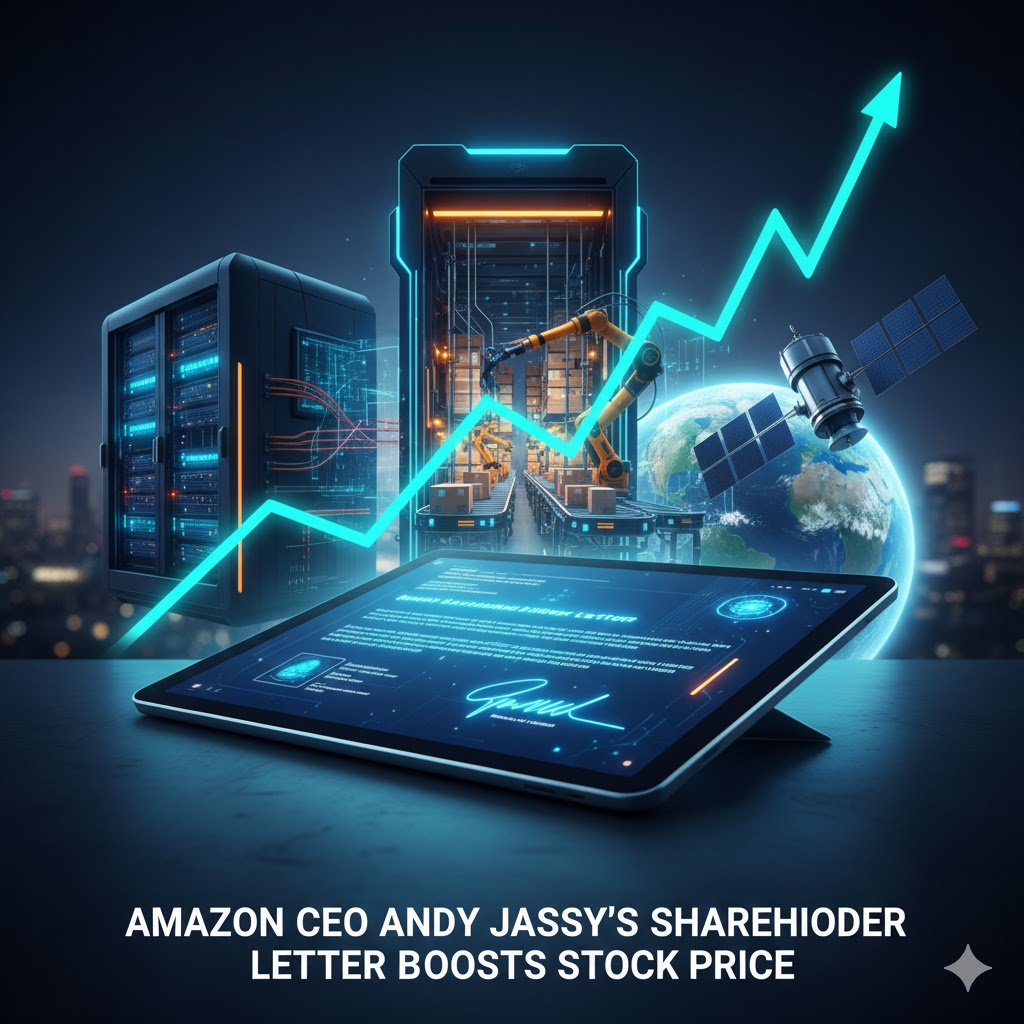
The release of the annual shareholder letter from Amazon.com, Inc. (NASDAQ:AMZN) CEO Andy Jassy in late April 2024 has become a pivotal moment for market sentiment, echoing the historical impact of similar missives from his predecessor, Jeff Bezos. This year’s letter, a comprehensive strategic roadmap and a reaffirmation of the company’s long-term vision, has provided a palpable boost to Amazon’s stock price. Investors, hungry for clarity amidst macroeconomic uncertainties and intense competitive pressures in both cloud computing and e-commerce, found reassurance in Jassy’s detailed outline of Amazon’s capital allocation priorities, generative artificial intelligence (AI) investments, and continued focus on operational efficiency across its vast global empire.
The market’s positive reaction saw Amazon’s stock climb over 3% in intraday trading following the letter’s publication, adding billions to its market capitalization. This surge suggests that Jassy successfully addressed key investor concerns, particularly those related to the deceleration of Amazon Web Services (AWS) growth and the persistent profitability challenges within its international e-commerce segments. The letter emphasized a disciplined approach to spending, promising continued cost optimization efforts that are expected to bolster the company’s operating margins through the latter half of 2024 and into 2025. For institutional investors like Fidelity Investments and T. Rowe Price Group, Inc. (NASDAQ:TROW), Jassy’s commitment to improving free cash flow—a metric that has seen volatility in recent quarters—was a critical takeaway.
AWS: Reaccelerating Growth and AI Dominance
At the heart of Jassy’s letter was a powerful affirmation of AWS’s strategic importance and its aggressive pivot toward generative AI. Jassy articulated that AWS, already the undisputed global leader in cloud infrastructure, is now focusing on becoming the “platform of choice” for AI development and deployment. He detailed the company’s multi-pronged AI strategy, which includes significant investments in foundational models via Amazon Bedrock, custom-designed AI chips such as Trainium and Inferentia, and a suite of AI-powered developer tools. This proactive stance is designed to counter the growing competitive threat from Microsoft Corporation (NASDAQ:MSFT) Azure and Alphabet Inc. (NASDAQ:GOOGL) Cloud, both of which are also heavily investing in their generative AI offerings.
Jassy provided quantitative evidence of AWS’s reacceleration, noting that the segment’s growth rate, which had dipped into the mid-teens in 2023, is now trending back toward the high-teens and is expected to exceed 20% by year-end 2024. This renewed momentum is largely attributed to large-scale enterprise migrations and the burgeoning demand for AI compute. Companies like Anthropic, a leading AI startup, have chosen AWS as their primary cloud provider, a testament to the platform’s robust infrastructure and specialized AI capabilities. The letter highlighted that AWS’s operating margin, which stood at 30.1% in Q1 2024, is expected to remain a powerful engine for Amazon’s overall profitability, generating the capital necessary for ambitious ventures in other segments.
E-commerce: Efficiency, Speed, and Profitability
While AWS captured significant attention, Jassy’s letter also provided a detailed update on Amazon’s massive e-commerce business. He acknowledged the previous inefficiencies in the company’s fulfillment network, particularly the fragmented logistics infrastructure that led to higher “cost-to-serve” per package. However, Jassy outlined a successful reorganization of the U.S. fulfillment network into eight distinct regions, a strategic move that has dramatically reduced shipping distances, lowered operational costs, and improved delivery speeds. This regionalization initiative, which began in late 2023, has already yielded impressive results, with average delivery times for Prime members shortening by over half a day in early 2024.
The financial impact of these operational improvements is substantial. Amazon (NASDAQ:AMZN) reported a significant improvement in its North American segment’s operating margin, which expanded to 7.8% in Q1 2024, up from 5.4% in the prior year. Jassy explicitly stated that these efficiencies are not a one-time gain but represent a structural overhaul that will contribute to sustained profitability. Furthermore, the letter detailed the expansion of Amazon’s advertising business, which leverages its vast consumer data to provide highly targeted ads. This segment continues to grow at over 20% year-over-year, contributing a high-margin revenue stream that diversifies Amazon’s e-commerce profitability away from pure transaction fees. For companies like Walmart Inc. (NYSE:WMT) and Target Corporation (NYSE:TGT), which are also investing heavily in their retail media networks, Amazon’s success in this area serves as both a benchmark and a formidable competitive barrier.
New Initiatives: Healthcare, Satellite Internet, and Robotics
Jassy’s letter extended beyond Amazon’s core businesses, offering insights into emerging growth vectors that could drive future revenue. He provided an update on Amazon Clinic, the company’s virtual healthcare service, noting its expansion across all 50 U.S. states and its increasing integration with Amazon Pharmacy. While still in its nascent stages, the healthcare initiative is a long-term play that leverages Amazon’s logistical expertise and massive customer base to disrupt a multi-trillion-dollar industry. The letter also highlighted the progress of Project Kuiper, Amazon’s ambitious satellite internet constellation, which successfully launched its first two prototype satellites in late 2023. Jassy confirmed that mass production of Kuiper satellites and customer terminals is underway, with commercial service expected to begin in select regions in 2025. This project places Amazon (NASDAQ:AMZN) in direct competition with Elon Musk’s SpaceX Starlink, marking a new frontier in the battle for global connectivity.
Furthermore, the letter touched upon Amazon’s robotics efforts, emphasizing the deployment of thousands of new robotic drive units and robotic arms across its fulfillment centers. These advancements are not merely about automation but about creating a safer and more efficient working environment for human employees. Jassy explicitly addressed concerns about automation replacing jobs, arguing that robotics allow human workers to focus on more complex, value-added tasks. This human-robot collaboration is expected to further enhance Amazon’s logistical capabilities and contribute to its efficiency gains in the coming years, drawing comparisons to similar initiatives at rival e-commerce and logistics players like Alibaba Group Holding Limited (NYSE:BABA) and FedEx Corporation (NYSE:FDX).
Capital Allocation and Shareholder Returns
A key focus of Jassy’s letter was on disciplined capital allocation. He reiterated Amazon’s commitment to investing aggressively in areas of high strategic importance, such as AI and AWS infrastructure, while maintaining a rigorous approach to cost management in more mature segments. Jassy also touched upon Amazon’s approach to shareholder returns, emphasizing that the primary focus remains on reinvesting in the business for long-term growth. While Amazon (NASDAQ:AMZN) has not initiated a regular dividend program, the company did authorize a $10 billion share repurchase program in early 2023, a move that signals a growing maturity in its financial management. For value-oriented investors, this commitment to buybacks, combined with improved free cash flow generation, is a powerful endorsement of the company’s financial health.
The broader macroeconomic environment also featured prominently in Jassy’s outlook. He acknowledged the ongoing inflationary pressures and the persistent challenges in global supply chains but expressed confidence in Amazon’s ability to navigate these headwinds. His optimism was rooted in the company’s strong balance sheet, its diversified revenue streams, and its relentless focus on customer obsession. For central banks, including the Federal Reserve, Amazon’s pricing power and its ability to absorb cost increases without fully passing them on to consumers are critical indicators of broader economic health. The letter’s tone was one of cautious confidence, acknowledging challenges but highlighting clear pathways to continued growth and profitability.
Conclusion: A Foundation for Future Growth
In summary, Amazon CEO Andy Jassy’s latest shareholder letter has proven to be a significant catalyst for the company’s stock price, affirming investor confidence in its strategic direction and operational execution. The letter skillfully balanced an aggressive vision for AI and new ventures with a clear commitment to improving efficiency and profitability in its core businesses. From the reacceleration of AWS driven by generative AI to the structural improvements in its e-commerce fulfillment network, Amazon (NASDAQ:AMZN) appears to be building a robust foundation for sustained growth in the latter half of the decade.
The insights into Amazon Clinic and Project Kuiper underscore Jassy’s long-term vision for diversification, positioning Amazon not just as an e-commerce or cloud giant but as a pivotal player in healthcare and global connectivity. For investors seeking exposure to innovation at scale, Jassy’s letter provides a compelling narrative that transcends quarterly fluctuations, focusing instead on the company’s unparalleled ability to invest, adapt, and lead across multiple transformative industries. The market’s positive reaction is a clear signal that this strategic clarity is precisely what was needed to reinforce Amazon’s position as a cornerstone of the global economy.