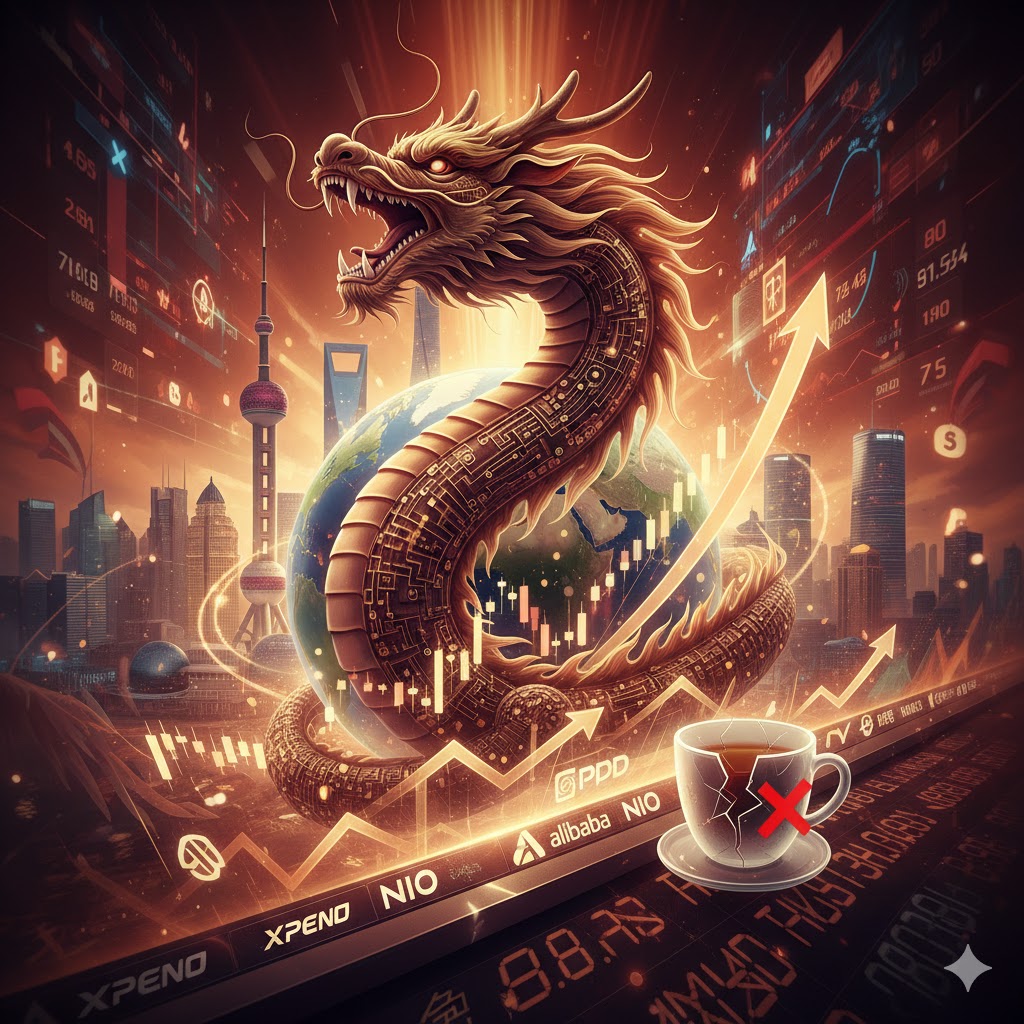
The global financial landscape is currently witnessing a significant and perhaps historic recalibration as Chinese Stocks stage a powerful offensive in the final trading weeks of 2025. Following a multi-year period defined by regulatory adjustments, property sector deleveraging, and macroeconomic recalibration, the Nasdaq Golden Dragon China Index has emerged as a beacon of momentum. In the early trading sessions of late December, the sentiment on Wall Street was electric: XPeng Inc. (XPEV) spearheaded the charge with a surge of nearly 5%, while industry heavyweights like NIO Inc., Li Auto, and the global e-commerce disruptor Pinduoduo (PDD) all climbed over 2%.
However, this broad-based enthusiasm was met with a stark and sudden anomaly in the “New Consumption” sector. Chagee (Cha Ji Ba Wang), the newly listed tea titan that had been the darling of the retail sector, saw its market valuation erode by over 10%. This collapse followed a viral controversy regarding caffeine transparency that ignited a firestorm on social media platforms like Douyin and Xiaohongshu, quickly transitioning from a consumer complaint to a significant “Topic of the Day” on the hot search lists.
This dichotomy—where hardware and high-tech platforms soar while lifestyle brands stumble—highlights a critical evolution in the market for Chinese Stocks. We are no longer in an era where “a rising tide lifts all boats.” Instead, investors are witnessing a sophisticated “K-shaped” recovery. Industrial prowess, AI-driven efficiency, and manufacturing depth are being rewarded with premium valuations and institutional inflows. Conversely, consumer-facing brands are being scrutinized with an intensity that borders on the forensic, proving that brand equity is more fragile than ever in the age of digital transparency.
The EV Renaissance: Why Technology is the Ultimate Moat
The performance of the Electric Vehicle (EV) sector remains the most compelling narrative within the broader basket of Chinese Stocks. XPeng’s 5% jump is not a speculative spike; it is a calculated response from the market to the company’s transition from a “burning cash” startup to a “software-defined” automotive leader. By the fourth quarter of 2025, XPeng’s XNGP (Navigation Guided Pilot) has achieved a level of urban autonomy that rivals—and in many localized Chinese urban contexts, exceeds—the performance of global competitors.
XPeng’s financial health has mirrored its technological ascent. With gross margins finally stabilizing above 18% due to the success of the Mona 03 series and the X9 MPV, the company has effectively decoupled itself from the ruinous price wars of 2023 and 2024. The market is now pricing XPeng as a technology company rather than just an automaker. This distinction is vital; in a world where vehicle hardware is increasingly commoditized, the proprietary AI stack and the vertical integration of electronic architectures provide a moat that is difficult for traditional OEMs to bridge.
NIO and Li Auto, rising over 2% respectively, represent the “Dual-Engine” growth of the premium segment. NIO’s commitment to its battery-swapping infrastructure—once viewed by skeptics as an expensive, capital-heavy gamble—is now paying dividends. The network has reached a critical mass of over 3,200 stations, creating a “lock-in” effect for the brand. This infrastructure allows NIO to offer a “Battery-as-a-Service” (BaaS) model that significantly lowers the initial purchase price, making premium EVs accessible to a wider demographic while ensuring a steady stream of recurring service revenue.
Li Auto, conversely, continues to be the “Fundamental Favorite” of the sector. Its mastery of the Extended Range Electric Vehicle (EREV) market has allowed it to maintain a positive net income for eight consecutive quarters. Li Auto’s strategy focuses on the “Family Segment,” providing high-utility vehicles with minimal range anxiety. With a cash reserve exceeding 100 billion yuan, Li Auto is well-positioned to weather any potential macroeconomic volatility in 2026, making it a defensive anchor within the high-growth EV portfolio of Chinese Stocks.
The Chagee Crisis: The High Cost of Consumer Trust
The 10% plunge of Chagee serves as a sobering counter-narrative to the tech rally. The “Chagee Caffeine” controversy, which trended at the top of social media platforms, exposed a vulnerability that many retail-focused analysts had overlooked: the speed of brand erosion in the digital age. Consumers reported palpitations and insomnia after consuming certain tea blends, leading to a public demand for ingredient transparency and laboratory testing.
Investors are reacting to more than just a social media trend. The sell-off reflects deeper concerns regarding Chagee’s post-IPO performance sustainability. Since its NASDAQ debut in mid-2025, the company has faced a saturated domestic market where “Price-to-Value” has replaced “Brand Premium” as the primary driver of consumer choice. When a company’s primary asset is its “lifestyle alignment,” any perceived lack of transparency regarding health impacts can lead to a catastrophic loss of institutional confidence.
The Chagee incident is symptomatic of the broader “Anti-Involution” movement in China. Consumers are no longer satisfied with flashy marketing or celebrity endorsements; they demand functional value, health transparency, and ethical consistency. For companies within the consumer discretionary category, the era of “blind growth” fueled by venture capital is over. The market is now demanding profitability and operational integrity. This incident has also cast a shadow over other “New Tea” players, leading to a sectoral de-rating as investors re-evaluate the risk profiles of high-frequency consumer brands.
Pinduoduo: The Resilience of the “Value” Thesis
In the e-commerce space, Pinduoduo’s 2.5% rise underscores the enduring strength of the “value-for-money” thesis. PDD remains a “must-hold” for institutional portfolios seeking exposure to the Chinese consumer. The company’s “Consumer-to-Manufacturer” (C2M) model has proven to be the most resilient strategy in an era of cautious spending. By leveraging massive data sets to predict consumer demand, PDD enables manufacturers to produce goods with high turnover and low inventory risk, passing those savings directly to the consumer.
Furthermore, PDD’s international arm, Temu, has continued to expand its footprint despite geopolitical headwinds. Temu’s ability to navigate the complex logistics and regulatory environments of Europe and North America has added a “Global Growth” layer to PDD’s valuation. While competitors like Alibaba and JD.com are focused on margin preservation and restructuring, PDD continues to capture market share through aggressive pricing and a superior supply chain efficiency that rivals can only hope to replicate.
Macroeconomic Tailwinds: The Policy Pivot of 2025
The underlying strength of Chinese Stocks in late 2025 is supported by a significant shift in Beijing’s policy stance. Throughout the year, we have seen a transition from “regulatory normalization” to “strategic support.” The Chinese government has recognized that the private sector, particularly in technology and green energy, is the primary engine of the “New Quality Productive Forces.”
The People’s Bank of China (PBOC) has maintained a supportive monetary environment, with targeted liquidity injections into the tech sector. Furthermore, the 2025 fiscal stimulus packages—which included widespread “trade-in” subsidies for electronics and vehicles—have successfully floor-priced the retail economy. For global investors, the risk-reward ratio for Chinese Stocks has become increasingly attractive compared to the “overcrowded” trades in US Big Tech. The valuation gap between the Nasdaq 100 and the Golden Dragon Index remains at historical highs, suggesting that even a minor mean-reversion could lead to significant upside for the Chinese ADRs.
Strategic Outlook for 2026: Navigating the New Paradigm
As we look toward 2026, the roadmap for Chinese Stocks is one of disciplined opportunity. The winners of the next cycle will not be those who grow the fastest, but those who grow the most sustainably.
- Industrial AI and EVs: Look for companies like XPeng and Baidu that are integrating AI into physical infrastructure. The “intelligence” of the vehicle or the factory is the new frontier of value creation.
- Rational Consumption: E-commerce platforms like PDD that prioritize supply chain efficiency will continue to outperform luxury or premium-priced brands that lack a clear functional advantage.
- Dividend and Buybacks: A new trend among Chinese Stocks is the return of capital to shareholders. Alibaba and Tencent have led the way with massive share buyback programs, a sign of corporate maturity that is attracting a new class of “Value Investors” to the space.
The recent “caffeine crisis” with Chagee serves as a necessary filter, reminding investors to distinguish between transient lifestyle trends and structural industrial leaders. The rally in XPeng, NIO, and PDD is a testament to the resilience of the Chinese private sector. While challenges remain—including global trade tensions and shifting domestic demographics—the current price action suggests that the period of peak pessimism is over. For the discerning investor, the late-2025 rally is not a temporary bounce, but the foundation of a more mature, value-driven growth story for Chinese Stocks.
Summary Performance Data (As of Late Dec 2025)
| Ticker | Company | Sector | Change | Catalyst |
| XPEV | XPeng | Auto/Tech | +4.95% | AI Autonomy Leadership |
| PDD | Pinduoduo | E-commerce | +2.35% | Value-Driven Consumption |
| NIO | NIO | Auto/Infra | +2.12% | Battery Swap Network Scaling |
| LI | Li Auto | Auto | +2.05% | Consistent Net Profitability |
| CHAG | Chagee | Consumer | -10.50% | Social Media/Transparency Crisis |
Analysis Conclusion:
The current divergence in the performance of Chinese Stocks reflects a healthy market mechanism. Investors are rewarding companies with high technical barriers and operational transparency while punishing those that rely on hype. As institutional capital continues to flow back into the Golden Dragon Index, the focus will remain on “Fundamental Quality” over “Speculative Growth.”