As the global financial markets prepared to shutter for the 2025 fiscal year, one of the most dramatic spectacles of the year unfolded on the NASDAQ. On December 30, 2025, Aimei Health Technology Co., Ltd. (NASDAQ: AFJK), a Special Purpose Acquisition Company (SPAC), witnessed a meteoric surge in its share price, capturing the attention of day traders and institutional analysts alike. After opening at $45.04, the stock rocketed to an intraday all-time high of $109.37 before eventually settling at a closing price of $82.58. This staggering 89.19% single-day gain capped a month of unprecedented volatility, where the stock had previously flirted with 1,000% gains followed by sharp after-hours corrections.
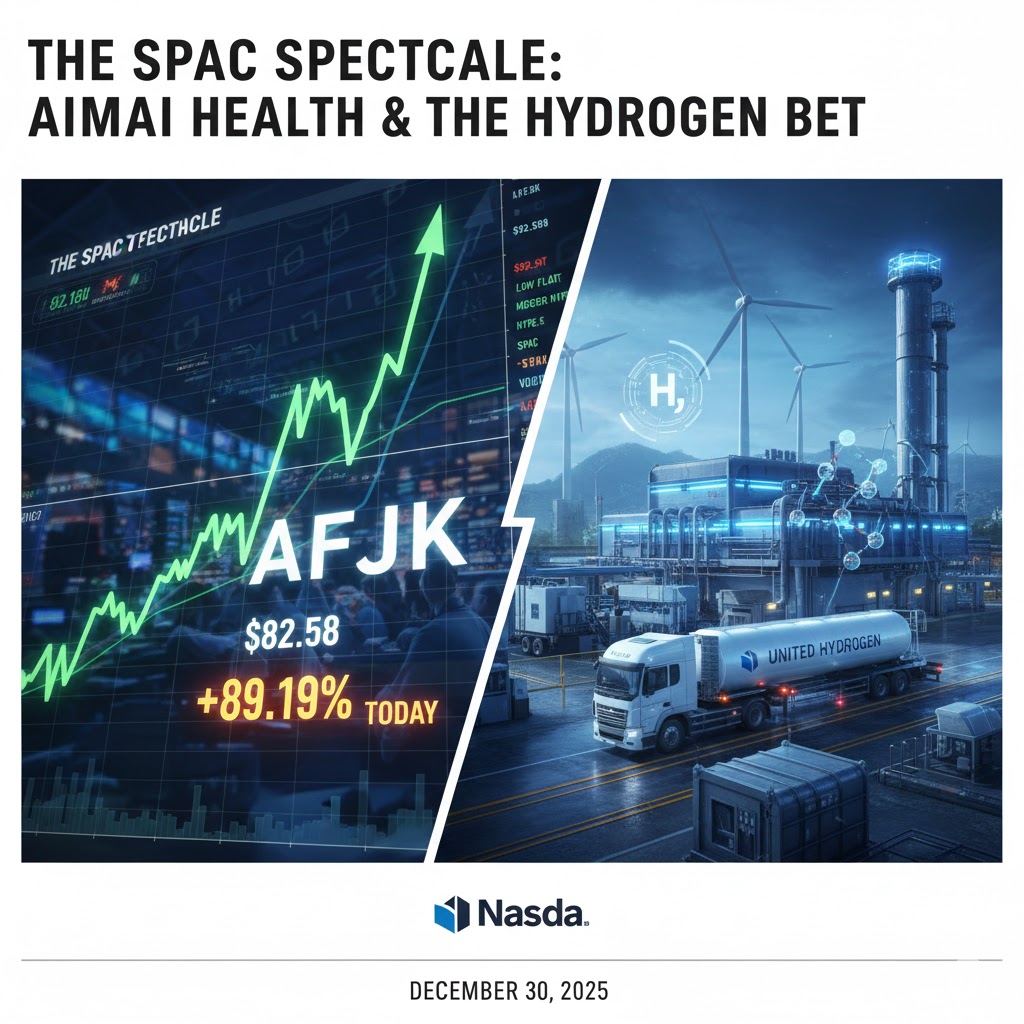
With a market capitalization that has swollen to approximately $517.29 million, AFJK is no longer a quiet shell company. The rally on December 30 appears to be driven by a confluence of low-float mechanics and intensifying anticipation surrounding its pending merger with United Hydrogen Group Inc., a Chinese hydrogen energy pioneer. As investors scramble to decipher the fundamentals behind the hype, this report provides a deep-dive analysis into the financial structure, business roadmap, and the high-stakes regulatory environment governing AFJK’s transition from a SPAC to a clean-energy player.
Financial Architecture: The Mechanics of a $500 Million Shell
Understanding AFJK’s financial position requires a look at its status as a blank-check company. According to its most recent 10-Q filing for the period ending September 30, 2025, and subsequent 8-K reports in December, the company’s balance sheet is primarily a vehicle for its trust account. As of December 2025, Aimei Health had deposited approximately $34,330.96 into its trust account specifically to facilitate its 13th monthly extension.
The company’s earnings per share (EPS) for the third quarter of 2025 was reported at $0.06, a figure that reflects interest income on trust assets rather than operational revenue. With a price-to-earnings (P/E) ratio exceeding 419x following the December 30 surge, AFJK is trading at a valuation that bears little relation to its current assets. The company’s liquidity remains tight, with a current ratio previously estimated as low as 0.02, a common trait for SPACs nearing their deadline where short-term obligations often outweigh immediate liquid cash outside of the restricted trust. To manage these costs, AFJK has relied on unsecured promissory notes, including a recent $150,000 note split between its sponsor, Aimei Health Ltd., and its merger partner, United Hydrogen Group.
The United Hydrogen Merger: A Pivot to Clean Energy
The primary engine behind AFJK’s market activity is its definitive agreement to merge with United Hydrogen Group Inc. Based in Hong Kong and operating extensively in mainland China, United Hydrogen is positioned as a vertically integrated provider in the hydrogen fuel cell industry. The business plan focuses on the production of hydrogen fuel cells and the development of hydrogen refueling infrastructure, tapping into China’s aggressive “Green Hydrogen” national strategy.
The development roadmap for the combined entity involves three key phases:
- Infrastructure Scaling: Establishing a network of hydrogen refueling stations across industrial hubs in the Pearl River Delta.
- Product Integration: Developing next-generation fuel cell stacks with high energy density for heavy-duty logistics vehicles.
- Market Penetration: Transitioning from R&D to large-scale commercial contracts with regional logistics providers by the end of 2026.
However, the path to completion has been arduous. The December 30 surge followed a series of delays; the company has pushed back its merger deadline 13 times. The latest extension, approved by shareholders on November 26, 2025, has moved the terminal date from December 2025 to December 2026, giving the parties another full year to navigate the complexities of cross-border regulatory approvals and the “Sovereign AI” integration within United Hydrogen’s logistics software.
Market Dynamics and the December 30 Surge
The explosive price action on December 30 is a textbook example of “SPAC Volatility.” With a total share count of approximately 6.12 million and a float of only 3.99 million shares, AFJK is highly susceptible to volume spikes. On December 30, the trading volume hit 918,189 shares, nearly triple its 90-day average.
The surge was likely triggered by “deadline momentum”—investors betting that the 13th extension and the accompanying deposit into the trust account signal that a final merger vote is imminent. Additionally, the broader market sentiment in 2025 has been characterized by a sharp drop-and-recovery pattern, where retail investors have shown a renewed appetite for high-beta, policy-sensitive stocks in the green energy sector. The technical rating for AFJK, as noted by Nasdaq Dorsey Wright, turned “High” in late December, creating a feedback loop of algorithmic buying that drove the stock toward the $109 mark.
Regulatory and Operational Risks
Despite the enthusiasm, AFJK remains a high-risk entity. The company has faced corporate governance hurdles, including an adjourned shareholder meeting in late 2025 due to low turnout. Furthermore, the merger involves a Chinese entity, which brings inherent “delisting risk” under the Holding Foreign Companies Accountable Act (HFCAA) if auditing standards are not met post-merger.
The “分手费” (breakup fee) and the terms of the promissory notes also loom over the deal. The notes issued to fund extensions are non-interest bearing but can be converted into private units at $10 per unit upon the consummation of the business combination. This potential dilution is a critical factor for long-term valuation models, as it could significantly increase the outstanding share count once the ticker symbol changes from AFJK to the new operating entity’s symbol.
Conclusion: A High-Stakes 2026 Awaits
Aimei Health Technology ends 2025 as one of the most volatile symbols on the NASDAQ. The $82.58 closing price on December 31 represents a market that is pricing in a successful, transformative merger, yet the fundamental operational data of United Hydrogen remains largely shielded from public view until the final proxy statement is released.
The year 2026 will be the definitive chapter for AFJK. With the deadline extended to December 2026, the company has the breathing room to finalize its “Green Hydrogen” pivot. However, as the average annual deal size for M&A hits new highs of $227 million globally, AFJK must prove it is more than just a vehicle for speculative trading. For the broader market, AFJK stands as a stark reminder of the power of the SPAC model to create immense wealth—and immense risk—overnight.