The grocery retail landscape of 2026 is one defined by two distinct forces: the cooling of post-pandemic inflation and the rapid digitization of the weekly shopping trip. For investors in Albertsons stock, the start of the year brought a pivotal update. On January 7, 2026, Albertsons Companies, Inc. (NYSE: ACI) unveiled its financial results for the third quarter of fiscal 2025 (the 12-week period ended November 29, 2025).
The Albertsons Companies Earnings report provided a masterclass in operational resilience. While the headline revenue figure was a narrow miss against Wall Street’s aggressive projections, the company’s ability to outperform on the bottom line showcased a refined strategy focusing on high-margin segments like pharmacy and digital fulfillment. As of January 9, 2026, the ACI stock price closed at $16.66, reflecting a market that is carefully weighing the company’s fundamental strength against the backdrop of a terminated merger with Kroger and a shifting regulatory environment.
Deciphering the Numbers: A Tale of Two Tiers
At the heart of the ACI Financial Report was a robust net income of $293.3 million, or $0.55 per share. However, the figure analysts truly fixated on was the adjusted net income of $390.3 million, which translated to an adjusted EPS of $0.72. This significantly beat the Zacks Consensus Estimate of $0.68, sending a clear signal that the company’s productivity initiatives are yielding fruit.
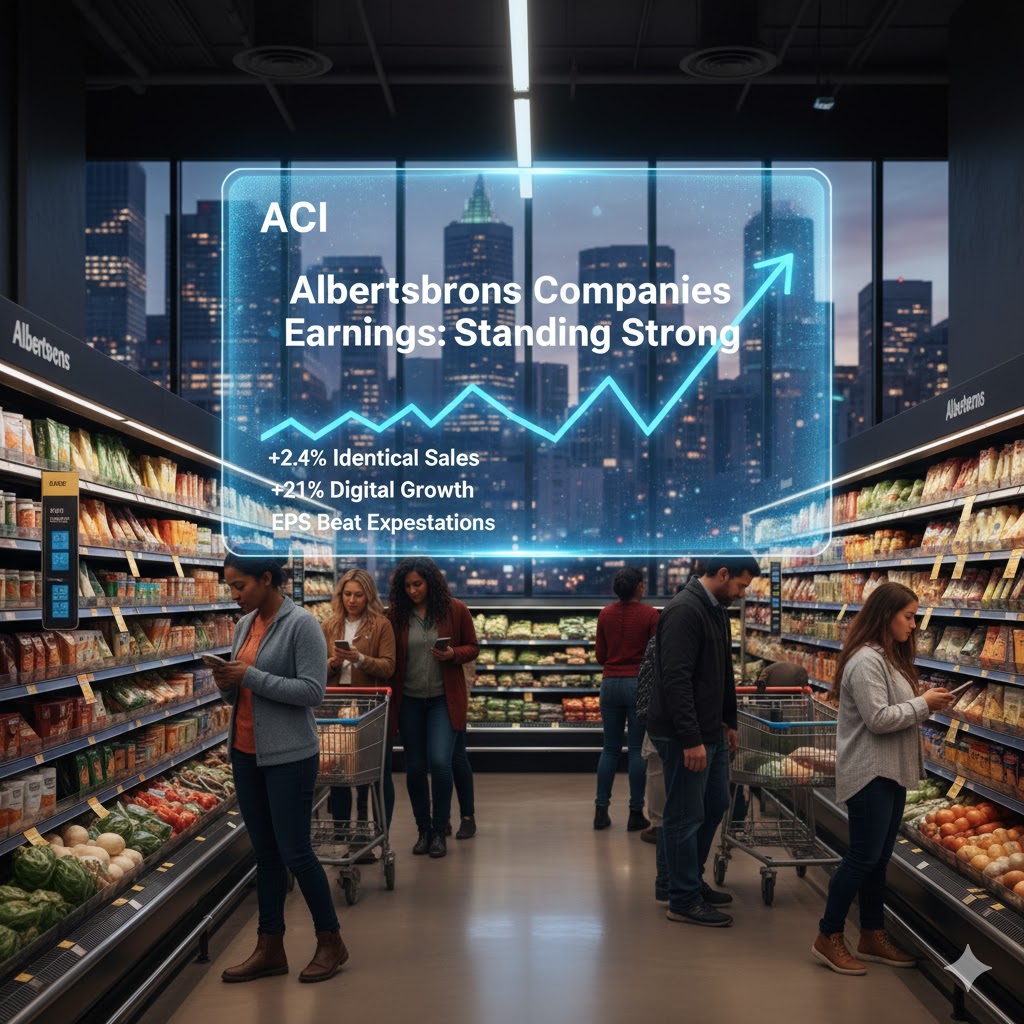
Net sales and other revenue grew by 1.9% year-over-year to $19.12 billion. While this growth was positive, it slightly lagged behind the consensus estimate of $19.16 billion. The driver behind the top-line growth was a 2.4% increase in identical sales (excluding fuel), a metric that tracks the health of stores open for at least a year.
The slight revenue miss can be attributed to several factors. First, store closures since the same period last year and lower fuel prices acted as a drag. Second, and perhaps more interestingly for macro analysts, management cited the temporary government shutdown and delayed SNAP (Supplemental Nutrition Assistance Program) funding as a 10-20 basis point headwind to identical sales. This highlights the vulnerability of mid-tier grocers to fluctuations in federal assistance programs, which remain a lifeline for a significant portion of the consumer base.
Digital Dominance and the Pharmacy Surge
If the brick-and-mortar side of the business is the stable foundation, then digital and pharmacy are the high-octane growth engines. Albertsons Earnings revealed a staggering 21% surge in digital sales, with digital penetration now reaching 9.5% of total revenue.
The company has aggressively pivoted toward “fast fulfillment.” Over half of all digital orders are now delivered in under three hours. This investment in speed is not just about convenience; it’s about capturing the high-frequency, “top-up” shop that was once the exclusive domain of convenience stores. By leveraging AI to optimize picking routes and delivery logistics, Albertsons is successfully defending its turf against pure-play delivery services.
Simultaneously, the pharmacy and health segment saw sales rise by roughly 18%. This was driven by a heavy push into immunizations and high-value health services. However, the ACI Financial Report flagged a looming challenge: the Inflation Reduction Act’s (IRA) Medicare drug-pricing negotiations, which took effect on January 1, 2026. Management warned that while profit impact should be “near neutral,” the reported pharmacy sales figures would likely be reduced in future quarters due to the lower negotiated prices.
Margin Pressure and Productivity Gains
One area of concern for those holding Albertsons stock was the gross margin rate, which dipped to 27.4% from 27.9% a year ago. Excluding fuel and LIFO (Last-In, First-Out) accounting, the margin decreased by 55 basis points.
This contraction was primarily due to “targeted price investments”—essentially, Albertsons is lowering prices on essential goods to stay competitive with discount giants like Walmart and Aldi. In an environment where the consumer is increasingly price-sensitive, these investments are necessary to maintain foot traffic, though they come at a cost to profitability.
To counter this, Albertsons is doubling down on its “Productivity Program.” The company is currently on track to deliver $1.5 billion in efficiency gains over the next three fiscal years. We can see the impact of this in the SG&A (Selling, General, and Administrative) expenses, which improved by 33 basis points year-over-year as a percentage of sales (excluding fuel). By automating back-office tasks and optimizing supply chain labor, the company is effectively “funding” its price cuts through internal savings.
Strategic Roadmap: Life After the Kroger Merger
The most significant shadow over the ACI stock price has been the now-terminated merger with Kroger. Following a federal judge’s ruling in late 2024 that the $24.6 billion deal would harm competition, both companies officially abandoned the merger on December 11, 2024.
Freed from the “merger limbo,” Albertsons is now executing an aggressive independent strategy. This includes:
- Own Brands Expansion: Management aims to increase the penetration of private-label “Own Brands” from 25% to 30%. These products carry higher margins than national brands and offer better value to the consumer.
- Retail Media Growth: The “Albertsons Media Collective” is increasingly using in-store and digital data to sell targeted advertising to CPG (Consumer Packaged Goods) companies. This is a high-margin revenue stream that is largely decoupled from grocery inflation.
- Capital Allocation: The company continued its $750 million accelerated share repurchase program, expected to be completed in early 2026. With $1.3 billion still remaining on its board authorization, Albertsons is clearly signaling that it believes its own shares are undervalued.
Outlook and Recommendation for ACI Stock
Looking ahead, Albertsons narrowed its fiscal 2025 guidance. The company now expects identical sales growth of 2.2% to 2.5% and adjusted EPS in the range of $2.08 to $2.16.
The current ACI stock price of $16.66 puts the stock at a forward P/E ratio of roughly 7.8x. Compared to the broader S&P 500 or even peers like Kroger (which often trades closer to 10-11x), Albertsons appears fundamentally undervalued. The market seems to be pricing in a “failed merger discount,” ignoring the fact that the company is a highly profitable, cash-flow-positive entity in its own right.
Recommendation: BUY. The combination of strong digital growth, a robust pharmacy business, and an aggressive share buyback program makes Albertsons stock a compelling value play for 2026. While margin pressure remains a risk, the company’s productivity gains provide a sufficient cushion. For investors seeking defensive exposure to the consumer staples sector with significant upside potential as the “merger overhang” fades, ACI is an attractive candidate.
The resilience shown in the latest Albertsons Earnings proves that the company doesn’t need a merger to survive; it has the technology, the loyalty base (now nearly 50 million members), and the operational discipline to thrive on its own.