The global pharmaceutical industry is currently undergoing a period of profound structural transformation, driven by a dual focus on precision medicine and the aggressive divestment of non-core assets. Novartis AG (NYSE:NVS), a titan in the healthcare sector, has emerged as a primary exemplar of this strategic shift. Following the successful spin-off of its generic and biosimilar division, Sandoz, the company has pivoted toward becoming a “pure-play” innovative medicines powerhouse. This strategic clarity bore significant fruit in the first quarter of fiscal 2024, as Novartis reported financial results that not only outpaced market consensus but also signaled a robust growth trajectory that led to an upward revision of its full-year guidance. The performance was characterized by double-digit top-line growth and substantial margin expansion, fueled by a diversified portfolio of blockbuster therapies.
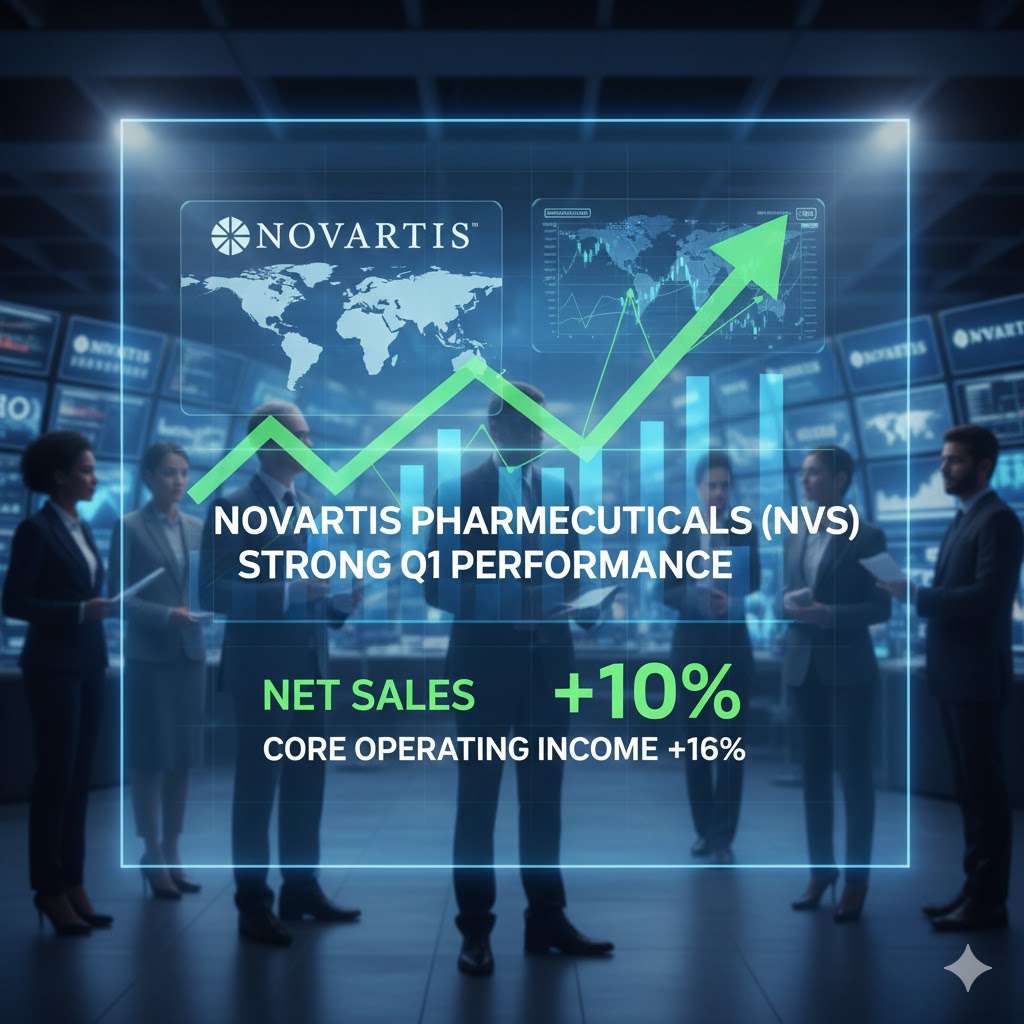
From a fiscal perspective, the first quarter of 2024 served as a validation of the company’s leaner operating model. Novartis (NYSE:NVS) reported net sales from continuing operations of $11.8 billion, representing a 10% increase in USD and an 11% surge in constant currency (cc) compared to the prior-year period. This growth was almost entirely volume-driven, with volume contributing 14 percentage points to the growth, effectively offsetting minor price erosion and generic competition impacts. Even more impressive was the core operating income, which jumped by 16% in USD (22% in cc) to reach $4.5 billion. The core operating margin expanded by 220 basis points to 38.4%, bringing the company closer to its ambitious medium-term target of a 40%+ margin by 2027.
The bedrock of this overperformance lies in the company’s “Big 6” growth brands, which are addressing critical unmet needs in immunology, oncology, and cardiovascular health. Entresto, the gold-standard therapy for heart failure, remains the company’s largest revenue contributor. In the first quarter, Entresto sales surged by 34% to $1.9 billion, driven by continued strong demand in both the United States and international markets. The therapy’s sustained momentum, despite being a mature brand, underscores the high barriers to entry in the heart failure segment and the success of Novartis’ market access strategies. In the competitive landscape of cardiovascular medicine, where companies like Bristol-Myers Squibb Company (NYSE:BMY) and AstraZeneca PLC (NASDAQ:AZN) are also vying for share, Entresto’s continued dominance is a key pillar of Novartis’ financial stability.
In the realm of immunology and dermatology, Cosentyx has demonstrated renewed vigor. After facing some pricing headwinds in the U.S. during previous cycles, the drug returned to strong growth, posting $1.3 billion in quarterly sales, a 23% increase. The expansion into new indications, such as hidradenitis suppurativa, has effectively broadened the patient pool, allowing Cosentyx to compete effectively against blockbuster rivals like Humira from AbbVie Inc. (NYSE:ABBV) and Taltz from Eli Lilly and Company (NYSE:LLY). The ability to maintain double-digit growth for a product that has been on the market for nearly a decade is a testament to Novartis’ lifecycle management capabilities and its ability to innovate within existing franchises.
The oncology portfolio also provided significant tailwinds. Kisqali, a CDK4/6 inhibitor for breast cancer, saw its sales climb by 51% to $627 million. This performance was particularly noteworthy given the recent positive readouts from the NATALEE trial, which positions Kisqali to expand into the adjuvant (early-stage) breast cancer market—a segment with multi-billion-dollar potential. By demonstrating a consistent survival benefit, Kisqali is increasingly being viewed as a preferred option over Pfizer Inc. (NYSE:PFE)’s Ibrance in certain clinical settings. Additionally, the company’s foray into radioligand therapy (RLT) with Pluvicto is proving to be a masterstroke of business development. Pluvicto, used for treating prostate cancer, generated $310 million in the quarter, a 47% increase. The resolution of previous supply chain bottlenecks and the expansion of treatment sites in the U.S. have cleared the path for Pluvicto to become a foundational therapy in the oncology space.
Beyond current commercial successes, the first quarter highlighted significant progress in the Novartis R&D pipeline and its market development initiatives. The company’s focus on five core therapeutic areas—Cardiovascular-Renal-Metabolic, Immunology, Neuroscience, Oncology, and Hematology—is supported by advanced technology platforms including xRNA, radioligand therapy, and gene and cell therapy. A major milestone in Q1 was the FDA filing acceptance for Fabhalta (iptacopan) in IgA nephropathy, a rare kidney disease. Fabhalta, already approved for paroxysmal nocturnal hemoglobinuria (PNH), represents a major opportunity for Novartis to establish a leadership position in the renal space, competing with specialized biotech firms and established players like Roche Holding AG (OTC:RHHBY).
The neuroscience segment, while smaller in terms of immediate revenue, is showing promising growth through Kesimpta. This B-cell therapy for multiple sclerosis (MS) saw sales jump 66% to $637 million. Kesimpta’s subcutaneous, self-administered format provides a significant convenience advantage over infused therapies like Ocrevus from Roche Holding AG (OTC:RHHBY), making it an attractive option in the highly competitive MS market. As Novartis continues to gain market share in the B-cell space, Kesimpta is on a clear path to becoming a multi-billion-dollar annual franchise, further diversifying the company’s revenue streams away from traditional pill-based medications.
The business development strategy has also been characterized by disciplined, value-creating “bolt-on” acquisitions. In early 2024, Novartis announced the acquisition of MorphoSys AG to strengthen its pipeline in myelofibrosis and other hematologic malignancies. This follows the trend of major pharmaceutical companies, including Merck & Co., Inc. (NYSE:MRK) and Sanofi (NASDAQ:SNY), utilizing their strong cash positions to acquire de-risked biotech assets to offset future patent cliffs. Novartis’ strong free cash flow from continuing operations, which amounted to $2.0 billion in the first quarter, provides the firepower necessary to continue this strategy while also returning capital to shareholders through dividends and share buybacks.
From a geographic perspective, the U.S. remains the most critical market for Novartis, contributing $4.6 billion in sales, a 13% increase. However, the company is also seeing significant growth in China, which has become a key strategic priority. As the Chinese healthcare system evolves to prioritize innovative therapies over older generics, Novartis is well-positioned to capitalize on the increasing demand for advanced oncology and cardiovascular treatments. The “China-plus” strategy, which involves tailored clinical development plans for the Chinese market, is already yielding results and is expected to be a major growth driver through the end of the decade.
The upward revision of the full-year 2024 guidance was perhaps the most significant “headline” for institutional investors. Novartis now expects net sales to grow in the high-single to low double-digit range (up from mid-single-digit) and core operating income to increase from low double-digit to mid-teens (up from high single-digit). This confidence is based on the assumption that no generic versions of Entresto will launch in the U.S. in 2024, a key variable that analysts at firms like Goldman Sachs Group, Inc. (NYSE:GS) and Morgan Stanley (NYSE:MS) have been monitoring closely. The legal battles surrounding Entresto’s patents remain a background risk, but the company’s recent court victories have provided a measure of near-term visibility.
Operating excellence and cost management have also played a vital role in the Q1 beat. The company has successfully implemented a new integrated organizational structure that has removed layers of management and improved the speed of decision-making. These structural changes have resulted in significant SG&A (Selling, General and Administrative) efficiencies. In the first quarter, SG&A expenses as a percentage of net sales decreased by 3.6 percentage points (cc), a remarkable feat that directly contributed to the margin expansion. This focus on “agility” is a core part of the CEO’s vision for a more responsive and efficient Novartis.
The environmental, social, and governance (ESG) performance of Novartis also continues to be a point of differentiation. The company recently ranked number one in the 2024 Access to Medicine Index, reflecting its commitment to expanding global access to its life-saving therapies. While ESG metrics are often viewed as secondary to financial performance, in the pharmaceutical sector, they are increasingly linked to “social license to operate” and long-term brand equity. For institutional investors with ESG mandates, Novartis’ leadership in this area adds an additional layer of attractiveness to the stock.
As the company looks toward 2025 and beyond, the focus will shift toward the execution of several high-stakes launches. The potential approval of Kisqali in the adjuvant setting and the continued rollout of Leqvio—a first-in-class siRNA therapy for lowering LDL cholesterol—are pivotal. Leqvio sales grew by 139% to $151 million in the quarter, and while the ramp-up has been slower than some analysts initially expected due to its unique physician-administered model, the long-term potential remains significant. If Leqvio can follow a similar trajectory to Entresto, it could become a cornerstone of the company’s cardiovascular franchise for the next decade.
In conclusion, the first-quarter performance of Novartis AG (NYSE:NVS) has set a high bar for the rest of the year. By successfully navigating the complexities of a major corporate restructuring and a shifting global healthcare landscape, the company has demonstrated that its “pure-play” strategy is working. The combination of strong volume growth from core brands, disciplined R&D investment, and aggressive margin expansion has created a compelling narrative for the investment community. While challenges remain—including potential generic entries, drug pricing legislation in the U.S. under the Inflation Reduction Act, and the inherent risks of clinical development—Novartis has entered the middle of the decade with significant momentum. Surpassing market expectations in Q1 was not just about the numbers; it was about proving that the “new” Novartis is faster, leaner, and more capable of delivering high-value innovation to patients and shareholders alike.